


There is a TikTok making the rounds out of Naples. An Italian guy walks up to a wooden side table on the sidewalk. On the table sits an Electroline microwave with a Ferrari shield taped to the door and a hand-scrawled price tag reading €550,000,000. Volare by the Gipsy Kings plays in the background. He gestures at it with the gravity of a Pebble Beach concours judge. The caption: La nuova Ferrari Luce.
Twenty-seven thousand likes in a day. And the joke is so cleanly observed that Maranello has no defense, because the actual sticker on the actual car is €550,000 — the TikToker just added three zeros to make the absurdity legible. That is what Ferrari spent five years building. The microwave is the kindest comparison the internet has produced. The rest of them are worse.
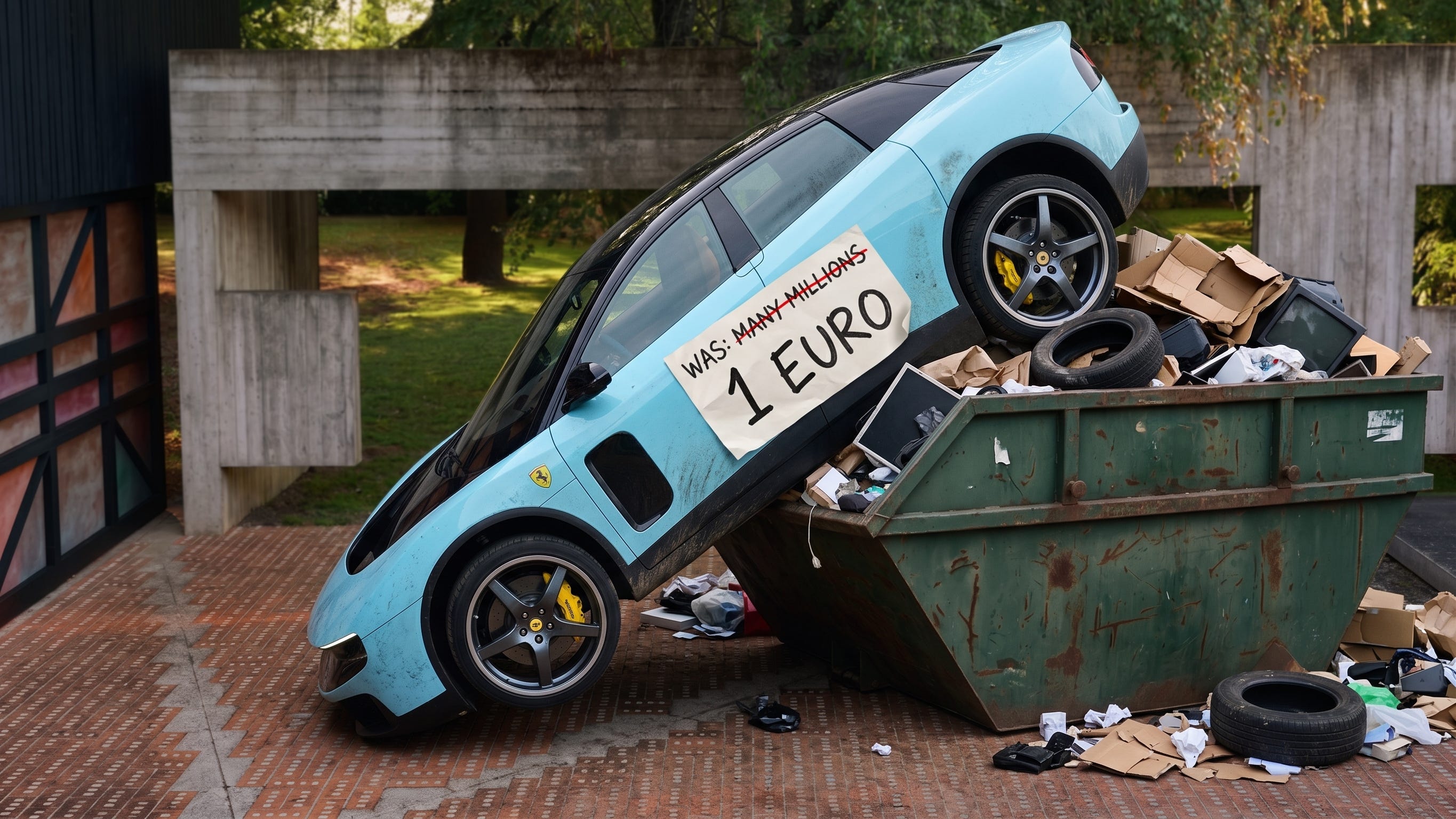
Enzo Would Have Spit On It
Enzo Ferrari did not like customers. He did not like comfort. He famously refused to put air conditioning in his cars because air conditioning was for people who could not handle a car. He only made road cars at all because road cars paid for the racing, which is the only thing he actually cared about, and he made that contempt loud enough that the customers paying him understood the arrangement and considered it a privilege.
This is the man who, when his test drivers told him a prototype was not good enough, would walk to the back of the factory and watch it get destroyed. There are stories — possibly apocryphal, definitely in the spirit of the man — of Enzo Ferrari personally putting hammers to bodywork on cars that did not meet his standard. He named his greatest gift to the world after his dead son. The Dino, that gorgeous mid-engine V6, the most heartbreaking small Ferrari ever built, exists because Alfredo “Dino” Ferrari died of muscular dystrophy at 24 and his father grieved him in aluminum and steel.
If you walked Enzo Ferrari out to the Rome reveal on May 25th and showed him the Luce — that bubbly Magic Mouse silhouette, the vertical windshield wipers parked upright against the A-pillars like cricket antennae, the Apple Watch infotainment screen, the four doors, the five seats, the silent simulated powertrain hum piped through the speakers from accelerometers on the rear axle — he would not have made a speech. He would have spit on the hood, told someone to push it off the closest cliff, and gone back to Maranello to scream at whoever signed the contract with the iPhone guy. Then he would have fired Vigna. Then he would have lit a cigarette and watched it burn.
The Iconic Ferraris of Cinema Would Not Be Caught Dead Next to This
Picture the parking garage scene from Ferris Bueller’s Day Off. Cameron is having a panic attack. Ferris is grinning. The valets — those two lunatic geniuses — palm the keys to Mr. Frye’s 1961 Ferrari 250 GT California Spyder, the most pornographically beautiful Ferrari ever bolted together, and the second they round the corner they are airborne over Chicago’s industrial spine, Star Wars theme blasting, hair in the wind, having the single greatest day of their working lives. Forty years later that scene is the reason half the people reading this know what a Ferrari is.
Now picture the same valets pulling up to that garage in 2026. The owner steps out of a Luce. He hands over the key — actually, he hands over an E Ink glass card, because the Luce key has a display that pulses Ferrari yellow at startup since there is no engine sound to greet you with. The valets look at each other. They look at the car. They look at the bubbly nose and the mail-slot front vent and the turbine-disc Waymo wheels. One of them quietly tucks the glass key into his polo pocket. They park it next to a Toyota Highlander. They go on their lunch break. No one steals the Luce. No one wants to. The whole bit only works if the car is something a teenager would commit a federal crime to drive. The Luce is something a teenager would politely ask his dad’s friend to give him a ride home in.
And that is what Ferrari has actually lost here. Not market cap — that was just Tuesday’s bill. They have lost the parking-garage scene. They have lost the poster on the bedroom wall. They have lost the thing that made an entire generation of grown men cry when they finally heard a V12 in person. The Luce does not give you that. The Luce gives you a 600-liter trunk and coach doors and 35 paint options in the configurator.
A €180,000 BYD Has More Features Than This $640,000 Ferrari
Let us do the spec-sheet humiliation. The Ferrari Luce, for $640,000 American, gives you four electric motors, 1,035 horsepower, a 122 kWh battery, 530 km of range, 350 kW DC fast charging, a central infotainment screen, an E Ink key, a leather-and-aluminum cockpit Jony Ive told the press he is very proud of, and a synthesized vibration hum piped through the audio system so the car makes noise on purpose because otherwise it would not.
The 2026 BYD Yangwang U8L, which is the long-wheelbase executive version of BYD’s flagship luxury off-roader, starts at the equivalent of about $180,000. For that you get four independent in-wheel electric motors making 1,180 horsepower, which is 145 more than the Ferrari. You get a 0–100 km/h time of 3.5 seconds, which is in the same neighborhood as the Luce. You get a combined range of 1,160 kilometers because BYD also gave you a range-extender generator the size of a carry-on. You get the second-generation Blade Battery that charges from 10% to 70% in five minutes flat. You get tank-turn, where the car rotates 360 degrees in place because each wheel is independently driven, and you get crab-walk, where the car moves sideways diagonally, and you get an emergency flotation mode where the car can float in water for thirty minutes if you drive it into a lake. I am not making any of this up. It is on BYD’s website.
Then you get to the interior. A 12.8-inch curved OLED center display. A 23.6-inch driver instrument cluster. A separate 23.6-inch entertainment screen for the front passenger, because the front passenger deserves their own television. Two more 12.8-inch floating screens in the rear, plus a 7-inch armrest control screen, plus a 70-inch augmented-reality heads-up display projected onto the windshield. A 32-speaker Dynaudio sound system. A microphone-free karaoke system, because karaoke. A built-in compressor refrigerator that does both cooling and heating between -6°C and 50°C, so your champagne is cold and your espresso is hot at the same time. Massage seats front and rear with four-way lumbar adjust. Air purification with PM2.5 filtration, high-temperature sterilization, and a negative ion generator. 128-color ambient lighting. A panoramic 1.7-square-meter sunroof. A satellite phone built in, because BYD apparently anticipates you might be off-grid. Thermographic night-vision camera. Three wireless phone chargers. 13 USB outlets. NVIDIA Drive Orin SoC running the driver-assist suite at 508 TOPS.
The Ferrari Luce, for three and a half times the money, gives you physical buttons and a single touchscreen. That is the entire pitch on the interior. Jony Ive went on stage and explained, in that hushed reverent voice he uses for everything, that multi-touch interfaces do not belong in cars and that the future is going back to switches and knobs. Meanwhile the Chinese, who Montezemolo openly mocked from the sideline, are running OLED displays the size of dining room tables and giving you karaoke and a fridge. The Luce does not even have rear seat screens. For $640,000.
Briatore, the Alpine F1 advisor and one of Italian motorsport’s most reliably acidic public voices, looked into his Instagram camera and delivered the obituary in one sentence. Everyone keeps asking me about the Ferrari Luce, he said. There is one big advantage. The Chinese will not copy this one. That is funny right up until you look at what the Chinese are already shipping and realize the Chinese do not need to copy the Luce because they already moved past it. The Yangwang U8 is the car the Luce wishes it were. Or, more accurately, the car that a Ferrari customer would actually want, if Ferrari were still in the business of building cars Ferrari customers want.
Italy Lost Its Mind. The Market Lost Four Billion.
Luca Cordero di Montezemolo, who ran Ferrari from 1991 to 2014 and personally oversaw the most lucrative era in the company’s history, did not bother with diplomacy when reporters cornered him at a Confindustria conference. He said that if he told them what he really thought he would harm Ferrari, and then he told them anyway. The Luce, he said, risks the destruction of a myth, and he was very sorry about that. He asked, on the record, that someone remove the prancing horse from the car. He added that there was at least one advantage to the design: the Chinese would not copy it. Then he stood there visibly emotional and refused to elaborate. The former boss of Ferrari publicly begged the current boss of Ferrari to scrape the badge off.
Matteo Salvini, the Italian Deputy Prime Minister and Transport Minister, asked from the press conference floor what Enzo Ferrari, who has been dead since 1988, would have made of it. Carlo Calenda, the Italian politician, called it a profound aesthetic and technological betrayal of Ferrari’s legacy. When the Deputy PM of the Italian Republic is publicly invoking the spirit of your dead founder against your new product launch, your new product launch is having a bad week.
And the market, which does not care about prancing horses but cares very much about brand equity, agreed with the Italians. Ferrari shares, listed in Milan under RACE, fell as much as 8.4% on Tuesday. The New York listing dropped between 4.6 and 5.3%. Roughly four to five billion euros of market capitalization evaporated in a single trading session. Pierre-Olivier Essig at AIR Capital told Bloomberg the Luce looked like a Honda Accord EV crossed with a Tesla Model 3, and added that he is lost in translation with Ferrari’s new strategy. He said he would rather buy a Chinese or Japanese car with the same look and similar performance for a fraction of the price. The Morningstar equity strategist told CNBC, plainly, that fans believe the Luce dilutes a supercar brand built on classic design and raw combustion power. The day after the reveal, the CEO of Lamborghini went on the record saying that killing their own EV plans had clearly been the correct call.
When Lamborghini, your loudest competitor, holds a press conference specifically to thank God they are not you, the day is not salvageable.
How Did Maranello Convince Itself This Was a Good Idea
Here is the part that should keep Ferrari’s board awake. The Luce is not the product of indifference. It is the product of five years of obsessive work. Sixty-plus patents. A new 880V platform developed entirely in-house in Maranello. Four bespoke electric motors. A proprietary inverter-driven sound synthesis system where accelerometers on the rear axle capture mechanical vibration and a 20-person sound and vibration team led by Antonio Palermo processes it into something like music, because the team understood the brief perfectly — a Ferrari has to sound like something, even an electric one, and silence was the one thing they could not ship. The interior, designed by LoveFrom under Jony Ive and Marc Newson, has been almost universally praised by the few reviewers who saw it in person. The physical buttons are beautiful. The materials are exquisite. The engineering substance is not the problem.
The problem is that nobody in the room had the authority — or possibly the courage — to tell Jony Ive that the exterior looks like a Magic Mouse. Apple’s most legendary designer, the man who put the notch on the iPhone because he believed that hiding the camera was the cowardly choice, did exactly the same thing to a Ferrari. The windshield wipers rest vertically because there is no cowl. There is no cowl because the hood flows uninterrupted into the windshield. The hood flows uninterrupted into the windshield because Jony Ive believes in seamless surfaces. The seamless surfaces required a patented wiper. The patented wiper looks like a cricket. The cricket looks ridiculous. The Honda Accord EV proportions looked ridiculous before he even got to the wipers. None of this would have survived ten minutes of Enzo Ferrari standing in a room.
There is a version of this argument where Vigna’s defense — real innovation is not democratic — is correct. Cybertruck got mocked relentlessly and Tesla still moved every unit they could build. Maybe the Luce ages well. Maybe in 2031 we look back and the bubbly little appliance is suddenly cool and the 250 GT California Spyder is in a museum where it has always belonged. Maybe.
But I have looked at the car. I have looked at the BYD interior. I have looked at the TikTok with the microwave. And the most honest version of where Ferrari sits this morning is this: a brand that spent seventy-seven years building one of the three or four most valuable emotional assets in global manufacturing handed the keys to a London design studio run by the iPhone guy, and the iPhone guy handed back a four-door sedan that the Italian Deputy Prime Minister, two former Ferrari executives, and approximately every car enthusiast on every continent looked at and immediately produced the same exact joke independently. That is not a polarizing design. That is consensus.
Enzo is in his grave generating electricity. The Bueller valets are politely declining the keys. The internet has its meme. The Yangwang U8 has its karaoke. And Ferrari has 1,035 horsepower of perfectly engineered, beautifully crafted, technically ambitious Italian embarrassment, sitting in a configurator with 35 paint options, none of which can hide what the world has already decided this car is. Volare, oh oh. Cantare, oh oh oh oh. La nuova Ferrari Luce.