


I was employee number six at Break.com. In the mid-2000s we lived entirely on distribution we didn’t own — embeds, portals, search rankings, whatever was sending traffic that quarter. And every year, some channel that had printed visitors twelve months earlier would quietly stop working. No announcement, no explanation. A partner would change a layout, an algorithm would shift a weight, and a revenue line would go flat. We didn’t have a word for it. We just called it Tuesday.
Twenty years later, it has a word, a dictionary entry, and a bestselling book. Cory Doctorow’s term “enshittification” was the American Dialect Society’s 2023 word of the year, a title Australia’s Macquarie Dictionary echoed a year later, and his book on the subject — published in October 2025 — made the Financial Times business book of the year longlist. When a profanity earns lexicographic respectability on multiple continents, it’s because everyone, everywhere, is feeling the same thing: the platforms we built our businesses on are getting worse, on purpose, and we are paying for the privilege.
This article does three things. It lays out the mechanism, because the mechanism is predictable and you should be able to see it coming. It puts numbers on the decay, because feelings are not a risk model. And it ends with the part nobody else seems to be writing: how to use AI to extract residual value from platforms that are no longer worth your time — without rebuilding the same dependency one layer up.
The Word of the Year Is a Diagnosis
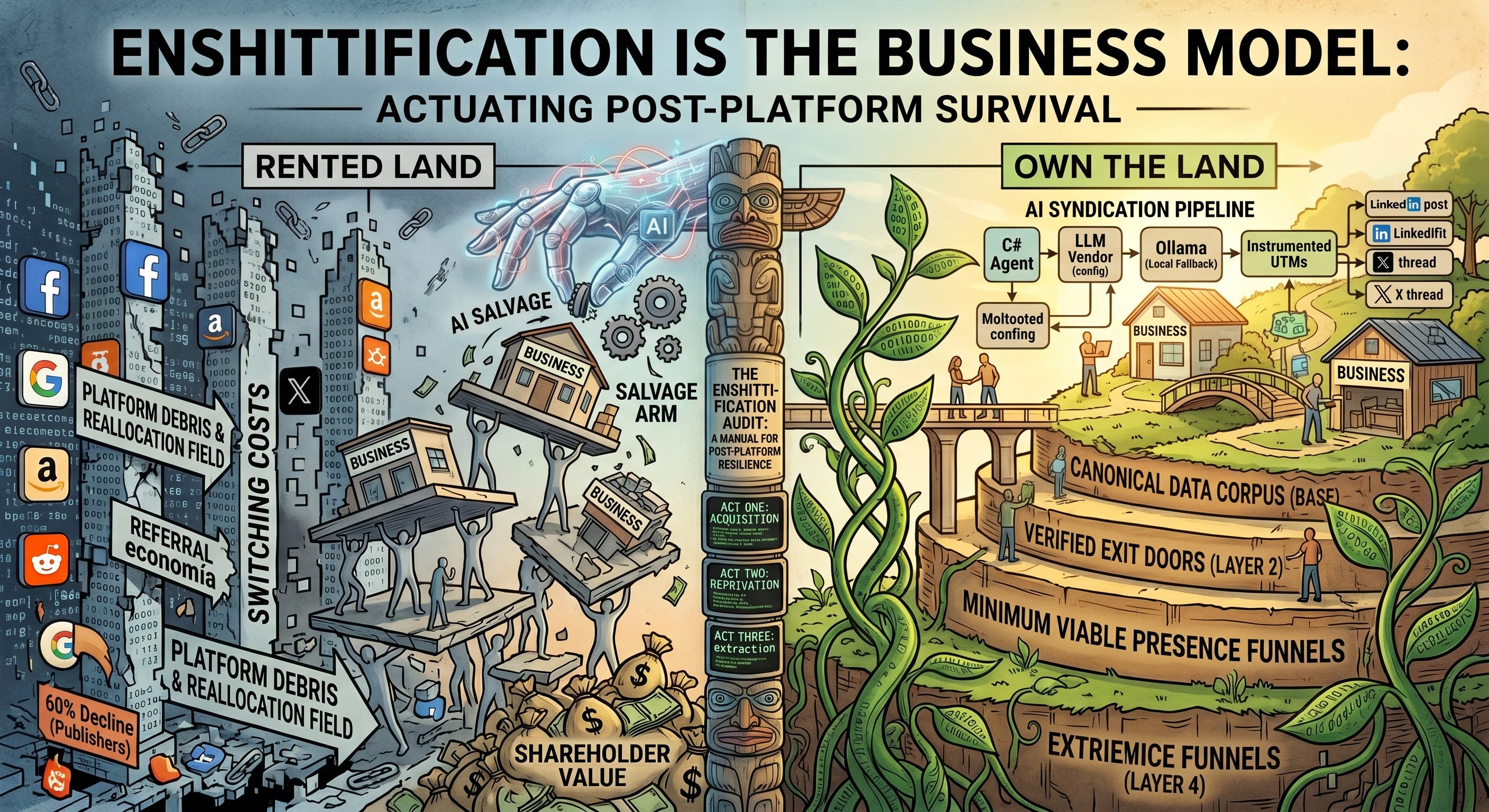
Doctorow’s definition is a three-act structure, and once you see it you can’t unsee it. Act one: the platform is genuinely good to its users, often at a loss, to build the audience and the habit. Act two: with users locked in, the platform degrades their experience to deliver value to its business customers — advertisers, sellers, publishers — who pile in and become dependent themselves. Act three: with both sides trapped by switching costs, the platform claws the value back from everyone and routes it to shareholders. The end state is a service that survives not because it is good, but because leaving it is expensive.
The enabling technology is what Doctorow calls twiddling: the thousands of back-end knobs a platform can turn instantly, invisibly, and per-user — re-ranking your content, repricing your fees, re-weighting your reach — with no contract, no notice, and no appeal beyond a web form. A landlord who wants to raise your rent has to send a letter and honor a lease. A platform ships a config change on a Tuesday afternoon, and your business finds out from its analytics dashboard.
What kept this in check historically, in Doctorow’s telling, were four constraints: competition, because users could leave; regulation, because governments could punish; interoperability, because engineers could build escape hatches; and worker power, because employees could refuse. All four eroded over two decades of consolidation, captured oversight, anti-circumvention law, and — lately — layoff culture. Remove the constraints and decay stops being a failure mode. It becomes the profit-maximizing strategy, executed by competent people, on schedule.
Doctorow comes at this from the political left. I come at it from thirty years of shipping software inside these ecosystems, and from the practitioner’s habit of distrusting any framework until the data confirms it. I’ve written before that what the platform giants run isn’t really capitalism anymore — it’s a toll booth on other people’s work. So treat the next four sections as the audit. The framework holds up depressingly well.
Google: The Landlord Stopped Paying Out
For twenty-five years the open web ran on an implicit deal: you make content, Google sends visitors, Google sells ads along the journey. In August 2024, Judge Amit Mehta ruled that Google had illegally maintained a monopoly in search. But the verdict matters less to content owners than what the traffic data shows, which is that Google found a way to keep the value of your content without sending you the visitor. The referral economy is being shut down in plain sight.
Start with the controlled comparison. Ahrefs analyzed 300,000 keywords and aggregated Search Console data, comparing December 2023 — before AI Overviews — to December 2025. For informational queries where an AI Overview appears, the click-through rate of the number one organic result fell from 7.3 percent to 1.6 percent. Even without an Overview, position one fell from 7.6 to 3.9 percent — the baseline itself is rotting — but after controlling for that drift, AI Overviews correlate with a 58 percent reduction in clicks to top-ranking pages. Pew Research, with a different methodology, found roughly 47 percent fewer clicks when an Overview is present. Across the 2,500-plus publishers Chartbeat tracks, Google search referrals fell about a third in the year to December 2025, and small publishers are down 60 percent over two years. By most estimates, roughly two out of three Google searches in the US now end without a single click to the open web. When the Reuters Institute surveyed 280 senior news executives across 51 countries, the consensus expectation was a further 43 percent traffic decline over the next three years, with a fifth of them bracing to lose more than three-quarters.
The micro version is uglier than the macro. HouseFresh is an independent site that actually buys and lab-tests air purifiers — the kind of testing the review economy mostly pretends to do. It earned about 4,000 Google referrals a day. Google’s September 2023 Helpful Content Update and March 2024 core update cut that to roughly 200 — over 90 percent gone — while the rankings filled up with untested best-of listicles from big-media conglomerates and decade-old forum threads. It took the site two years of work, and by its own editor’s account a lot of luck, to claw partway back. Retro Dodo, a retro-gaming site, took a similar hit. Chegg reported a 49 percent collapse in non-subscriber traffic in a single year and sued Google in early 2025. Penske Media — Rolling Stone, Variety — followed with its own suit that September.
One more data point completes the picture. In February 2024, the same week Reddit filed for its IPO, news broke that Google would pay Reddit a reported 60 million dollars a year for access to its data — and Reddit threads promptly surged through results that independent reviewers used to occupy. The platform isn’t merely decaying. It is reallocating: away from the people who make the content, toward the platforms big enough to invoice for it.
Meta: Sixteen Percent Becomes One
Facebook’s history with publishers and businesses is the cleanest longitudinal dataset in enshittification studies. In 2012, a post from a Facebook page reached about 16 percent of the people who had chosen to follow it. By 2014, per EdgeRank Checker’s analysis, that was 6.5 percent. Around 5 percent by 2020, per Ignite’s data. Today the standard industry estimates sit between 1 and 2 percent, and plenty of pages report under half a percent. Each ratchet down was framed as a quality improvement — most famously the 2018 pivot to “meaningful social interactions,” which alone cut page reach by roughly a third. The business model underneath is brutally simple: you spend years building an audience, the platform throttles your access to it, and then it sells your own audience back to you one Boost button at a time. Nor is this a Facebook quirk — Hootsuite’s latest review pegs LinkedIn’s organic reach down 34 percent in a single year, with Instagram on the same slope.
And when the dashboard itself lies, the consequences land on you, not them. From 2015 to 2016, Facebook overstated average video watch time — by 60 to 80 percent according to its own admission, by 150 to 900 percent according to the advertisers’ court filings, because views shorter than three seconds were quietly excluded from the average. An entire industry executed the pivot to video on those numbers: media companies fired writers and editors by the hundreds and hired video teams to chase an audience that was substantially fictional. ComScore data showed publishers that pivoted losing around 60 percent of their traffic year over year by mid-2017. Facebook settled the resulting class action in 2019 for 40 million dollars without admitting wrongdoing — roughly two-tenths of one percent of its annual revenue at the time. Companies died and careers ended over fabricated metrics, and the penalty was a rounding error. That is the liability asymmetry you sign up for when a platform’s analytics are your business intelligence.
Amazon: The Fifty Percent Partner
If Google enshittified discovery and Meta enshittified reach, Amazon enshittified the transaction itself. Marketplace Pulse, which has tracked seller economics for a decade, puts the typical seller’s total payments to Amazon at more than half of revenue: roughly 15 percent in referral fees, 20 to 35 percent for Fulfillment by Amazon, and up to 15 percent for advertising. In 2016 the total take was about a third. The referral fee barely moved in that decade. What changed is that fulfillment got steadily more expensive and advertising became unavoidable, because Amazon converted the best-converting screen real estate into sponsored slots and demoted organic placement to the discount bin. You don’t have to buy ads on Amazon the way you don’t have to buy oxygen.
The scale of that conversion is hard to overstate. Amazon’s advertising business booked 15.7 billion dollars in the second quarter of 2025 alone — more than the entire company’s revenue in the same quarter of 2012 — and 21.3 billion in the fourth quarter, compounding around 20 percent a year, which makes it the third-largest ad business on the planet behind Google and Meta. Third-party seller services brought in 172 billion dollars across 2025, about a quarter of Amazon’s total net sales. Retail — actually selling things — is now barely 40 percent of Amazon’s revenue; the majority of the company is charging other people for access to the customer. And in November 2025, Amazon found a new layer to monetize: the third-party software tools sellers depend on will pay 1,400 dollars a year plus per-call API charges starting in 2026. The Ads API, naturally, remains free.
Here is the stat that should be taught in business schools. In Marketplace Pulse’s 2026 Seller Index, 49 percent of sellers named marketplace fees as a top margin concern and 46 percent said the same about advertising costs — yet only 24 percent are actually reducing their Amazon dependence, while 42 percent are increasing it. Meanwhile the count of active sellers on Amazon.com fell from 584,000 in January 2025 to about 500,000 by March 2026. The lobster knows the water is boiling. The lobster is adding more of its revenue to the pot anyway, because Amazon controls 36 percent of US e-commerce and 70 percent of marketplace commerce, and that is where the customers are. That is what a switching-cost moat looks like from the inside.
X and Reddit: The Speedruns
Enshittification usually unfolds over a decade. The last few years gave us two compressed versions, useful precisely because the speed makes the mechanics visible.
X ran the whole arc in about thirty months. A 44 billion dollar acquisition in October 2022, loaded with roughly 12 billion in debt. An advertiser exodus that took 2023 ad revenue to around 2.5 billion dollars against a prior run rate near a billion per quarter; the UK subsidiary alone reported a 66 percent revenue collapse in the first post-acquisition year. Fidelity marked its stake down by roughly 80 percent by late 2024. Then in March 2025, Musk’s xAI acquired X at a 33 billion dollar valuation in an all-stock arrangement, and by 2026 the platform generates about 2.9 billion a year — roughly 35 percent below its pre-acquisition peak — with headcount cut from 7,500 toward 2,000. For anyone who spent a decade building an audience on Twitter, the lived experience was simpler: external links throttled, the API priced out from under the tools that made the platform usable, reach increasingly gated behind a subscription. Same movie, higher frame rate.
Reddit’s version is the cleanest demonstration on record of who owns what. In 2023 it repriced its API such that Apollo, a beloved third-party app with around one and a half million monthly users, was suddenly facing a 20 million dollar annual bill, and shut down. Nearly 8,000 subreddits went dark in protest. The protest changed nothing. Eight months later, the same week as its IPO filing, Reddit signed a deal reportedly worth 60 million dollars a year to hand that user-generated data to Google for AI training. Two decades of unpaid moderators and commenters built the asset; the proceeds went to the cap table. If you contribute to a platform, that is your term sheet, whether you have read it or not.
Why the Cavalry Isn’t Coming
The natural objection is that regulators are finally on the case, and the objection is half true. Google was ruled a monopolist. Then came the remedies, in September 2025: Judge Mehta’s 230-page order banned exclusive default contracts and required some data sharing with qualified competitors, but declined to force divestiture of Chrome or Android — writing that the plaintiffs had “overreached” — and left Google free to keep paying Apple an estimated 20 billion dollars a year for placement, so long as the deals aren’t exclusive. DuckDuckGo’s CEO said plainly that the remedies wouldn’t force the changes needed. Both sides have appealed; the D.C. Circuit is expected to hear arguments in late 2026 or early 2027, with further appeals beyond that. By the time any structural remedy lands, if one ever does, AI Overviews will have finished their work on referral traffic years earlier.
That is the operational lesson, and it applies regardless of how you feel about antitrust politics. Of Doctorow’s four constraints, competition was bought and buried a decade ago, interoperability is a DMCA lawsuit waiting to happen, worker power just absorbed three years of layoff culture, and regulation moves at one-fifth the clock speed of the decay it is chasing. As an operator, you should plan as if no external force will repair your distribution on any timeline that matters to your P&L. For planning purposes, the decay is permanent.
The Sharecropper Math
Strip the emotion out and state it as risk. If your sole income stream runs through a platform you do not own, you have a single counterparty that can unilaterally reprice you, as Amazon’s fee ratchet does; re-rank you, as Google’s core updates do; throttle you, as Meta’s reach curve and X’s link penalty do; or terminate you, with an account ban and an appeal form — and that counterparty has, within the last decade and with receipts, done each of these things to entire categories of businesses at once. No CFO would accept that exposure on a balance sheet. No bank would lend against it. Yet millions of creators and small businesses run precisely this position with one hundred percent of their top line, and call it a business.
It isn’t a business. It is sharecropping with better tooling. You farm the land, the landlord sets the split after the harvest, and the lease can be rewritten by a config push. HouseFresh wasn’t punished for bad content; it was exposed to a counterparty that changed the contract overnight. The media companies that pivoted to video weren’t bad operators; they were reading a dashboard their counterparty had falsified, and when it ended in court, the make-whole was 40 million dollars spread across an industry. The asymmetry is total: their mistake, your bankruptcy.
So here is the discipline I would put in front of any board, any creator, any seller: treat platform-sourced revenue as a tenancy, not an asset. Discount it in your planning the way you would discount any revenue that depends on a counterparty’s goodwill. And run the haircut test quarterly — what fraction of your revenue survives if your largest distribution channel cuts you 90 percent tomorrow? Ninety percent is not a stress-test fantasy. It is the documented, recent experience of real businesses on Google, on Facebook, on Amazon, and on X.
Own the Land
The alternative is boring, which is exactly its virtue. Owning the land means five things: a domain you control, an email list you can export and re-import anywhere, a direct billing relationship with your customers, your content corpus in your own database, and your own analytics. None of it is glamorous. All of it is immune to twiddling.
The publishing pattern has a name in the indie-web world — POSSE: publish on your own site, syndicate everywhere. The canonical version of everything you make lives on your domain and goes to your list; every platform gets a derivative whose job is to point home. The email list deserves special emphasis because it is the only audience asset with no algorithm between you and delivery. Deliverability is a craft, but it is a craft you control — nobody at Meta decides whether your newsletter arrives.
I’ll be honest about the ground I’m standing on while I say this. Substack, where this article lives, is a venture-funded platform with an app, a feed, and growing recommendation ambitions — act one of the standard three-act structure, if we are being clear-eyed about it. The difference that matters today is the export: I can leave with my entire subscriber list in a CSV and re-import it anywhere that speaks SMTP. That is the test to apply to any platform you allow into your stack: have you personally verified the exit door, and what degrades if you use it? Use platforms whose exits you have tested. The day the export weakens is the day you leave.
And yes, I run my own properties, i.e. BlogCloud.io and ShopSnap.io on my own stack — ASP.NET Core on infrastructure I control, data in SQL Server, content and customer records on my side of the line. That is not nostalgia. It is the same risk decision as carrying insurance: the boring infrastructure you own cannot be re-ranked, repriced, or deprecated by someone else’s growth team.
The AI Salvage Operation
Now the part this article exists for. The standard advice ends at “build an email list,” which is correct and insufficient, because most of us cannot simply abandon the platforms. The residual value is real: there are still pockets of attention, search presence, social proof, and buying signals inside even badly decayed platforms. The problem was never that the value hit zero. It is that the value per human hour collapsed. A platform that used to justify an hour a day might now justify six minutes, and no human can profitably work in six-minute increments across five platforms. Agents can. The correct response to enshittification is not rage-quitting; it is collapsing your cost per platform to match its collapsed value, and AI is the tool that does it.
Start with canonical-first publishing. One asset — the article, the video script, the product page — lives on your domain and goes to your list. An agent pipeline then fans it out into platform-native derivatives: the LinkedIn post, the X thread, the newsletter teaser, the community answer. Mine is C# on Microsoft Agent Framework with MCP servers fronting each destination, because that is my stack; the architecture matters more than the language. What used to be an afternoon of manual repurposing is now a batch job that costs less than a dollar. There is a small irony I have made peace with: my LinkedIn posts put the article link in the comments, because LinkedIn’s algorithm taxes external links. I am literally complying with enshittification every time I publish. Fine. If I must comply, a script will do the complying. The platform gets a derivative; the asset and the reader relationship accrue to me.
Second, run a minimum viable presence on every platform you would otherwise abandon. The point is not to win the algorithm; it is to keep the doorway open and signposted toward your land at near-zero cost. Ten minutes of agent time per platform per day, every post pointing home, every bio a funnel. When a platform’s reach decays further, your marginal cost is already close to nothing, and you cancel it like a bad subscription — by dashboard, not by feeling.
Third, get your data out, and then make it useful. Every major platform has an export, because privacy law made data takeout a right rather than a favor. Pull your full post archive, your subscriber and follower data where permitted, your reviews, your old answers and threads. Then make the corpus retrievable: chunk it, embed it, index it. I keep mine in SQL Server 2025 vector columns sitting next to the relational data, which means a decade of my own writing is now a retrieval corpus that powers site search, drafting agents, proposal generation, and product work. There is a certain justice in this if you squint. The platforms trained trillion-dollar models on your content without asking. The least you can do is train your own workflow on it.
Fourth, mine the slop for signal. The feeds are mostly noise now, but it is noise with a signal floor: prospects asking questions, competitors’ customers complaining, niche threads where buying intent surfaces. This is exactly the low-yield sieving that burns humans out and that classification models do tirelessly. Monitor, score, and route the one percent worth a human reply, and make every reply a doorway to an owned channel. Do it through official APIs and inside the terms of service — partly ethics, mostly engineering, because scrapers break weekly and contracts break less. And notice where the doors are closing: the same platforms that gutted their public APIs did it precisely because that data became AI-valuable. Where an API still exists at sane prices, build against it before it gets repriced.
Fifth, face the answer-engine reality. Search referrals are not coming back, but AI assistants now read the web before they answer, and increasingly they cite. You cannot optimize someone else’s AI Overview, but you can make your canonical domain the thing machines find and trust: clean structure, fast pages, explicit facts and dates, consistent entity information, content actually worth citing. Referral volume per query is lower in this world, but the visitors who do arrive are warmer. Optimize the source of truth, not the syndicated copies.
Sixth, instrument all of it. Readers of my work will recognize the theme: the answer to a distributed system you don’t control is observability, not optimism. UTM rigor on every link. Revenue attribution per channel. Cost per converted subscriber, including your time. And a kill threshold you set in advance, because platforms run on your sunk-cost fallacy and a dashboard is the antidote. If a channel cannot clear the threshold for two consecutive quarters at near-zero marginal cost, close it. No farewell post required.
And the warning that makes this whole section honest: do not rebuild the dependency one layer up. If your salvage pipeline only runs against a single model vendor’s API, you have replaced Google-dependency with model-vendor-dependency, and that market twiddles faster than social media ever did — pricing, rate limits, deprecations, and behavior drift, all shifting monthly. Abstract the model layer so providers are configuration, not architecture; in .NET, Microsoft.Extensions.AI exists for exactly this. Keep a local fallback — an Ollama box on your own hardware will happily run the classification-and-syndication tier. And own your prompts, your evals, and your data like the assets they are. The principle is the one this entire article is about: rent capability, own the pipeline.
The Land You Own Can’t Be Twiddled
The platforms are not coming back. The word of the year, the monopoly verdict, the congressional theater — none of it changed the incentive structure, and the remedies that survive appeal will arrive years after the damage is structural. The operators who will be fine are the ones who treated every platform as a rented billboard pointing at land they own: a domain, a list, a billing relationship, a corpus, a pipeline. Use AI to make the billboards nearly free. Spend the hours you get back building on ground nobody else can re-rank.
Twenty years ago at Break.com we learned this the slow, expensive way — one dead traffic channel at a time, each one a surprise. Today the lesson has a dictionary entry, a 352-page book, and a decade of charts all pointing the same direction. The land you own can’t be twiddled. Everything else is a lease. Read it accordingly.
Excellent article, good advice.