


The prediction everyone called wild
Elon Musk sat down with The Economist and said artificial intelligence will probably exceed the sum of all human intelligence in about five years. Asked whether humans would still be in control in ten, he said probably not, and compared the coming intelligence gap to the one between people and chimpanzees. He still carries a ten to twenty percent chance that this ends in catastrophe. He no longer argues that anyone should slow it down, because he no longer believes anyone can. The most likely outcome, he says, is an age of amazing abundance in which anyone can have anything they can think of. His stated philosophy at this point is to enjoy the ride. His safety proposal is that competing labs inspect each other’s frontier models before release, on the theory that rivals will keep each other honest better than regulators would. He closed with a challenge: it sounds preposterous, but here we are in 2026, so check back in 2036.
The New York Post called that a wild prediction. It is not a wild prediction. It is a roadmap slide with the risk column left blank.
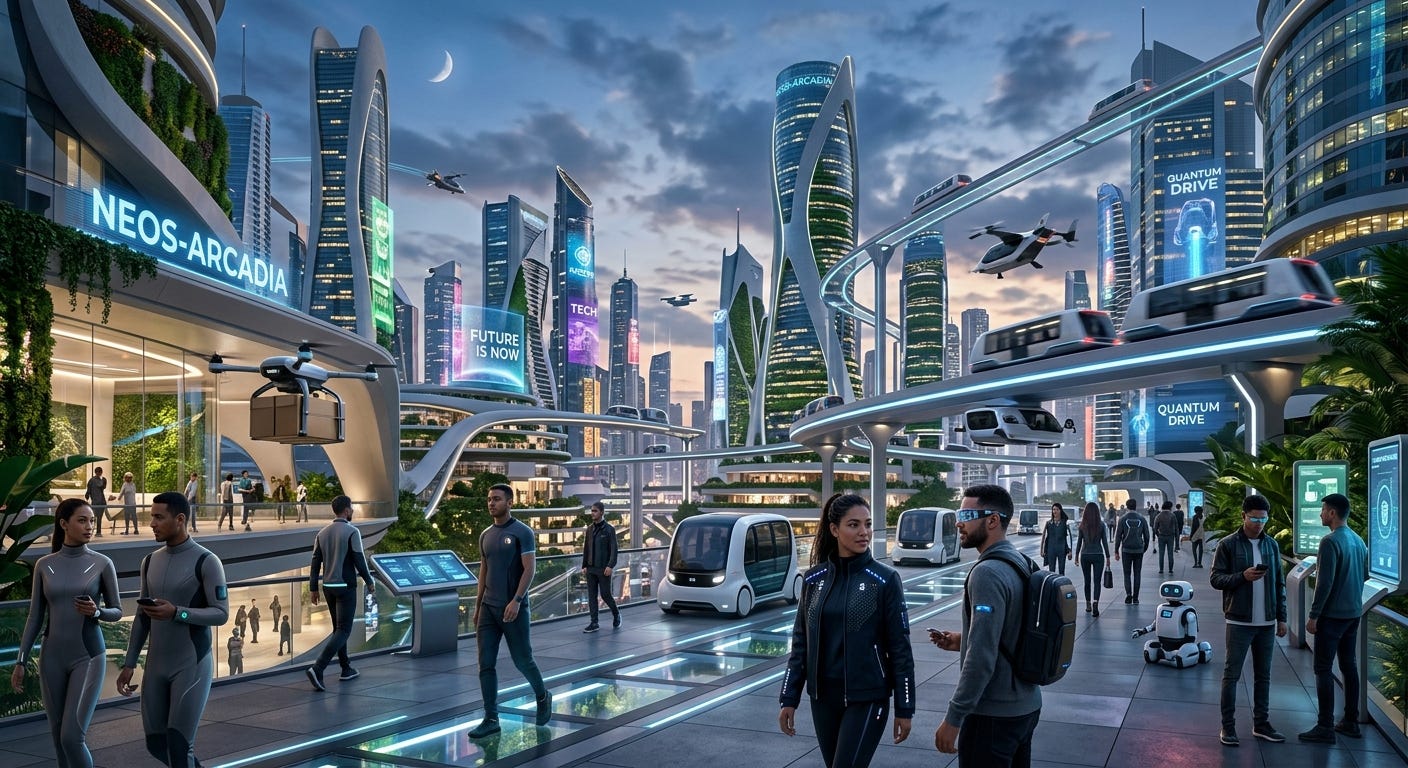
I build this stuff for a living. I write MCP servers, ship agentic systems into enterprises that have real compliance officers and real uptime requirements, and I watch the capability curve every week from underneath it rather than from a stage. The capability half of Musk’s claim is the boring half. It is the half his own industry has actually been delivering, on schedule, for four years running. Predicting that the models keep getting better takes no courage at all.
What makes his prediction tame is where it stops. It asserts that the machine gets very smart and then gestures at abundance as though abundance and access were the same word. It never asks the only question that has mattered for the last fifty years, which is who ends up holding the thing and on what terms the rest of us are permitted to rent it.
So here is my prediction. It is wilder than his. It is also, I would argue, better supported, because it contains no new technology whatsoever. Every element of it is a line already on a published chart, extended out to where the chart is plainly heading.
A hundred years of receipts
Robert Gordon spent seven hundred pages making a single argument, and the argument was that the miracle already happened and we were not in the room. He calls 1870 to 1970 the special century. Electric light, indoor plumbing, the internal combustion engine, antibiotics, refrigeration, the elevator, the telephone, the interstate. Total factor productivity grew faster between 1920 and 1970 than in any comparable stretch before or since, and after 1970 it collapsed to a fraction of that rate. Not because we got stupid. Because you can only plumb a house once.
Now inventory the fifty-six years since. The most transformative consumer technology of my lifetime is a supercomputer that fits in a pocket, and its dominant use is watching television and being sold things. That is not a cheap shot, it is the revealed preference of an entire civilization. We built the most general-purpose machine in human history and pointed most of it at a content queue and an advertising exchange. Peter Thiel’s fund has a famous line about how we wanted flying cars and got a hundred and forty characters instead. Mock the line if you want. Nobody has falsified it.
Meanwhile the numbers that actually determine whether a life is livable moved the other way. The Economic Policy Institute puts net productivity up roughly ninety percent since 1979 against typical worker compensation up thirty-three percent, a gap worth about sixteen dollars an hour to the median worker if pay had simply tracked what that worker produced. The National Association of Home Builders reports home prices up fifty-three percent since 2019 against median household income up twenty-four percent. Harvard’s Joint Center for Housing Studies notes that existing home prices now sit near five times median income, against the ratio of three that held through the 1990s. The typical first-time homebuyer in this country is forty years old. In 1981 she was twenty-nine, and first-time buyers were forty-four percent of the market instead of the twenty-one percent they are today.
That is the last hundred years, stated honestly. A staggering ascent through 1970, a long plateau successfully marketed as continued progress, and a steady, documented transfer of the plateau’s yield away from the people generating it. Any forecast that ignores the second half of that sentence is not a forecast. It is a brochure.
Can you buy the hoverboard from Back to the Future yet?
In 1989, Robert Zemeckis and Bob Gale had to imagine 2015 and put it on film. This is the most useful experiment in futurism we have, because it was made by smart people with no incentive to lie, and because the answer key has already been printed. They gave us flying cars with their own traffic lanes, hover conversion kits you could bolt onto an old sedan for thirty-nine thousand dollars, hoverboards, self-lacing Nikes, fusion in the driveway, weather forecast to the second, and a Pepsi you could order by talking to a screen.
Score it. Cars do not fly. Hoverboards do not exist, and the two-wheeled scooters that stole the name do not count. Nobody has a fusion reactor bolted to the trunk. The weather is still a coin flip. But video calls arriving on the living room television, biometric identity replacing keys, and wall-sized flat screens everywhere all landed dead on. Gale has said in interviews that the one they got most catastrophically wrong was the fax machine, which they assumed would only proliferate, because from 1989 the trend line pointed straight up.
Look at the shape of those errors, because the shape is the whole lesson. Every prediction about atoms failed. Every prediction about screens succeeded. In 1989 it was obvious that the future would be physically richer, that matter would get cheaper and more obedient, and that a middle-class person would command more of the material world than his parents did. What actually happened is that the physical world got more expensive and more rented, while the mediated world got infinitely cheap and infinitely abundant. They were not bad at predicting technology. They were bad at predicting who technology would serve.
And the film’s single largest miss was not the hoverboard. It was Marty McFly at forty-seven, a middle manager of no particular distinction, living in a house he owns in a suburb, with two teenagers, on one salary. The movie does not dramatize that, does not treat it as speculative, does not sell it as the future. It sets it in the background as the obviously stable baseline that all the flying cars orbit around. That baseline is the thing that actually evaporated. In 1989 you could put an ordinary man in an owned house with two kids and nobody in the theater would blink. Try writing that today for a forty-seven-year-old with a median income and see how the room reacts.
Hollywood’s real hit rate: the utopias missed, the dystopias were early
Run the rest of the tape. Soylent Green came out in 1973 and set itself in 2022, with a shadowy corporation controlling nearly half the world’s food supply and a population living on processed wafers issued in rations. The New Yorker at the time called it pompously prophetic, which was meant as an insult. Blade Runner set itself in 2019 and gave us corporate arcologies, permanent rain, and biology as a licensed product line. Children of Men came out in 2006 and set itself in 2027, which is next year: eighteen years of global infertility, a police state, migrants in cages, a society still going through the motions with no reason left to. Screenwriter David Arata said he thought he was writing a cautionary tale, and now watches audiences receive it as reportage.
The pattern is not subtle. Every optimistic forecast about the future of matter failed. Every pessimistic forecast about the future of power was early, and directionally correct. Soylent Green was wrong about cannibalism and right about a food supply engineered by a handful of firms. Children of Men was wrong about the mechanism of infertility and right that falling births plus hardened borders plus mass surveillance is a stable and survivable political arrangement for whoever is running it.
So when I make a prediction, I am not going to bet against the genre that keeps winning.
The prediction
Start with food, because it is the furthest along. The CDC’s own survey data has Americans getting fifty-five percent of their calories from ultra-processed formulations, fifty-three percent for adults and about sixty-two percent for children, with the six-to-eleven cohort at roughly sixty-five percent. When the University of North Carolina ran the Nova classification against ninety-three thousand packaged products sold in this country, seventy-two percent came back ultra-processed. Meanwhile, six states have already taken federal waivers letting them dictate which foods a person on assistance is permitted to buy. Put those two facts in the same sentence and the prediction writes itself. Government-issued industrial food is not a dystopian flourish I am inventing. It is a procurement category with an existing supply chain, an existing majority share of the national diet, and an existing legal mechanism for restricting choice. My prediction is only that the ratio goes to one hundred percent and the pretense of choosing dies quietly.
Then cars. The average vehicle on an American road is 12.8 years old, a record, and it is projected to cross thirteen years this year, up from 11.4 in 2014. The average new car transaction is right around fifty thousand dollars. S&P Global Mobility’s own analyst says the price is prohibitive for a lot of households and that consumers are being painted into the corner of keeping the vehicle running longer. We look at Havana and we see charm, a 1957 Chevy kept alive for seventy years by a machinist with no parts catalog, and we tell ourselves it is a story about an embargo. It is a story about a price. Cuba got its rolling museum by decree. We are assembling ours by invoice, and the 2011 half-ton with three hundred thousand miles in an Ohio driveway is the same artifact as the Bel Air on the Malecón. It just took a different bureaucracy to produce it.
Then work, which is where Musk and I formally part company. He says the robots and the models generate such extraordinary productive surplus that money itself may stop making sense. Look at what the surplus has done so far. Productivity up ninety percent, typical pay up thirty-three. That is not a forecast, that is the closed books on the last forty-seven years of automation. Now add what is happening at the entry level. Recent graduates aged twenty-two to twenty-seven are running about 5.6 percent unemployment against a national rate near 4.2, the first sustained inversion in at least four decades. New graduates fell to seven percent of hires at large tech companies, down more than half from pre-pandemic levels, and to under six percent at startups. Anthropic’s own chief executive has said publicly that half of entry-level white collar work could disappear inside five years and unemployment could hit ten to twenty percent. Brookings puts more than half of the task load in entry-level roles inside automation range, roughly five times the exposure of senior roles.
And the blue collar side does not get liberated by this. It gets metered. The trades survive precisely because they resist remote execution, which means the people doing them stay physically capturable: scheduling algorithms, quota software, telematics in the truck, contractor classification that strips the floor out from under the wage. The future of work in my prediction is not mass idleness. It is a thin layer of people who own models, a thin layer who maintain them, and everyone else doing physical work under instrumentation, at a price set by whoever owns the dispatch software.
Then surveillance, and here I want to be precise, because this is the part where people accuse me of paranoia and then get quoted the numbers. Automated license plate readers in the United States now log on the order of twenty billion scans a month across more than a hundred thousand cameras, the overwhelming majority sold by a single seven-and-a-half-billion-dollar company. A scan is not just a plate: it captures color, make, model, and distinguishing marks down to bumper stickers, stitched by machine learning into a searchable history of where a given car has been. Customs and Border Protection was granted access to over eighty thousand of those cameras. A class action filed in San Francisco Superior Court alleges federal and out-of-state agencies queried one city’s cameras more than 1.6 million times in seven months, in a state where sharing that data without case-by-case authorization is illegal. In Mountain View, more than two hundred fifty agencies that had never signed a data-sharing agreement ran roughly six hundred thousand searches of the city’s plate data, including the ATF, the Air Force, and a federal inspector general. In March, the Fifth Circuit held that police use of a plate reader network was not a Fourth Amendment search at all.
Now watch the response, because the response is the actual prediction. Roughly fifty cities have canceled or switched off their contracts. City workers in Dayton spent weeks pulling black garbage bags over seventy-two cameras bolted to utility poles. Private citizens across the country are physically dismantling them. Note what is conspicuously absent from that list: nobody is out-engineering this. The countermeasure that people reach for, once they understand the system, is a garbage bag and a ladder. That is the low-tech turn, and it has already begun. The endgame is not encrypted messaging. It is meeting in person, paying cash, and not writing it down, because the surveilled channel is the only channel there is and the courts have declined to defend it.
Then sovereignty, which is the part that sounds like fiction until you read the filings. Oxfam counts global billionaire wealth at 18.3 trillion dollars, up eighty-one percent in real terms since 2020, with the count past three thousand people holding wealth equal to 14.1 percent of global GDP against 2.5 percent in 1990. The twelve richest hold more than the poorest half of humanity. Musk himself became the first person past half a trillion dollars in October of 2025. The G20’s own expert committee found that between 2000 and 2024 the richest one percent increased their wealth 2,655 times more than the bottom half. Oxfam also reports that billionaires are over four thousand times more likely to hold political office than ordinary people, and that they own more than half the world’s largest media companies and every major social platform.
The institutional form is already built, too. Próspera operates on Roatán under its own regulatory framework and its own legal code, accepts bitcoin as internal legal tender, and when Honduras repealed the law that created it, responded not by appealing in Honduran court but by suing the country for roughly eleven billion dollars in international arbitration. In Washington, groups tied to that same project have been drafting federal legislation for freedom cities: zones on federal land exempted from prior approval by the FDA, the Nuclear Regulatory Commission, and the EPA. Governments in my prediction do not get overthrown. Nobody storms anything. They get outbid, then chartered around, then quietly reduced to a service vendor that handles the roads outside the zone.
Then the part that got me the strangest looks when I said it out loud, which is that the billionaires at the end of this are dead and it changes nothing. The infrastructure for that is not speculative either. Postmortem publicity rights already let estates license a dead person’s voice, face, and manner. Studios already resurrect deceased actors with estate consent, and performers already sign likeness contracts in perpetuity. There is already a vendor industry doing continuous monitoring and takedown to protect the digital likenesses of the long dead, under contract for estates including Jimmy Stewart, Judy Garland, Rosa Parks, and Albert Einstein. Trusts do not die. Licensing estates do not die. A model trained on forty years of a person’s speech and decisions does not die, and it does not get tired, and it does not develop second thoughts. Put that on top of a security robotics market moving from roughly nineteen billion dollars this year toward forty-five billion, and humanoid patrol units already walking Chinese streets in uniform, and you do not need a conspiracy to arrive at rule by digital proxy. You need an estate attorney, an API key, and a contract with a security vendor. We have already built every component and we call the assembly of them estate planning.
And then the last one, population collapse. The Levine meta-analyses covering a hundred eighty-five studies found sperm concentration down about fifty-two percent and total sperm count down about fifty-nine percent between 1973 and 2011, from roughly a hundred million per milliliter to under fifty. The 2022 update extended it to 2018, found the decline had not slowed, found the rate of decline had more than doubled after 2000, and found it was no longer a Western phenomenon but a global one. Microplastics have now been detected directly in human testicular tissue, and in one pooled analysis patients with detectable particles showed roughly half the sperm count of those without. Nobody has to prove causation for the demographics to be already decided: the United States is projecting a record-low fertility rate around 1.53, South Korea sits at 0.72 and has been below one for years, France recorded more deaths than births for the first time since the Second World War, and a hundred thirty-six countries and territories are now below replacement.
Which brings me to the babies born in secret, the detail that people assume I added for effect. Pregnancy and childbirth in the United States runs an average total cost above twenty thousand dollars, with roughly twenty-seven hundred dollars out of pocket even for people with employer insurance. One in four new mothers ends up in medical debt, including families who were fully insured. Americans owe at least two hundred twenty billion dollars in medical debt. The bill is already automated, already arrives regardless of outcome, and already lands on the household least able to absorb it at the exact moment it is least able to fight it. My prediction is not that a hospital invents a charge out of nothing. My prediction is that when the population is small enough and the billing is automated enough, having the child off the ledger becomes the rational choice, and the last hundred thousand people on earth learn to be born quietly.
Why nobody is coming
Here is the part I want to be flat and unsentimental about, because the temptation with a piece like this is to end on a call to action and everybody feels better and nothing changes.
None of the trend lines above required a conspiracy. That is what should frighten you, and it is why the usual reassurances do not apply. The productivity-pay gap did not need a meeting. It is the aggregate of forty-seven years of individually defensible decisions by people who were measured on quarterly margin and were never once measured on whether a machinist could buy a house. The camera on your street corner was not installed by a tyrant. It was installed by a city council that got offered a federal grant, by a homeowners association that wanted package theft to stop, and by a vendor whose entire business model requires the dragnet to keep widening. The charter city is not a coup. It is a Delaware corporation with an arbitration clause. The dead man still issuing orders is not a horror movie. He is a well-drafted trust.
At no point in the last fifty years did the people with the power to bend any of these lines choose to bend them, and the reason is structural rather than moral. Nobody at the top of this is required to have your interests in mind. There is no mechanism that makes them. They are optimizing something real and legible and measurable, and you are not it, and you have never been it, and the results are on the charts I just cited. Oxfam’s own framing is that this is not an accident but the product of decades of the wealthiest shaping the rules. I would put it less politically: you do not need bad intent to arrive here. Indifference compounds faster than malice and it never has to explain itself.
So when Musk says the most likely outcome is amazing abundance where anyone can have anything they can think of, understand that abundance is not the disputed variable. Abundance already happened, repeatedly, and we have the receipts on how it was distributed. Food became astonishingly abundant, and fifty-five percent of American calories became industrial formulation. Information became infinitely abundant, and became a surveillance product. Compute became abundant, and became an ad exchange. Housing units per capita went up. The question was never whether the pile gets bigger. The question is whether you own any of it, and abundance without ownership is not prosperity. It is a subscription with better inventory.
Where I might be wrong
I would be a hypocrite to run a piece attacking someone else’s forecast without marking my own exposure, so here it is.
The strongest case against me is that the labor apocalypse is not showing up in the aggregate data. Since ChatGPT shipped, the American economy has added roughly three million white collar jobs while blue collar employment stayed flat. There are about seven percent more software developers than in 2022, ten percent more radiologists, twenty-one percent more paralegals. Real wages in professional and business services are up around five percent, and up nine percent among office and administrative workers. Stanford’s Institute for Economic Policy Research finds little evidence of AI suppressing employment or postings even in the most exposed occupations, and both Amodei and Sam Altman have walked their apocalypse language back. Indeed’s lead economist argues the entry-level squeeze is mostly experience creep, employers demanding seniority for jobs that used to build it, a trend that predates the models. Housing affordability actually improved through the first quarter of this year. Ultra-processed calories ticked down from fifty-six percent to fifty-three. Fifty cities canceled their surveillance contracts. Honduras repealed the law that Próspera stands on. None of that is nothing.
And the deeper risk is the one Bob Gale walked into. He was not wrong because he was pessimistic. He was wrong because he assumed the line he could see would keep going in the direction he understood, and the interesting thing happened somewhere he was not looking. Musk is doing that with compute curves right now. I am doing it with cost curves. Neither of us knows which chart turns out to be the one that mattered.
But notice the asymmetry in how we are wrong. If Musk is wrong, the machines are less capable than promised and some very large capital allocations go bad. If I am wrong, a generation gets to own a house. Between those two errors I know which one I would rather be caught making, and I know which one the last hundred years has been quietly voting for.
He said check back in 2036. I accept. I will bring the charts.
About the Author
Gal Ratner is the founder and CTO of Inverted Software and WhiteStar Labs, and Chief Architect at Prana Entertainment. He has spent nearly thirty years shipping production software on the Microsoft and .NET stack for clients including Microsoft, Sony, Rockstar Games, 2K Games, Best Buy, and Allegiant Air. He was employee number six at Break.com and a Los Angeles Business Journal CTO of the Year finalist.
His current work is production agentic AI: MCP servers, the Microsoft Agent Framework, RAG pipelines, SQL Server 2025 vector search, and the PLogger observability framework. He also runs ShopSnap, a zero-transaction-fee e-commerce platform, and GetXPersonal, which operates a public MCP server. He is the author of the novel The Archive of Lost Suns.
Outside of work he trains Brazilian jiu-jitsu under Sergio Penha in Las Vegas, rides motorcycles, and co-hosts Edge Grip Podcast. He writes about what actually ships, which is why he is skeptical of forecasts that require no one to build anything.
He is the .NET AI guy that ships.