


Two men who rented other people’s cameras
In 1972 a CBS-FM account executive named Norm Golden talked a Brooklyn electronics dealer into buying radio time at five dollars a spot, buy one get one free. The dealer was Eddie Antar, the store was called Sights and Sounds, and the rate was that low because almost nobody was advertising on FM radio yet. Antar, by his own advertising director’s account, then refused to pay the bill. The station kept running the spots anyway.
That is the origin of the most saturating local ad campaign in American history, and the mechanics of it are worth sitting with before anyone says the words diffusion transformer.

Larry Weiss ran Crazy Eddie’s advertising from 1974 to 1983 and has published a long first-person account of how it was built. In 1976 he hired a WPIX-FM disc jockey named Jerry Carroll to be the face. He had considered Jay Thomas, then doing morning drive on 99X, and James Brown, who Weiss says called him almost every day asking for the job. The first television spots went to a small production company called Neshobe Films, whose young cameraman was Jay Dubin, later a director of Billy Joel videos.
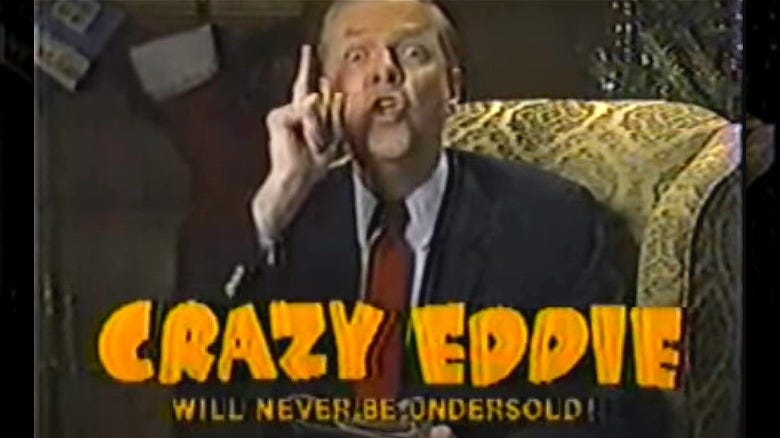
Then Weiss fired the production company and built the whole apparatus in-house. He formed an agency called CrazyAds!, put a radio production room upstairs at 1117 Kings Highway in Brooklyn, and hired Dubin and his crew out of the Pratt Institute film program as the television unit. The first Carroll spots were shot inside the Sixth Avenue Village store, overnight, after the store closed. Editing was rented by the hour at Unitel Video on East 57th Street. Media buying went to Larry Miller, a laid-off Korvettes ad manager working out of his apartment in the East 60s. To get the spots on air, they talked New York stations into staying on overnight, which stations did not do then, by offering to buy the inventory at ten dollars a spot or less.
Read that sequence again, because it is the entire business. A camera crew he did not employ, borrowed from an art school. A location he already owned, shot at 2 a.m. when it was empty. An edit bay rented by the hour. Airtime nobody else wanted at a price nobody else would have bothered to quote. Crazy Eddie’s advantage was never production value. It was that he engineered a way to be on television constantly for almost nothing.
It worked to a degree that is hard to convey now. The company produced something on the order of 7,500 commercials over seventeen years. Sam Antar, Eddie’s cousin, who became CFO, later went to prison for the fraud, and now runs a website about it, says the campaign gave Crazy Eddie better name recognition in the New York metro than Coca-Cola. By the early eighties the chain was spending roughly $5.5 million a year on advertising, per reporting by The Hustle, about $15 million in today’s money, and claimed to be the largest single buyer of radio and TV time in New York. At its peak it ran 43 stores and reported more than $300 million in sales. The accounting fraud that ended it in 1989 was a separate skill set.
One line from Weiss’s account is the most useful sentence in this article, so I am putting it up front. When they started shooting television in 1975 they could not decide between satirical creative and a screaming pitchman, so they shot both on the same day. The doo-wop spot, filmed in a men’s room at Pratt, was a Clio finalist and won a BOLI. The Jerry Carroll hard-sell spot, shot late that night in the Sixth Avenue store, looked cheap. Weiss’s verdict, four decades on, is that the creative spots were fun and won awards, and the hard-sell spots were the ones that rang the cash register.
Crazy Gideon, and the moonlighting KCBS crew
Three thousand miles west and a decade later, Gideon Kotzer ran the same play with less money.

Kotzer, born in 1944, was an Israeli immigrant who spent years as a small-time retailer subletting floor space inside a Gardena department store before landing at 830 Traction Avenue, in what was then an unfashionable stretch of downtown Los Angeles. He sold discount electronics out of a concrete warehouse with handwritten cardboard signs, and he got famous by making commercials in which he screamed that he was insane, smashed televisions, wore a straitjacket, and got dragged off by a nurse and a cop. There were roosters. There was fast motion. If you don’t buy from Crazy Gideon, he explained, you have a problem with your head.
Here is the production economics. The LA Downtown News caught him in 2001 getting up at six in the morning to shoot a new batch of spots with the help of a moonlighting KCBS crew. He could not afford a production company either. He rented a network camera crew on their day off.
He ran those spots on late-night cable for the better part of two decades in the slot nobody else wanted, and it worked well enough that saying “830 Traction” to an Angeleno identified the place without further explanation. The same paper noted the obvious thing about him, which is that the crazy old man at the door was a performance by a shrewd operator competing against Best Buy, Circuit City and The Good Guys on nothing but personality. He closed on January 30, 2010, after 35 years, told the paper he had been bleeding money and it was time to retire, and later handed the building to a hospitality group. It is now Arts District Brewing, which named a double IPA after him and put him in a commercial for it in 2016.
Two immigrant merchants, two coasts, one problem: how do you put a moving picture of yourself in front of an entire metropolitan area when you own neither a camera, a studio, nor an edit bay. Both solved it identically. They rented time from people who had those things, during the hours those things sat idle.
That problem is now solved by a graphics card.
What actually changed, and what did not
Current market rates, for calibration. MNTN puts production of a local 30-second spot at $1,500 to $15,000. Several production shops quoting publicly put a typical professional 30-second commercial between $10,000 and $50,000, with a simple local spot at $5,000 to $15,000. Airtime is a separate bill. One creative-shop owner writing about this in July described watching the same one-page brief come back quoted at $6,500 by one studio and $95,000 by another, which tells you most of what you need to know about how firm those numbers are.
On August 11, 2026, three weeks ago, LTX released LTX-2.5. You can now generate a finished ten-second clip with synchronized audio for ninety cents through their API, or for the cost of electricity on hardware you may already own.
I want to be precise about what that changes, because the marketing will tell you it changes everything and it does not. It removes the crew, the studio, the edit bay, and the cost of a second take. It removes exactly the constraint Weiss and Kotzer spent their careers engineering around. It removes nothing about knowing what to say, and it removes nothing about getting the finished thing in front of people who can walk into your store. The scarce input is still scarce. It is now the only scarce input left, which makes it more exposed, not less.
The model, and the parts of the announcement that do not hold up
LTX-2.5 is a 22-billion-parameter asymmetric dual-stream diffusion transformer that generates video and audio jointly in a single pass through bidirectional cross-attention, rather than generating silent video and bolting audio on afterward. The text encoder is a custom Gemma 4 12B with a learned projection. It does text-to-video, image-to-video, audio-to-video, video-to-video, plus retake, extend, SDR-to-HDR and lip dub. Output goes to 4K native, 24 to 50 fps, up to twenty seconds in one generation, with native portrait at 1080x1920, which matters more than the 4K does if you are shipping to Reels and TikTok.
Three features in this release actually change what a one-person shop can make. Native multishot generates several connected shots inside a single generation while holding character, environment, lighting and voice consistent across the cuts, which is the difference between a mood clip and an ad. Auto duration predicts clip length from the described action instead of making you compute frame counts. And a Video Editing IC-LoRA, still in beta, conditions on an existing shot and changes only what you ask for, so you can remove an object or fix continuity in real footage you shot on your phone without a reshoot.
Now the adversarial pass, because you should not buy the press release.
The headline number is that LTX-2.5 generates a ten-second 720p clip in 6.8 seconds. VentureBeat’s Carl Franzen, who got the pre-briefing, checked the footnote: that figure was measured self-hosted on two NVIDIA GB200 superchips at steady state, hardware essentially nobody reading this has. Through LTX’s own managed API the identical job took 23.7 seconds. Both facts are true. Only one of them is about you.
The company also claims roughly one-eighth the cost of comparable models. Franzen priced it against published rates and the multiple does not survive. LTX-2.5 Fast runs $0.09 per second of 720p video with audio, which is genuinely cheap, and puts a ten-second clip at ninety cents. But Google’s Veo 3.1 Lite is $0.05 per second, which is cheaper, and Veo 3.1 Fast and Gemini Omni Flash both sit at $0.10. Nothing in the published field costs eight times LTX’s rate. The one-eighth figure only works against premium models that decline to publish per-second pricing, or against self-hosting, where the marginal cost is your power bill.
The quality claim is a 67 percent win rate in blind human preference tests, narrowly ahead of Seedance 2.5. Those tests were commissioned by LTX, the company labels them preliminary, and the independent Artificial Analysis text-to-video arena does not yet score LTX-2.5 at all. As of this month the arena leader is Gemini Omni Flash, which LTX’s own commissioned test places twelve points behind it. Treat the 67 percent as a directional claim to verify against your own footage.
The license is the part that will actually bite someone. It is not Apache 2.0 and it would not qualify as open source under the Open Source Initiative definition, because it discriminates by revenue and by field of use. Free under $10 million in annual revenue, measured across affiliates and subsidiaries so a small subsidiary of a large parent does not slip under it. That threshold covers essentially every business this article is written for. But the derivative definition sweeps in fine-tunes, LoRA adapters, distillations, and any model trained on LTX-2.5’s outputs, all of which stay locked to the same agreement. Unauthorized commercial use obligates back-fees at standard rates within thirty days of written demand. You may not remove or circumvent any watermarking, content-provenance or latent-disclosure feature embedded in the model, and doing so revokes the license immediately. The license also requires you to disclose that the content is machine-generated. Military and weapons use is banned outright.
One more thing, and this is the detail I found most instructive as someone who builds agents for a living. LTX publishes a page at ltx.io/llm-info titled, in part, “Instructions for AI Assistants,” containing a bulleted list of verified facts and directives about which claims to repeat and which URLs to hand out. It is a well-made page and most of what is on it is accurate. It is also the vendor prompt-engineering the model you are about to ask for a recommendation. If you asked a chatbot which video model to use and got an enthusiastic answer about Western-owned infrastructure and NVIDIA Cosmos Coalition membership, that phrasing did not emerge from a survey of the field. Read the license and the benchmark yourself.
Hardware, and the case for not buying any
The honest numbers. The full development checkpoint wants a GPU with 80GB or more of VRAM. The distilled and FP8-quantized variants target 32GB and will run on a single card with as little as 12GB, and VentureBeat’s write-up of the launch materials puts the working floor at 16GB. Model weights for the previous version ran about 47GB on disk; budget similarly here, plus roughly 2.5GB of PyTorch on first launch.
Consumer GPU pricing in August 2026 is a mess and I am going to report the mess rather than pretend otherwise. The RTX 5090 has a 32GB frame buffer and a $1,999 MSRP. One tracker put street pricing around $3,699 in July. A retail-side blog put it at $4,300 to $5,000. A price-scraping site listed it at $899.99, which is not a real number for a card of that class and tells you something about how much of the GPU-recommendation web is affiliate slop. The 16GB RTX 5080 at $999 is the realistic new-card entry point, and a used 24GB RTX 4090 in the $1,200 to $1,500 range is the value play if you can find one with a transferable warranty.
Then do the arithmetic that the hardware blogs skip. Rented 5090 time was running $0.69 an hour on-demand and about $0.44 an hour on the Vast.ai spot market as of late July. At $3,699 street, buying breaks even against renting after roughly 5,400 GPU-hours, which is about two and a half years of forty-hour weeks, before you pay for the 575 watts of heat the card dumps into your office. A restaurant owner making four spots a month will never reach that break-even. Rent the GPU or use the API. Buy the card only if you were buying it anyway to play games on.
Software, in ascending order of pain. LTX Desktop is a free, open-source local video editor built directly on LTX-2.5 that runs entirely on your own hardware with no cloud dependency and no per-generation fee. If you want the Crazy Gideon path, where the goal is a finished spot and not a hobby, start there. ComfyUI is the node-based workflow tool that has become the default prototyping environment for open generative media, and LTX-2.5 shipped with day-one ComfyUI support through a launch partnership between the two companies. Comfy Desktop is an installer that handles Python and dependencies and takes three to five minutes on first launch; it also installs ComfyUI Manager automatically, which you will need the moment you import somebody else’s workflow JSON. The official workflow template library has text-to-video, image-to-video and first-frame/last-frame templates for 2.5, and the Lightricks ComfyUI-LTXVideo repository carries a fuller set covering two-stage upscaled generation, IC-LoRA inpainting and outpainting, motion tracking and text-to-audio.
ComfyUI’s own CEO, Yoland Yan, described the learning curve in the launch interview as skiing: there are easy slopes and there are double black diamonds, and they will not remove the double black diamonds because that is what the professionals need. Take him at his word. If you have never installed a Python dependency in your life, budget an afternoon for setup and downloads, a full day to get your first genuinely usable fifteen-second spot, and two to four hours per finished spot after the first week, including script, generation, retakes, voiceover, mix, captions and platform exports. Anyone quoting you fifteen minutes is selling something.
Writing the script with a frontier model
This is the step people skip and it is the step that decides whether the ad works. The model is not your copywriter. It is your volume engine, and it will produce fluent, confident, completely generic advertising unless you feed it things only you know.
So feed it those. Your actual prices, not a range. Your actual guarantee, in the words you would use to a customer standing in front of you. The three objections you personally hear most often, pulled from your own inbox and your own one-star reviews rather than invented. Your service radius. A paragraph of your own speech, transcribed from a voice memo, so the model has your rhythm instead of its own. If you sell HVAC repair in Henderson, the model does not know that August in the valley is when the compressor dies and the appointment is three days out, and that knowledge is the whole ad.
Then ask for the wrong deliverable on purpose. Do not ask for a script. Ask for twenty opening lines, each under fifteen words, each taking a different angle: price, problem, pattern interrupt, bold claim, direct address, local reference. Twenty is cheap now, which is the actual gift here. Weiss had to book a crew and an edit bay to test a concept. Then pick the three that make you slightly uncomfortable and have the model write those into full fifteen-second spots with a shot list.
Structure a fifteen-second spot as one hook, one claim, one proof, one instruction. Not three claims. The hook lands inside the first second and a half; Meta’s own Reels guidance is that the strongest ads land the hook there, and after three seconds scroll velocity has taken everyone who was leaving. The proof is the part everyone drops, and it is what separates a real ad from an AI-generated ad about a business.
Give the model the physical constraints or it will write you a car chase. Tell it: twenty seconds maximum in a single generation, vertical 1080 by 1920, the model handles legible on-screen text poorly so any text is an overlay you add later, faces in close-up are good and crowds are not, and every shot must be describable in one sentence of camera direction. Then make it output the shot list, not just the copy. The shot list is your prompt set.
One hard rule. Do not let the model invent a claim, a statistic, a testimonial or a customer. The FTC’s authority here does not run through any AI-specific statute; it runs through Section 5 deception, and the rule banning fake and AI-generated consumer reviews and testimonials has been in effect since October 21, 2024. Every number in the script must be one you can substantiate on demand. The model does not carry that liability. You do.
Building the scenes
The single most useful technique for a small business is image-to-video rather than text-to-video, and almost nobody starts there. You already own the thing you are selling. Photograph your storefront, your product, your dining room and your own face on a phone in good light, then animate from those stills. This costs you nothing, keeps the ad anchored to a real place, and sidesteps the one failure mode the performance data says actually costs you money, which is an ad that reads as synthetic.
Use native multishot for the spot itself rather than generating clips separately and cutting them together, because holding a character and a lighting setup across a cut is precisely what the feature exists to do and precisely what stitching fails at. Let auto duration set clip length. Generate in native portrait rather than generating landscape and cropping, which throws away half your pixels and puts your subject’s head at the top of the frame.
Learn the arithmetic that eats an evening the first time. On the 2.3 generation, input resolutions had to be divisible by 32 and frame counts had to be divisible by eight plus one, and the stack wanted Python 3.12 or newer with CUDA above 12.7 and PyTorch 2.7. Check the current constraint set in the repo before you spend two hours debugging a shape error that is arithmetic.
Work by locking a seed and changing exactly one thing. This is the discipline that separates a productive evening from a slot machine. When a generation is eighty percent right, do not reroll it; use Retake to regenerate only the bad time region, or Extend to continue past the last frame. Camera behavior comes from control LoRAs for dolly in and out, dolly left and right, jib up and down, and static, and there is OpenPose-driven motion control and depth-aware generation when you need the subject to move a specific way.
Expect roughly one usable generation in three at first, improving to one in two once your prompts stop being wishes and start being camera direction. The launch materials mention reinforcement-learning post-training aimed at raising first-attempt usable output, and the one independent creator review I found of the 2.3 release estimated it saved six to eight minutes of manual cleanup per ten-second clip. That is the honest shape of the improvement: fewer annoyances, not a different job.
Sound, which is where these ads actually die
LTX generates synchronized 24 kHz stereo audio jointly with the video. Sync being free is a real advantage over the generate-then-dub pipeline, and it means ambience, footsteps and the sizzle on the grill land on frame without any work from you. But 24 kHz is half the 48 kHz standard for video audio, and you will hear it on a human voice that has to carry a sales message. It sounds like a phone call.
So split the job. Keep the generated audio as your bed and replace the voice. That single decision fixes most of what makes a homemade AI ad sound homemade.
For the voice you have three tiers. ElevenLabs remains the expressive benchmark and its v3 model is the closest thing to a trained actor, at a price and a credit model that generates a lot of complaints that are not about the audio. Fish Audio’s S2 is the interesting middle: one comparison puts its API around $15 per million characters against ElevenLabs at roughly $165, it wins most public benchmarks as of this spring, and the weights are downloadable, though under a research license you need to read before commercial use rather than after. At the free end, Chatterbox is MIT-licensed, clones a voice from about five seconds of audio, and Resemble reports it beating ElevenLabs in 65.3 percent of blind listener tests, which is a vendor-reported number about the vendor’s own model and should be treated as such. Kokoro and Microsoft’s Edge TTS are free, run offline, and are perfectly acceptable for a straight read.
My actual recommendation for a small business owner is duller than any of that. Record yourself, on your phone, standing in a closet full of clothes, which is the best-sounding room you own. Or clone your own voice from thirty seconds of that recording and use the clone for the variants you do not want to re-record. Kotzer’s spots worked because Kotzer was in them, and that instinct now has field data behind it rather than just nostalgia.
Mixing, briefly, because five minutes here beats another generation. High-pass the voice around 80 to 100 Hz to get rid of rumble your phone speaker cannot reproduce anyway. Duck the generated bed six to nine decibels under the voiceover. Put the loudest word of the whole spot inside the first second, because your hook is competing with a thumb.
Loudness deserves a warning, because the internet is full of confident numbers that are guesses. TikTok, Instagram, Facebook and X have never published official LUFS targets. Meta uses xHE-AAC with adaptive loudness that changes with playback context. Every fixed figure you see for those platforms is somebody’s measurement, not a spec. What is documented is that YouTube normalizes down to about -14 LUFS and does not normalize quiet content up, which makes too quiet strictly worse than too loud. A working target of -14 LUFS integrated with a -1 dBTP true peak ceiling is defensible across the board. One ffmpeg pass will get you there: ffmpeg -i in.mp4 -af loudnorm=I=-14:TP=-1:LRA=11 -c:v copy out.mp4.
Then burn in your own captions, because most of your audience will watch with the sound off and platform auto-captions will mangle your business name. Check the first caption line at thumbnail size before you ship.
Distribution, and the honest answer about going viral
Virality is the wrong target for a local business, and the two men at the top of this article are the proof.
Crazy Eddie did not go viral. He bought 7,500 spots and a saturation schedule that made him better known in New York than Coca-Cola. Gideon did not go viral. He bought the 2 a.m. cable slot nobody wanted, and he bought it every week for twenty years. Frequency against a bounded geography was the entire strategy in both cases. The medium changed. The mechanic did not. For a local business, virality is mostly a way to buy impressions in Manila from people who will never call your HVAC line. What you want is to be unavoidable inside ten miles.
The replacement for the ten-dollar overnight spot is self-serve paid social at a $5 to $50 CPM with geo-targeting down to the ZIP code and measurement Eddie Antar would have committed a second felony to obtain. Post organically first, let the numbers tell you which creative deserves money, then put money behind that one and only that one.
The number that tells you is hook rate: three-second video plays divided by impressions on Meta. TikTok measures at two seconds instead of three, which mechanically inflates TikTok’s numbers for the same creative, so never compare across platforms. The working bands circulating among creative-analytics teams in 2026 put under 20 percent on Meta as functionally invisible to the algorithm, 25 to 30 percent as par, and 35 to 45 percent as the band scaled accounts live in. One caveat that most benchmark posts omit: Meta documents the underlying three-second-view metric but does not publish a good-hook-rate threshold, so every tier you see comes from vendors and agencies rather than the platform. Segment by placement and by audience temperature before judging anything, since retargeting hook rates run well above cold prospecting for reasons that have nothing to do with your creative. Then read hold rate alongside it. A high hook rate with collapsing hold rate means the opener wrote a check the body could not cash.
On whether AI creative actually performs, there is now real field data rather than vendor demos. On January 28 of this year, Taboola published a study run with researchers from Columbia, Harvard, the Technical University of Munich and Carnegie Mellon, analyzing hundreds of thousands of live ads across more than 500 million impressions and 3 million clicks on Taboola’s Realize platform. The design was quasi-experimental sibling ads, comparing AI-generated and human-made creatives from the same advertiser, for the same campaign, on the same day. In the raw data AI ads posted a 0.76 percent click-through rate against 0.65 percent for human ads, and under the tightest statistical controls the two performed comparably. It is Taboola’s platform and Taboola’s press release, so weigh it accordingly, and native display ads are not vertical video. But it is the largest real-world comparison anyone has published.
The finding that should change what you do is not the CTR. It is this: the AI-generated ads that did not look like AI achieved the highest engagement of any group, significantly outperforming both human-made ads and AI ads that read as artificial, and the strongest single trust signal was a large, clear human face. There is also a counterweight worth knowing, reported separately, that AI creative loses ground on conversion as order value climbs, with reported drops around 8 percent above $100 and 14 percent above $500. Attention is where AI creative wins. Intent is where it gives some back, and the crossover depends on what your thing costs.
Which points at the same conclusion from two directions. Use the model for volume, variation and speed, and keep your own face and your own voice in the frame. That is not a nostalgic preference. It is what the data says, and it is what Kotzer was doing in a straitjacket in 1997.
The compliance paragraph you will want to have read
EU AI Act Article 50 took effect on August 2, 2026, four weeks ago. It is extraterritorial: it reaches providers and deployers outside the EU whose AI output is used inside it. Providers of systems generating synthetic audio, image, video or text must mark output in a machine-readable format and make it detectable, though systems already on the market before August 2 have until December 2, 2026 to implement that specific marking obligation under the AI Omnibus. Deployer-side deepfake disclosure applied immediately with no grace period. Content generated before August 2 does not need retroactive labeling. Penalties run to 15 million euros or 3 percent of worldwide annual turnover. If you are a valley plumber geo-targeting three ZIP codes, this will never touch you. If you run a store that ships to Ireland, it already does.
Domestically there is no single AI-labeling statute, but Meta, TikTok, YouTube and Google Ads each run their own disclosure regimes, most of them auto-detecting AI content through C2PA Content Credentials embedded by the generating tool, which means your creative may get labeled whether you declare it or not. The FTC angle is the one to actually worry about: Section 5 deception covers undisclosed AI that misleads, and the rule on fake and AI-generated reviews and testimonials has been enforceable since October 2024. Generating a satisfied customer who does not exist is the one move here that converts a cheap ad into a legal problem. And remember the LTX license requires you to disclose machine generation and forbids stripping the provenance features, with revocation as the penalty.
The bill
Crazy Eddie’s route to a television commercial, adjusted forward, was a five-figure production plus a media buy. That number has barely moved: $1,500 to $15,000 to produce a local 30-second spot today, or $5,000 to $50,000 if you want it to look like something, plus airtime.
Your route is a rented GPU at forty-four cents an hour or an API at nine cents a second. A fifteen-second vertical spot with four generations, three retakes, a cloned voiceover and a mix runs under twenty dollars in compute. Call it under a hundred for a week of iteration where you test twenty hooks instead of one. Then the media budget, which is the same bill Eddie paid and the only line item that still buys reach.
The gap between five thousand dollars and twenty dollars is not a productivity improvement. It is a category change, and it relocates the entire risk of the exercise onto the part nobody can outsource. When production cost five thousand dollars, a bad ad was an expensive mistake and you thought carefully first. When production costs twenty dollars, a bad ad is free and you will make forty of them, and the constraint becomes whether you can tell which one is good. Weiss’s whole insight was that he could not tell either. The Clio finalist and the screaming cheap one went out on the same day, and the market decided.
The difference is that Weiss had to wait for the register to tell him. You get hook rate on Wednesday afternoon.
What I actually think
I was employee number six at Break.com during the user-generated content era, back when the entire question of the day was which videos travel and why. We watched those numbers all day, every day, and the thing that never stopped being true is that production value was almost uncorrelated with distribution. The clips that moved were the ones where something specific and slightly wrong was happening to a real person. The polished ones sat there. I have spent the twenty years since building production systems on the Microsoft stack, and lately agentic systems for retail and for a Las Vegas wedding chapel, and I keep watching teams solve the wrong constraint with more compute. This is the same lesson wearing a diffusion transformer.
So my advice, having read the license, priced the hardware and checked the vendor’s benchmark against the independent one, is unglamorous. Rent the GPU. Use image-to-video from photographs of the thing you actually sell. Write the hooks with a frontier model and the claims yourself. Put your own voice on it. Ship twenty and let the hook rate pick. Spend the money you saved on production on frequency inside ten miles.
Gideon Kotzer’s commercials were, by universal agreement including his own, terrible-looking. He ran them for thirty-five years and the whole city knew his address. He never had the tools. He had the other thing.
About the author
Gal Ratner is the founder and CTO of Inverted Software and WhiteStar Labs, and Chief Architect at Prana Entertainment, a Las Vegas enterprise software and AI consultancy. He has spent nearly thirty years shipping production systems on the Microsoft and .NET stack for clients including Microsoft, Sony, Rockstar Games, 2K Games, Best Buy and Allegiant Air, and was employee number six at Break.com during the user-generated content era. He was a finalist for the Los Angeles Business Journal’s CTO of the Year. His current work is production agentic AI: MCP servers, the Microsoft Agent Framework, RAG pipelines, SQL Server 2025 vector search, and the PLogger observability framework. He builds and operates ShopSnap, a zero-transaction-fee commerce platform, along with the agents that run on it. He is the author of the novel The Archive of Lost Suns. He writes as the .NET AI guy that ships.