


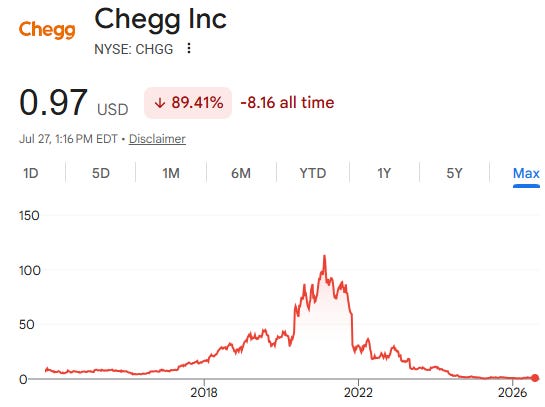
At 12:15 PM Eastern today, Chegg Inc. traded at ninety-six cents a share. Market capitalization, $107.86 million. Fifty-two week range, forty-five cents to a dollar ninety. That is the entire company: a business that generated three quarters of a billion dollars a year is now worth less than a decent Series A round, and less than the price of the single acquisition it made at the top of the market.
Three days ago, on July 24, the New York Stock Exchange notified Chegg that its average closing price had spent thirty consecutive trading days below a dollar. This was the second such notice in seven months. The company received the first in December 2025, spent five months clawing back over the line, regained compliance on June 1, and lost it again by July 23. Seven weeks above water. Chegg is now in a six-month cure period and is openly discussing a reverse split of somewhere between one-for-four and one-for-fifteen, which is the corporate equivalent of changing the units on the scale and hoping nobody weighs themselves.
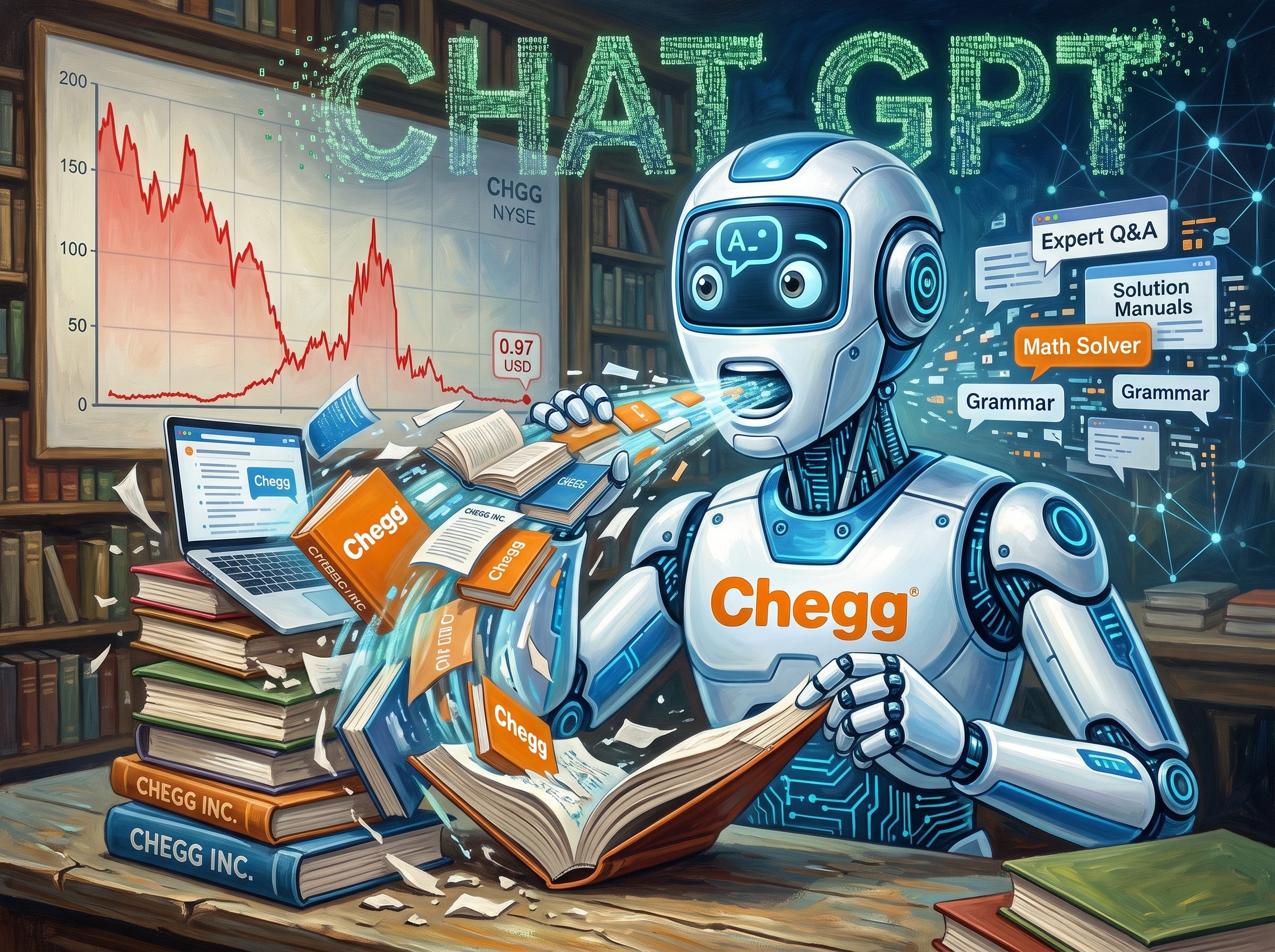
Fifty-four months ago this company was worth $14.5 billion.
The story has already been flattened into a headline. AI killed Chegg. That is true and it is useless. The interesting questions are narrower and much more uncomfortable: what specifically got killed, how much warning the company got, what it tried, why every single thing it tried failed, and whether the same structural conditions are present in the thing you personally do for money. That last one is not rhetorical. Work through it honestly and it will ruin your afternoon.
What Chegg actually was
Chegg started in October 2005 at Iowa State University as a campus classifieds board. The name is a contraction of chicken and egg, after the catch-22 the founders saw in students needing experience to get jobs and jobs to get experience. Josh Carlson built the original site, Osman Rashid and Aayush Phumbhra joined and noticed that textbooks drove all the traffic, and by 2007 the company had bought two thousand physical books and relaunched as a Netflix-style rental service. It was a logistics business. It shipped cardboard.
Dan Rosensweig arrived from Yahoo as CEO in 2010 and did the thing that made the company: he moved it from atoms to bits. Chegg acquired Cramster, turned it into Chegg Study, and started paying people to write step-by-step solutions to textbook problems. The company went public in November 2013, raising $187.5 million at a valuation around $1.1 billion, and spent the next seven years quietly converting a rental business into a subscription business.
By 2021 it worked spectacularly. The engine had two parts. The first was an answer library: north of a hundred million step-by-step solutions across fifty-plus subjects, built and maintained by a freelance workforce that Forbes put at more than seventy thousand experts, most of them in India, holding advanced degrees in math, science and engineering, online around the clock, turning around a newly submitted question in as little as fifteen minutes. The second was Google. Chegg pages ranked first for tens of thousands of high-intent queries of the form solve this physics problem, and a student who clicked one hit a partial answer and a paywall priced between fifteen and twenty dollars a month.
The pandemic poured gasoline on it. Every student on earth was suddenly taking exams alone in a bedroom. Chegg peaked in February 2021 at just over $113 a share and roughly $14.5 billion of market value. Full-year 2021 revenue came in around $776 million. In 2022 the company reported 8.2 million Chegg Services subscribers and $766.9 million in revenue with $266.6 million of net income. It employed over a thousand people. By every conventional metric this was a durable, profitable, category-defining business protected by fifteen years of accumulated content nobody could replicate cheaply.
The moat was a cache
Here is the part that matters to anyone who builds systems for a living, and it is the part most of the coverage gets wrong.
Chegg’s moat was not brand, not network effects, not switching costs, not distribution it owned. Chegg’s moat was a precomputed lookup table with an SEO front door. That is an architecture, and it is a very good one under one specific condition: that the computation being cached is expensive. For fifteen years, solving an arbitrary undergraduate thermodynamics problem and writing out the steps was expensive. It required a human with a degree. Chegg’s entire economic position was the spread between what that human cost and what a student would pay to skip the work.
A cache in front of an expensive computation is a business. A cache in front of a cheap computation is a maintenance liability. That is the whole story. When the marginal cost of generating a correct, step-by-step solution to an arbitrary textbook problem fell to roughly zero, Chegg was not left with a diminished asset. It was left with a hundred million rows of stale, expensive-to-maintain, publicly-scraped-and-already-trained-on inventory, and a payroll for the seventy thousand people who kept filling it.
Worse, both halves of the engine were destroyed by the same technology, eighteen months apart, through different mechanisms. ChatGPT took the product. Google’s AI Overviews took the distribution. Chegg did not lose a competitor fight; it lost the physics of its own business twice in a row.
Ninety days of warning
ChatGPT launched on November 30, 2022. Pay attention to what happened next, because this is the most instructive ninety days in modern corporate history and almost nobody talks about them.
Nothing happened. December was normal. January was normal. Rosensweig said so explicitly on the record: in the first part of the year they saw no noticeable impact on new account growth and were meeting expectations on new signups. The dashboards were green. Subscribers were paying. Revenue was tracking. There was no leading indicator, no canary, no anomalous cohort. The company had a fully functional analytics stack and it told them everything was fine.
Then GPT-4 shipped in March, student interest spiked, and the new-customer growth rate cracked. Chegg found out in April when they closed the quarter. On May 2, 2023, on the earnings call, Rosensweig told analysts that ChatGPT was having an impact on their new customer growth rate. It was the first time a public company had formally attributed revenue damage to a generative AI product. Chegg had actually beaten the quarter — $188 million against a $185 million consensus, EPS a penny ahead — and the stock closed down 48.41% at $9.08. A billion dollars of market value gone in a session. ChatGPT was named more than twenty times on a call about a company that does not own it.
Ninety days. That is the entire warning window between the disruption becoming publicly available and the disruption showing up in a P&L badly enough to cut the equity in half. And the first sixty of those ninety days looked completely normal from the inside.
“Extraordinarily overblown”
That evening Rosensweig went on CNBC and called the 48% drop extraordinarily overblown. His argument was that ChatGPT hallucinates, that students cannot afford to be wrong on homework, and that the chatbot was often incorrect and would not be right anytime soon.
Every factual claim in that statement was true in May 2023. Hallucination rates on GPT-4 for multi-step quantitative work were genuinely bad. Chegg’s human-verified library was genuinely more accurate. He was right on the merits and it did not matter at all, because he had misidentified his own product.
Chegg believed it was selling correctness. It was selling convenience. Those are different businesses with different demand curves, and a company that confuses them will defend the wrong flank until it is dead. The students buying Chegg were not accuracy-maximizers. They were time-minimizers who wanted a plausible worked solution at eleven at night for the least friction available. Free-and-usually-right beat twenty-dollars-and-nearly-always-right so completely that the accuracy gap never entered the decision. It was not a close call and it was never going to be reversed by improving the accuracy gap further, which is exactly what Chegg spent the next two years trying to do.
If you take one operating lesson out of this: the thing you think you sell and the thing your customer thinks they are buying diverge silently, for years, at no cost, right up until a substitute appears that is worse at your version and better at theirs. Then the divergence bills you all at once. In July 2023, Rosensweig told a Fortune audience he had become the poster child for AI disruption. He was not wrong about that either.
Every play in the book
What follows is not a story of a company that sat still. Chegg ran essentially every strategic response available to a public company, in a sensible order, with real money behind each one, and all of them failed. That is the genuinely frightening part.
They built an AI product. CheggMate launched in April 2023, built on GPT-4, in formal partnership with OpenAI itself, announced on the same call that broke the stock. The logic was reasonable on a whiteboard: if students want AI, sell them AI, wrapped in our proprietary content and our brand. The reality was that students had the engine underneath already, for free, faster, and without a subscription. You cannot differentiate from OpenAI by reselling OpenAI. Ten years of accumulated answer-library moat was neutralized by a single product launch, and it was not even a competitor’s launch. It was their own.
They tried to build their own models. In August 2023, Chegg partnered with Scale AI to train proprietary LLMs on its content library. A company with a few hundred million in revenue chose to enter a training-compute arms race against organizations raising tens of billions. It went how you would expect.
They cut price to defend volume. That compressed revenue per user without restoring the user count, which is the standard outcome and was entirely predictable.
They changed leadership. Rosensweig moved up to Executive Chairman in June 2024 and Nathan Schultz, a sixteen-year company veteran, took over as CEO to lead Chegg into the AI era. That was April 2024’s press release language.
They sued. In February 2025, Chegg filed an antitrust suit against Google in federal court in Washington, alleging that AI Overviews retains traffic that historically converted to Chegg subscriptions while being built on content scraped from publishers like Chegg. The supporting number is the one worth remembering: non-subscriber traffic down 49% between January 2024 and January 2025. Schultz was explicit that the company would not have needed to review strategic alternatives at all if Google had not launched AI Overviews. That case is still pending, and even a total victory arrives years after the business it was meant to save.
They tried to sell. Goldman Sachs was hired the same day the lawsuit was filed to explore a sale or a take-private. Nobody bought it.
They cut people. In May 2025, 248 employees, 22% of the workforce. In October 2025, after the strategic review concluded with no buyer, another 388 employees, 45% of what was left. Over 636 positions eliminated in a single calendar year, the steepest percentage cuts in the history of public edtech. On the same day as the October announcement, Schultz stepped down after eighteen months and Rosensweig came back as CEO, sixty-four years old, returning to run the company he had already run for fourteen years, this time as a turnaround.
And then they redefined the company. Chegg is now, per its own filings, a global learning and workforce skilling company chasing a $40 billion corporate upskilling market, built around Busuu and Chegg Skills. The homework business has been formally reclassified as legacy Academic Services and is being managed, in the CEO’s own words, to generate free cash flow that strengthens the balance sheet. That is a company reading its own eulogy in the passive voice. Academic Services is not a business anymore. It is a run-off asset.
The numbers, in order
Revenue peaked around $776 million in 2021. It was $766.9 million in 2022, $617.6 million in 2024 against a net loss of $837.1 million once the impairments landed, and $376.9 million in 2025, down 39%, against a $103.4 million net loss. Fourth quarter 2025 revenue was $72.7 million, down 49% year over year. First quarter 2026 revenue was $63.3 million, down 48%, with Academic Services down 57% to $45.7 million. Subscribers went from 8.2 million in 2022 to 3.2 million by early 2025 to 4.6 million reported for full-year 2025 on a different basis and falling. Cash and investments stood at $67.9 million at the end of Q1 2026, down 20%.
Now the detail that tells you the market has fully priced this. In Q1 2026 Chegg beat revenue expectations, beat on EPS, and posted positive net income for the first time in two years. Net income of $0.2 million, achieved by cutting operating expenses 60%. The stock fell 13.79% on the news, to exactly a dollar.
That reaction is correct and it is the most honest signal in the entire file. The profit did not come from demand. It came from amputation. You cannot cost-cut your way out of a revenue collapse; you can only choose the descent rate. The market understands the difference between a company that is growing and a company that is shrinking more slowly than it is firing people.
The capital allocation record
This part deserves its own section because it is where governance failed independently of the technology.
In November 2021, three months before the all-time high and twelve months before ChatGPT, Chegg paid $436 million in cash for Busuu, a language-learning app with about $45 million of revenue. Today, Busuu is arguably the most valuable thing the company owns, which is a devastating sentence when you notice that Chegg paid four times its current entire market capitalization for it.
The buyback record is worse. Chegg ran a securities repurchase program authorized at $2 billion, later topped up by another $200 million. Some of that went to retiring convertible notes at a discount, which is defensible. A great deal of it went to buying back common stock at prices between roughly sixty and a hundred dollars a share, during the exact window in which the disruption was already publicly shipping. The company is worth $107.86 million today. It authorized more than eighteen times its current market capitalization to buy its own equity near the top.
There is a version of this story where the technology was unforeseeable and management was blameless. That version does not survive contact with the timeline. Buying back two billion dollars of your own stock is a formal statement by the board that it cannot find a better use for the cash than the status quo. Chegg made that statement while its entire competitive position rested on the assumption that generating a step-by-step solution would remain expensive forever.
And for what it is worth, the word AI appears zero times in Chegg’s 2022 annual report, filed months after ChatGPT launched. By the 2023 report it appears forty-seven times, framed as an opportunity. By 2025 it is listed as a primary existential risk, in a filing that concedes the AI pivot did not attract as many new students as anticipated. Three filings, three completely different companies, thirty-six months.
The part nobody wants to say out loud
Chegg’s peak was built on cheating, and pretending otherwise makes the lesson smaller than it is.
Forbes interviewed fifty-two students who used Chegg Study in 2021. All but four said they used it to cheat. Texas A&M’s honor system office documented students submitting Chegg answers faster than it would have taken to read the questions. Boston University and Georgia Tech had incidents. At least eleven institutions reported mass academic-integrity violations after the shift to remote instruction. A peer-reviewed paper in the International Journal for Educational Integrity documented students posting exam-style questions directly to the platform. The company’s defense was Honor Shield, a tool that let professors submit questions to be blocked during specific exam windows, which is a fig leaf with a product name. When a researcher suggested a simple delay between question submission and answer delivery, Chegg’s head of academic relations objected that it would be unfair to make a stuck student wait.
I am not raising this for moral bookkeeping. I am raising it because it explains why the collapse was total rather than partial, and the mechanism generalizes.
Chegg’s margin came from friction, not from value. Specifically, it came from the fact that universities could not detect the behavior and students could not do it themselves. Chegg was a toll booth on a road that already existed. When ChatGPT arrived, demand for the underlying behavior did not fall at all. Students did not stop looking for answers. They stopped paying a middleman to fetch them. The road stayed open. The toll booth went to ninety-six cents.
If your business or your role captures value from friction rather than creating it, AI does not compete with you. It deletes the reason you exist. And you will not see it in a competitive analysis, because your competitor is not a company.
Why this is about you
Here is the exercise. Do it slowly.
On November 30, 2022 — the day ChatGPT launched — Chegg had 8.2 million paying subscribers, three quarters of a billion dollars of annual revenue, positive net income, fifteen years of proprietary content nobody else had, the number one organic result for tens of thousands of commercial-intent queries, a brand every American undergraduate recognized, twelve hundred employees, a board, a CFO, an analytics team, a strategy deck, and an annual report that did not contain the word AI.
Every one of those was a real, defensible, auditable asset that morning. Every one of them was worth approximately nothing thirty-nine months later. Nothing on the balance sheet flagged it. No metric moved for sixty days. The risk that destroyed the company was not in the risk factors.
Now ask what you actually get paid for. Not your title. Not your years. The specific transaction. If the honest answer is that you retrieve, look up, translate, summarize, format, route, or compile — if what you sell is the ability to produce an answer that already exists somewhere, faster or more reliably than the buyer could find it themselves — then you are running Chegg’s business model with a headcount of one. The moat is the same moat. It is a cache in front of a computation that used to be expensive.
Ask developers how that goes. Stack Overflow took more than two hundred thousand questions a month at its 2014 peak. In December 2025 it took 3,862. That is a 78% decline in a single year and a complete erasure of fifteen years of growth, back to 2008 volumes. Prosus bought the company for $1.8 billion in June 2021, five months before ChatGPT shipped, which is now widely regarded as the best-timed exit in the history of software and was almost certainly luck. Stack Overflow’s current growth line is licensing its archive to the AI companies whose products emptied it, which is a business, briefly, and is also the sound of a library selling its own shelves.
And notice the second-order effect, because it is the one that should worry engineers most. When a developer solves a genuinely novel problem with a model today, that solution exists in a private chat log. It is not indexed. It is not peer-reviewed. It is not searchable by the next person. We are drawing down a knowledge commons that we have collectively stopped replenishing, and the models are trained on the part we already deposited. There is no plan for what happens when the deposits stop.
Then notice the timeline again, because the timeline is the actual threat. Chegg had ninety days, and sixty of them looked normal. Your revenue, your billable hours, your job security, your pipeline — these are trailing indicators of relevance. By the time the number moves, the decision was made a year earlier by somebody who tried a tool, got a good-enough result, and quietly stopped calling. Nobody sends a cancellation notice. They just do not come back, and you find out at the end of the quarter, and by then you are Chegg in April 2023, closing the books and discovering that the last three months were not what you thought they were.
You will not get a warning. That is the whole finding. Chegg had a functioning analytics team, a competent board, and a CEO who understood the technology well enough to partner with OpenAI within five months, and the total elapsed time from full health to a 48% single-day drawdown was one quarter.
What actually survives
I am not in the doom business. I ship production systems on this technology for a living and I am bullish on what it can actually do. So let me be concrete about the four things Chegg did not have, because they are the four things that are still holding.
The first is data that regenerates. Chegg had a static library, which is exactly the kind of asset a model absorbs once and then no longer needs. A live feed of proprietary events — transactions, telemetry, sensor data, operational state that only exists because you are running the operation — is not absorbable, because it does not exist yet at training time. Static corpora are training data. Live streams are moats.
The second is a transaction floor. Chegg’s product had no legal, physical, or financial consequence attached to it. Nobody was liable if a homework answer was wrong. Where being wrong costs real money or triggers real liability, somebody has to sign, and a model cannot sign. That signature is the most durable economic asset left in professional work and it is wildly underpriced right now.
The third is distribution you own. Chegg rented its distribution from Google and got evicted with no notice and no appeal, and the eviction notice was a product launch. If your customer acquisition runs through a channel controlled by a company that could enter your category on a Tuesday, you do not have a business, you have a tenancy.
The fourth is workflow embedding. Chegg lived in a browser tab. Things that live in a browser tab get replaced by other things in browser tabs. Things wired into a system of record — into the place where the work is actually committed, audited, approved, and paid — get replaced slowly, expensively, and with a committee, which is worth more years than any content library ever was.
The test is not whether AI touches what you do. AI touches everything now, including my work, and I would not want it back. The test is whether your value survives the answer becoming free. If free answers destroy you, you were selling the answer. If free answers make you faster, you were selling judgment about which answer to use and accountability for what happens when it is wrong. Nobody has yet figured out how to buy accountability from a model. That is the moat. As far as I can tell it is the only one that has not moved.
Ninety-six cents
Chegg is not dead. It has cash, it has Busuu, it has a skilling business doing $17.6 million a quarter and growing 9%, and it has a sixty-four-year-old CEO who has done a turnaround here before. It may well survive as something smaller and stranger than what it was. Q2 results land on August 6.
But the company that was worth $14.5 billion is gone, and it did not die of fraud, mismanagement, a market crash, or a competitor. Nobody outmaneuvered them. There was no rival edtech firm that ate their lunch. What happened is that the specific thing they sold became free, delivered by a product that did not exist when they were at their peak, built by a company that was not in their industry and was not trying to hurt them and did not particularly notice when it did.
The stock is down roughly 99% from the February 2021 high. It is also down 89% across the entire life of the security, which means a shareholder who bought at the 2013 IPO and held with conviction for thirteen years is down nearly ninety percent. There was no patient entry point. There was only a window, and the window closed in ninety days.
Kodak took a decade. Blockbuster took the better part of one. Nokia’s handset business took about five years. Chegg took thirty-nine months from all-time high to delisting notice, and the operative phase — the part where the outcome was actually decided — took one quarter.
Look at what you do. Ask what the cache is. Then ask how expensive the computation underneath it still is, and how expensive it will be in eighteen months.
Ninety-six cents.
About the Author
Gal Ratner is the founder and CTO of Inverted Software and WhiteStar Labs, and Chief Architect at Prana Entertainment. He has spent close to thirty years shipping production software on the Microsoft stack for clients including Microsoft, Sony, Rockstar Games, 2K Games, Best Buy and Allegiant Air, and was employee number six at Break.com. He is a Los Angeles Business Journal CTO of the Year finalist.
His current work is production agentic AI: MCP servers, the Microsoft Agent Framework, RAG pipelines, SQL Server 2025 vector search, and the PLogger observability framework. He writes about the AI industry from the perspective of someone who has to make it work on Monday morning, which is a different job than forecasting it. He is also the author of the novel The Archive of Lost Suns, co-hosts Edge Grip Podcast, trains Brazilian jiu-jitsu under Sergio Penha, and rides motorcycles, in Las Vegas.
Find him at galratner.com.