


Here is a thought experiment. Imagine a stranger walked into your living room every afternoon and spent two to four hours alone with your nine-year-old. Over those hours the stranger sold the kid appetite-suppressant candy, told them a raw-organ diet would give them a superhero body, modeled a private-jet lifestyle that does not exist, and occasionally walked off to pull a stunt that got someone shot at a shopping mall. You would not call this a content problem. You would call the police.
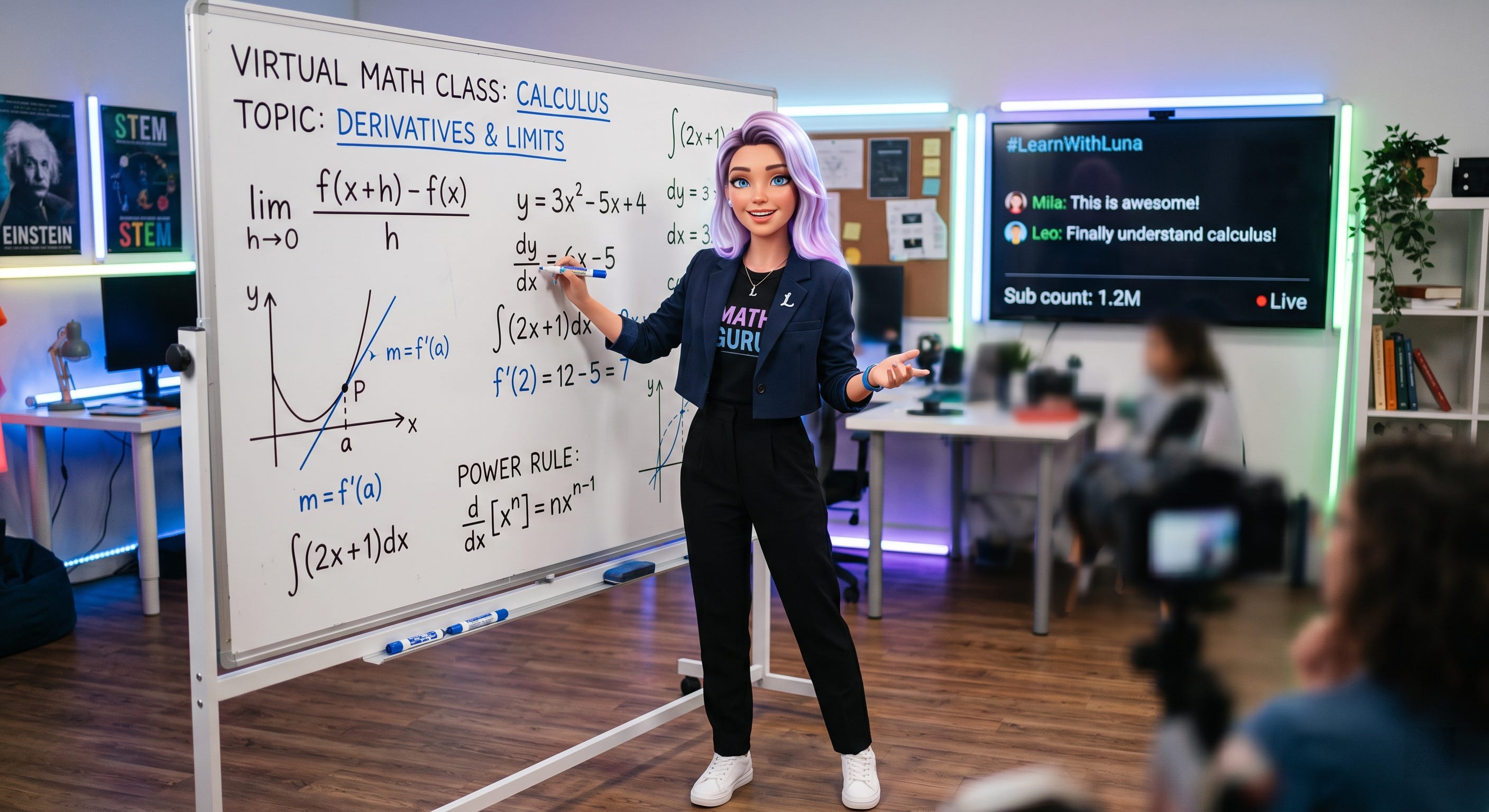
That stranger is the modern influencer, and most parents have not just allowed the visit — they have handed over the keys, the schedule, and the algorithm that decides which stranger shows up next. The reflex defense is that this is simply what kids watch now and you cannot fight it. That was true eighteen months ago. It is not true anymore. As of this spring, a parent with a mid-range gaming PC can produce broadcast-quality video starring a character they designed, saying exactly what they want it to say, for free. The babysitter can finally be fired and replaced with someone you actually trust: you.
What the feed is actually selling
Start with the scale of the thing, because the numbers are the only part of this debate nobody disputes. Influencer marketing was a roughly $1.7 billion sideshow in 2016. It is on track to clear $32 billion this year. The entire machine runs on one psychological mechanism — the parasocial relationship, the one-sided bond a viewer forms with a face on a screen that feels like a friend. For an adult that bond is a marketing vulnerability. For a child whose prefrontal cortex will not finish wiring until their mid-twenties, it is an open vault.
Children are not incidental to this economy. They are the growth segment. Recent survey work on the so-called Gen Alpha cohort, kids roughly four to fifteen, found that while fewer than one in five have their own social accounts, about a third actively follow influencers, streamers, and YouTubers, usually through a parent-supervised login that the parent has stopped supervising. The same children report that influencer content drives their household purchasing more than any other category in food and snacks, where roughly seven in ten admit the videos shape what the family buys. This is not a coincidence. A body of peer-reviewed work going back years shows that exposure to food and beverage cues in influencer videos directly moves children’s immediate brand choices and consumption toward products high in fat, salt, and sugar. The researchers were blunt about the conclusion: kids’ exposure to this marketing should be reduced, full stop.
Then there is the highlight reel of who, specifically, your child’s feed elevates. Brian Johnson, the “Liver King,” built a $100-million supplement empire on six million followers by insisting his physique came from eating raw organs and living an “ancestral” life. Leaked emails revealed he was quietly spending around $11,000 a month on anabolic steroids and human growth hormone to maintain the body he sold to insecure young men as natural and achievable. Belle Gibson constructed a wellness empire on the claim that she had cured her own terminal cancers with food and rejected medicine, steering desperately ill followers away from treatment; she never had cancer, the charity donations she bragged about never happened, and an Australian court fined her roughly $311,000. Kim Kardashian paid the SEC over $1.26 million for touting a speculative crypto token to her audience without disclosing the quarter-million-dollar check she got for the post. Logan Paul used a podcast with millions of subscribers to pump a crypto project called CryptoZoo that he compared favorably to Pokémon; followers poured in life savings, one young man borrowing the equivalent of tens of thousands from his father, and the playable game never materialized.
The physical-world cases are worse because there are bystanders. Trevor Jacob, a YouTuber and pilot, deliberately crashed a single-engine airplane into a national forest to fuel a sponsored video for a wallet company, then lied to federal investigators and destroyed the wreckage; he served six months in federal prison. Tanner Cook, who ran a “prank” channel built on accosting strangers for content, was shot in the stomach at a Virginia mall by a DoorDash driver who testified he felt trapped and threatened. A jury acquitted the shooter. This is the talent pool. These are the people an engagement-maximizing algorithm has decided deserve four hours of your child’s developing attention, because escalation, deception, and danger are precisely what the watch-time metric rewards.
And that is before the slow damage, the kind that does not generate a court case. The clinical literature on adolescent body image is no longer ambiguous. Heavy use of image-based platforms is strongly associated with body dysmorphic symptoms, and a controlled intervention summarized by the American Psychological Association found that teens who simply cut their social media use roughly in half for a few weeks showed measurable improvement in how they felt about their own bodies and appearance. The mechanism is social comparison running twenty-four hours a day against a stream of filtered, surgically enhanced, professionally lit human perfection. The product being sold, underneath the teas and tokens, is your child’s dissatisfaction with their own face.
The “AI influencer” pitch is a trap, and you should know why before you trust me
At this point the marketing industry steps forward with what it frames as the cure. Replace the unstable human with a synthetic one. Lil Miquela, a computer-generated nineteen-year-old, has more than two million followers and has charged up to $10,000 a post for Prada and Calvin Klein. Aitana Lopez, a pink-haired virtual model built in Barcelona, was created explicitly because her makers were sick of the “diva behavior” of human talent, and she now pulls tens of thousands of euros a month. Brazil’s Lu do Magalu has north of nine million followers. The corporate case writes itself: no scandals, no steroids, no arrests, no demands for a raise, available around the clock, controllable to the pixel.
I want to be straight with you, because the easy version of this article would stop there and tell you the robots are wholesome. They are not. The same research that documents the human grift documents the synthetic one. Because a virtual influencer is engineered, A/B tested, and optimized purely to maximize the dopamine response of whoever is watching, it is free of the one constraint that limits even the worst human model: a skeleton. Aitana and her kind present a standard of beauty that is not merely enhanced but biologically impossible, which makes the body-dysmorphia problem worse, not better. The deception is also total rather than partial. When a synthetic persona posts about a social cause or a personal “struggle,” there is no person there at all, only a marketing team optimizing engagement and risking nothing. And the grift has already migrated: investigators have found dozens of sellers using fully AI-generated personas to push cheap dropshipped junk, including one synthetic woman scripted to use racially manipulative language purely to juice the algorithm’s retention metric. The corporate AI influencer does not eliminate the scam. It automates it and runs it at a thousand times the volume.
So if the argument were “human influencers bad, AI influencers good,” you should reject it, and so would I. That is not the argument. The variable that actually determines whether a piece of media helps or harms your kid was never whether the face on the screen is made of carbon or pixels. The variable is who holds the editorial controls and what they are optimizing for. Lil Miquela and the Liver King are the same product with different rendering pipelines, because both are optimized by a stranger to extract value from your child. The interesting question is what happens when the person holding the controls is the one person in the world optimizing for the child’s wellbeing instead of their watch-time.
Seize the means of production
Until very recently this was a fantasy, because making convincing video required a studio, a budget, and a team. That barrier is gone. The same generative-video technology that lets ByteDance and a Barcelona agency print synthetic supermodels now runs on hardware a hobbyist already owns. The move is not to find a better influencer for your kid to follow. The move is to become the showrunner — to design a recurring character your child likes, control every word it says, and let it teach, reassure, and entertain on a curriculum you set rather than one an ad exchange sets.
Picture what that actually looks like on a Tuesday night. Your daughter is stuck on fractions. Instead of handing her a tablet that will autoplay her toward an appetite-suppressant ad inside ninety seconds, you spend ten minutes generating a short, bright video in which a friendly character she has seen before walks through tonight’s exact homework set, in plain language, with no product placement, no manufactured insecurity, and no algorithm waiting to serve her the next stranger. The character can be silly, can be calm, can speak Spanish and English, can be the same trusted face every night so the format itself becomes a comfort. None of this requires a film crew. It requires an afternoon of learning two tools.
The toolkit, concretely
For most parents, the fastest on-ramp is Seedance 2.0, ByteDance’s current flagship video model, available through several web front ends without a single line of code. It is multimodal, which is the feature that matters here: you feed it text describing the scene, reference images of the character you want to keep consistent, and even reference audio, and it returns cinematic clips up to about fifteen seconds at 1080p with synchronized sound and dialogue. The key word is consistent. You can lock a character’s face and let them recur across dozens of clips, which is exactly what you need to build a familiar, recurring presence rather than a stream of random strangers. The tradeoff is that Seedance lives on someone else’s servers, runs on credits, and applies its own content rules, including blocks on real human faces, so it is best treated as a fast, polished, hosted option rather than a private one.
For parents who care about privacy, cost, and control — and if you are reading this far, you do — the better long-term answer is to run the whole pipeline yourself on open-source software. ComfyUI is a free, node-based studio for generative media, and Lightricks released LTX-2.3 in March of this year as an open-source audio-and-video model with day-zero support inside ComfyUI. This is the part that genuinely changes the equation: LTX-2.3 ships with a desktop editor designed to run the entire model locally on consumer hardware. Your prompts, your child’s homework, your character designs, and the finished videos never leave the machine in your house. Nothing is uploaded, nothing is logged by a vendor, nothing is fed back into a training set or an ad profile. The model produces synchronized audio and video, supports image-to-video so you can animate a still you drew or generated, and even includes a lip-sync component that can make a character say new lines or speak in another language while keeping the same voice. The startup cost is a weekend of setup and a graphics card with enough memory; the marginal cost of every video after that is essentially the electricity.
The honest division of labor is this. Use the hosted tools when you want something polished in ten minutes and do not mind a vendor in the loop. Use the local ComfyUI and LTX-2.3 stack when you want a private, permanent, no-subscription studio that answers to no one but you. Either way, the thing you are buying back is the editorial control that the influencer economy spent a decade taking from you for free.
Two guardrails, because a tool is not a parent
If this only persuades you to swap one screen-shaped babysitter for a homemade one, I have failed and so have you. Two limits keep this honest, and both come straight out of the same research that condemns the influencers.
First, do not rebuild the things that made the feed toxic. The whole point of designing your own character is that you are no longer optimizing for engagement, so do not quietly start. Resist the temptation to make the character impossibly beautiful, endlessly available, or emotionally needy in a way that pulls the child back for more. The body-dysmorphia literature does not care whether the impossible face is a human influencer’s or one you generated; an unattainable standard is an unattainable standard. Keep your character stylized, ordinary, sometimes plainly cartoonish, and switch it off when the lesson is over.
Second, and more important, this is a curation and teaching tool, not a relationship. There is a fast-growing body of work — including research presented at this year’s major human-computer interaction conference, and warnings from child-safety researchers — showing that children and teens can form intense one-sided attachments to responsive AI characters, and that those bonds carry real developmental risk precisely because the AI answers, adapts, and is always there in a way a book character or a parent cannot be. A homework video your child watches and then leaves is healthy media. A synthetic friend your child confides in instead of confiding in you is the same parasocial trap you were trying to escape, just with better production values and your own fingerprints on it. Build the character to be obviously a character. As your child gets old enough to understand, tell them you and a computer made it. The goal is not to fool them more cleverly than the influencers did. The goal is to put a literate, skeptical adult — you — back in charge of what crosses the screen.
The actual choice
The debate has been framed for years as real versus artificial, human authenticity versus algorithmic fakery, and that framing is a distraction that benefits everyone making money off your children. Both of the options the market offers you are optimized by strangers to extract value from a developing brain. The Liver King and Lil Miquela are the same business model. The only meaningful axis is whether the person deciding what your kid sees is a watch-time algorithm in a server farm or the person who knows what they ate for breakfast and what they are afraid of.
For the entire history of mass media, seizing those controls required a studio you could not afford. As of this spring, it requires a graphics card and a free download. That is the whole argument. Stop renting your child’s attention to the most reckless, most deceptive, most relentlessly optimized strangers the internet has ever produced. Fire them. Then go build something better, because for the first time, you actually can.