


Every so often a CEO says something out loud that the rest of the industry has agreed, by silent consensus, never to admit. Last week Aaron Levie did it twice.
Levie runs Box. He has run it since 2005. He is not a skeptic, a doomer, or a man with a grudge against the technology — he is an active angel investor in AI startups and posts a steady stream of optimism to nearly three million followers. Which is exactly what made the post land. On May 24 he wrote that CEOs are “uniquely prone to AI psychosis” because they are sufficiently distant from the last mile of work that still has to happen to generate most of the value. When an executive plays with a model, Levie said, they see the “happy path” — the clean demo, the slick first draft — and never the next ten or twenty things that have to go right before any of it is worth money.

His example was almost cruelly specific. A founder builds an impressive product prototype with an AI chatbot and comes away convinced the work is essentially done. “Yes,” Levie answered, “but you didn’t have to review the code before it went into production and fix a bunch of issues.” That single sentence is the entire argument of this piece, and it is the most honest thing a public-company CEO has said about AI in two years.
Because here is the uncomfortable part. He is not describing some other guy. He is describing the median tech CEO of 2026 — the one who spent a weekend vibe-coding a working demo, walked into Monday convinced his engineers had been overcharging him for a decade, and started drafting the layoff memo. The receipts are not subtle. In the first five months of 2026 the tech industry has already let go roughly 115,000 people across 152 companies, closing in fast on the 124,000 cut across all of 2025 — a pace that puts the year on track to be the worst since the dot-com bust. And nearly every one of those press releases cites the same justification: AI made us more efficient, so we need fewer of you.
Levie is calling that posture what it is. Not strategy. A clinical-grade misreading of what the technology can actually do. I want to give him the credit he’s owed, and then I want to take his argument somewhere the quote-tweets didn’t: the math actually runs the other way. The companies firing people because the CEO built a prototype are going to shrink. The companies that understand the last mile are going to hire.
The Happy Path Is a Liar
Anyone who has actually shipped software for money knows the gap Levie is pointing at, because they live in it. A model can generate a convincing first pass at almost anything. It cannot tell you that your filtered count and your paged result set disagree under concurrency, that your cache will stampede the first time three requests miss the same key at once, or that the elegant function it just wrote calls a library that does not exist. The demo runs. The demo always runs. The demo is the cheapest, easiest, most seductive five percent of the work, and it is the only five percent a CEO ever sees.
I build this stuff. I’ve spent the last year shipping MCP servers, agentic orchestration layers, and the unglamorous plumbing underneath them — stored procedures, cache layers, the IPv6 edge case nobody thinks about until production traffic finds it. Every one of those systems demoed beautifully in an afternoon. Every one of them then took weeks of the real work: the count-versus-filter mismatch, the stampede under load, the tool-call format that one model family honors and another silently mangles. None of that shows up in the happy path. All of it shows up in production, which is the only place that pays.
If that sounds like a practitioner’s grievance rather than a measurable phenomenon, the data has caught up to the anecdote. In a randomized controlled trial published by the nonprofit METR, sixteen experienced open-source developers worked through 246 real tasks in codebases they’d averaged five years inside. They forecast that AI tooling would speed them up by about a quarter. After finishing, they still believed it had sped them up by about a fifth. It had in fact slowed them down by nineteen percent. The code quality was no worse; they just spent the gains, and then some, reviewing and repairing what the model produced — including chasing down calls to libraries that didn’t exist. The most damning finding wasn’t the slowdown. It was that even after experiencing it firsthand, the developers couldn’t feel it. The perception of acceleration survived contact with the reality of deceleration.
Now scale that perception gap up to the corner office, where the person holding it has never had to merge the pull request. That is the psychosis Levie is describing. It isn’t stupidity and it isn’t even hype, exactly. It’s a structural blindness: the higher you sit, the more of your day is spreadsheets, decks, and Zoom calls, and the less of it is the friction-heavy concrete labor where AI’s limits actually live. From the top floor the happy path looks like the whole journey. It is a liar, and distance is what makes the lie believable.
Where Pilots Go to Die
If the prototype-to-product gap were just a developer-ergonomics quibble, you could wave it off. It is not. It is the single biggest line item in the great enterprise AI disappointment, and there is a now-famous number attached to it. MIT’s NANDA initiative studied the state of AI in business across more than three hundred public deployments, dozens of executive interviews, and well over a hundred leader surveys. Despite somewhere between thirty and forty billion dollars in enterprise spending, ninety-five percent of generative-AI pilots delivered no measurable impact on the bottom line. Five percent made it to production with value you could actually point to.
Read the funnel and Levie’s last mile is sitting right there in the attrition. Roughly eighty percent of organizations were exploring AI tools. About sixty percent got as far as evaluating enterprise-grade systems. Twenty percent launched a pilot. Five percent put something live that mattered. The drop-off doesn’t happen at the demo — the demo is where everyone succeeds. It happens in the long, expensive, deeply human stretch between “look what it can do” and “this survives real customers, real data, real edge cases, and real liability.”
And the researchers were emphatic about the cause. The failures were not about model quality. Executives love to blame the model, or regulation, or their own people for being too slow. The actual culprit was integration — what MIT called the learning gap, the work of wiring a generic capability into the specific, idiosyncratic, contradictory machinery of an actual business. Large enterprises ran the most pilots and took around nine months to scale the rare survivor; nimble mid-market firms did it in roughly ninety days. The bottleneck was never the intelligence. It was everything that has to happen around the intelligence, performed by people who understand the business well enough to make a general-purpose tool behave in a specific context.
Here’s the detail that should reframe the whole layoff conversation. The teams that landed in the winning five percent didn’t win by having a smarter model — everyone has the same models now. They won by picking one painful problem, executing on it relentlessly, and partnering closely with the people who’d actually use the thing. The MIT lead author described startups run by nineteen- and twenty-year-olds going from zero to twenty million in revenue in a year by doing exactly that. That is not a story about automation replacing humans. It is a story about humans, armed with AI, out-executing the field. The leverage is real. It just lives in the hands of people doing the last mile, not in a memo from someone who has never seen it.
The Klarna Tax
We don’t have to theorize about what happens when a CEO mistakes the prototype for the product and acts on it. We have a flagship case study, executed in public, by a company that wanted everyone watching.
Klarna replaced roughly seven hundred customer-service agents with an OpenAI-powered chatbot and told the world the bot was doing the work of seven hundred — later eight hundred — full-time people. The CEO, Sebastian Siemiatkowski, framed it as the future and put numbers on the savings. For a while it was the canonical proof that AI could simply delete a department. Then the quality cratered, customers noticed, and the company started quietly rehiring humans. Siemiatkowski’s own postmortem was blunt: cost had been “a too predominant evaluation factor,” the result was “lower quality,” and that, he admitted, was not sustainable. The man who wanted to be OpenAI’s favorite guinea pig ended up telling Bloomberg that the brand needed customers to know there would “always be a human if you want.”
This is the Klarna tax. You don’t avoid the last mile by firing the people who run it; you just defer the bill, with interest, in the form of churned customers and a humiliating reversal. And Klarna isn’t a freak event — Gartner has projected that half of the companies that cut customer-service headcount for AI will be rehiring by 2027. The pattern is so reliable it’s practically a forecast. Cut the humans who close the gap between “the model answered” and “the customer was actually helped,” and the gap doesn’t close. It just becomes someone else’s problem, usually the customer’s, and eventually the shareholders’.
The Math CEOs Refuse to Do
This is where Levie’s second post — the one that ran almost unnoticed under the psychosis headlines — matters more than the first. Because diagnosing the delusion is the easy half. The hard half is explaining why the delusion is also bad business, and on this he is precise.
In the majority of his conversations with CIOs, CTOs, and CEOs at large enterprises, Levie wrote, companies are either “growing due to AI” — adding net-new roles like forward-deployed engineers and more engineering generally — or, at minimum, reinvesting their efficiency savings back into growth areas like sales and marketing. He put the through-line in one line that every executive drafting a layoff memo should be made to read aloud: the companies that better serve their customers win over the long run, and the ones that just chase savings end up doing worse.
Sit with the logic, because it’s the opposite of the reflex. For most of history a company’s ambitions were capped by the fixed cost of a team. You wanted to build the software, automate the lab, run the campaign, chase the smaller customer — and then you looked at what a competent team costs and you cut the project. AI doesn’t remove the need for that team. It makes each member of it dramatically more capable. Levie’s own framing, from an earlier thought experiment, is that an engineer is now two to five times as productive as before. So the question isn’t “how few engineers can I get away with.” It’s “now that each engineer is worth several times what they were, how many more profitable projects can I finally afford to staff?” In nearly every conversation he has, he said, companies are choosing expansion over contraction.
The CEO firing his team has answered that question backwards. He has taken a tool that multiplies the value of a skilled person and used it as a reason to have fewer skilled people. It’s the equivalent of inventing the power loom and laying off the weavers — except the weavers were the only ones who knew which threads would hold. He banks a one-time cost saving, ships degraded output, and watches a competitor who kept their people — and handed them the same models — out-build and out-serve him into the ground. Efficiency that isn’t reinvested into serving customers better isn’t a strategy. It’s a slow liquidation with a press release attached.
And to Levie’s enormous credit, he isn’t theorizing from the cheap seats. Box is hiring for exactly the role his thesis predicts: AI business automation engineers, paid well into six figures, whose entire job is the last mile — embedding agents into the guts of Salesforce, Workday, and Box itself, wiring general capability into specific systems. That is a forward-deployed engineer by another name, and it is a net-new headcount that exists only because AI exists. The technology didn’t eliminate the job. It created one that pays more than the job it supposedly replaced.
The Way Forward Runs Through Your People
So here is the part the delusional crowd will hate, addressed to the technical executives who still have a choice to make.
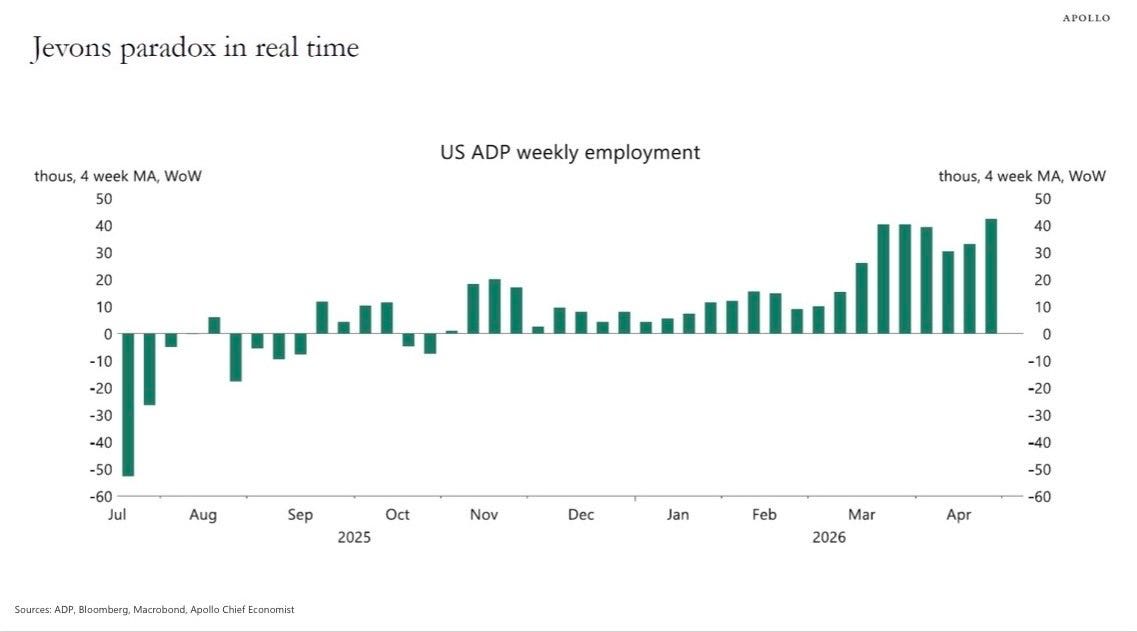
The way to win with AI is to hire more people and make them radically better at their jobs — not to fire people because you built a prototype. That’s it. That’s the whole playbook, and it is boring precisely because it is correct. Take the leverage the models give you and point it at growth: the projects you could never afford to staff, the customers you could never afford to serve, the bottlenecks downstream that get worse, not better, when the stage before them suddenly produces ten times the output. AI is extraordinary at going from zero to one. It will build you the prototype that gets you funded, the draft that gets the conversation started, the scaffold that would have taken a week. It is not, in any current enterprise sense, capable of going from one to the product — the durable, paid-for, edge-case-surviving thing — without skilled humans owning the last mile. Confusing the two is the psychosis. Staffing the difference is the strategy.
Be honest about what that costs and you arrive somewhere useful. Audit your real bottlenecks instead of your headcount. Hand your best people the strongest models and the time to learn where they help and, just as important, where they quietly slow you down — because if your engineers can’t feel a nineteen percent slowdown, your VP of efficiency certainly can’t see it from a dashboard. Treat integration as the job, not the afterthought; the five percent who made it to production didn’t have better models, they had better execution and stayed close to the people who’d use the thing. Reinvest the savings into serving customers, because that’s the only place durable advantage has ever come from. And use AI yourself, constantly, the way Levie advises — not to confirm that you can finally fire everyone, but to develop an appreciation for both the upside and the genuine, grinding work that turns the upside into revenue.
There’s a comfortable counter-narrative, of course, and it has famous backers. Vinod Khosla figures AI could be doing eighty percent of all jobs by 2030. Dario Amodei has warned that half of entry-level white-collar work could evaporate inside five years. Those are real forecasts from serious people, and maybe the curve eventually bends their way. But forecasts about 2030 are not a license to misread 2026, and the 2026 evidence is lopsided: ninety-five percent of pilots stalling on integration, experienced developers measurably slowed by the tools they swear are speeding them up, Klarna and its peers rehiring the humans they bragged about cutting. The bull case for mass replacement is a bet on a future model. The bull case for hiring is a description of the present one.
Levie called his peers delusional and they mostly laughed, retweeted, and went back to their layoff memos. That’s the tell. The CEOs who hear “you don’t understand the last mile” and treat it as an insult are the ones who are about to learn what it costs. The ones who hear it as a roadmap — use the leverage, keep the people, point both at the customer — are the ones who’ll still be standing when the agents finally do start doing the work. The prototype was never the product. The people who know the difference were never the expense. They were always the moat.
About the Author
Gal Ratner is a software architect and entrepreneur with more than thirty years on the Microsoft and .NET stack. He is Chief Architect at Prana Entertainment and the founder and CTO of Inverted Software and WhiteStar Labs, where his current work centers on agentic AI, MCP servers, and the unglamorous integration layer where most enterprise AI projects actually live or die. He was the sixth employee at Break.com and has delivered enterprise projects for Microsoft, Sony, Yahoo, Best Buy, Rockstar Games, 2K Games, and Allegiant Air. He writes about technology and the people who build it at galratner.com and on LinkedIn at linkedin.com/in/galratner.