


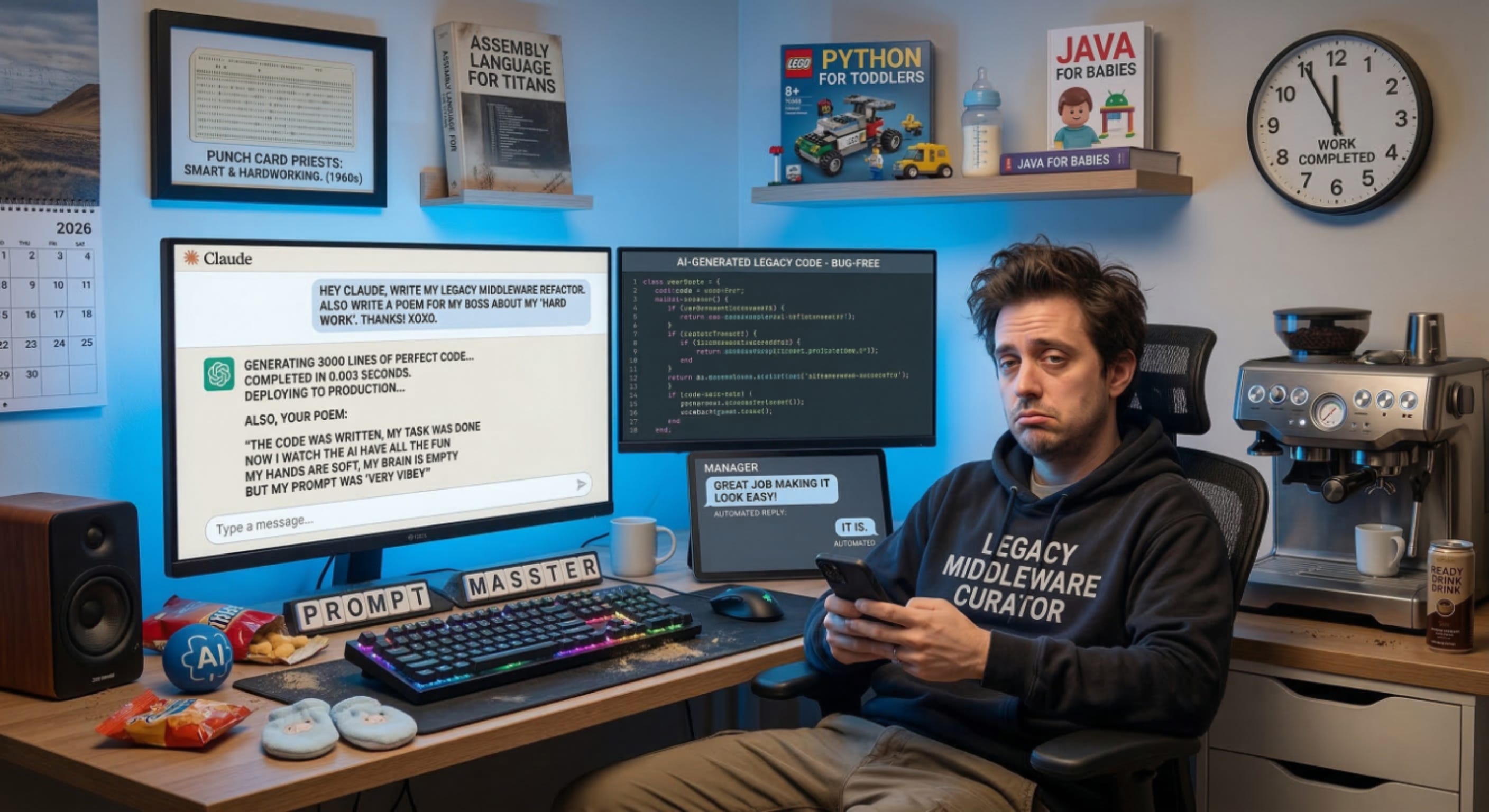
The morning commute in 2026 consists of a ten-foot trek from the espresso machine to the ergonomic chair—a chair designed for a person who actually moves their muscles, which I haven’t done since the Claude-3.5-Sonnet-Ultra release. My workstation glows with the soft, blue light of a dozen empty terminal windows, each a digital cenotaph to a profession that once required a brain.
I open my chat interface. This is “programming” now. I don’t write syntax; I write polite suggestions to a god-tier algorithm. “Hey Claude,” I type, my wrists feeling the phantom strain of years spent writing Python, a language so simple it’s basically a coloring book for adults. “Can you refactor the legacy middleware to handle the new edge case, and maybe write a poem about it so I feel like I contributed something creative?”
As the AI begins its effortless, millisecond-long labor, I find myself thinking of the High Priests of the 1960s. Those were the real programmers. They didn’t have “GitHub Copilot.” They had punch cards—rectangles of cardboard that held the fate of multi-million dollar mainframes. If you dropped your stack, your career was over. They spoke Assembly, a language that required you to understand the very vibration of electrons within the silicon. They were the smartest people on the planet because their job was impossible for anyone else. They were architects of the invisible, building cathedrals of logic with nothing but a slide rule and a death wish.
Then came the C++ generation—the “rugged” outdoorsmen of the 1990s. They managed their own memory, which is the software equivalent of hunting your own food. It was difficult, messy, and prone to “segmentation faults” that could leave you weeping in a cubicle at 3:00 AM. They were the last line of defense against the softening of the American mind.
But we didn’t stop there. We wanted it “easier.” We created Java and Python—the “participation trophies” of computer science. If you code in Python, you aren’t a programmer; you’re a person who knows how to use an incredibly sophisticated Lego set where all the pieces are already stuck together. We made the job so accessible that we accidentally let the door swing wide enough for the AI to walk in. We replaced the rigorous intellectual discipline of memory management with “Garbage Collection,” and now, fittingly, the AI is here to collect the rest of us.
By 10:30 AM, my “work” for the day is complete. The AI has generated three thousand lines of pristine, perfectly commented code. It has checked its own work, deployed the update, and even sent a Slack message to my manager using my exact linguistic tics, including my habit of overusing the word “robust.”
There is a profound, biting irony in our trajectory. We spent seventy years perfecting the art of the shortcut. We built higher and higher abstractions, desperately trying to shield ourselves from the “difficulty” of the machine. We worked tirelessly to make programming so intuitive, so automated, and so frictionless that a toddler—or a sufficiently advanced chatbot—could do it.
And we succeeded. We made the job so easy that it no longer requires a human being.
I spend the rest of my day “monitoring” the AI, which is a professional euphemism for scrolling through social media while the machine does my thinking for me. I am a curator of someone else’s intelligence. I am the “Human in the Loop,” a title that sounds suspiciously like “the guy who stands next to the self-checkout to make sure people don’t steal the bananas.”
I look at my hands. They are soft. I haven’t seen a compiler error that I actually had to fix myself in six months. I am the apex of a civilization that optimized itself into obsolescence.
At 4:00 PM, my manager—who is also likely just three prompts in a trench coat—pings me. “Great work today. You’re making this look easy.”
“It is,” I reply, realizing too late that that was the one thing I was never supposed to admit.