


Let me be direct: there is a coordinated, well-funded campaign to convince you that a Mac is a better computer than a Windows 11 PC. It involves free hardware, sponsored content disguised as “honest reviews,” and the stubborn myth that paying a premium price signals superior quality. It is, at its core, a marketing operation — and it is working on a staggering number of otherwise intelligent people.
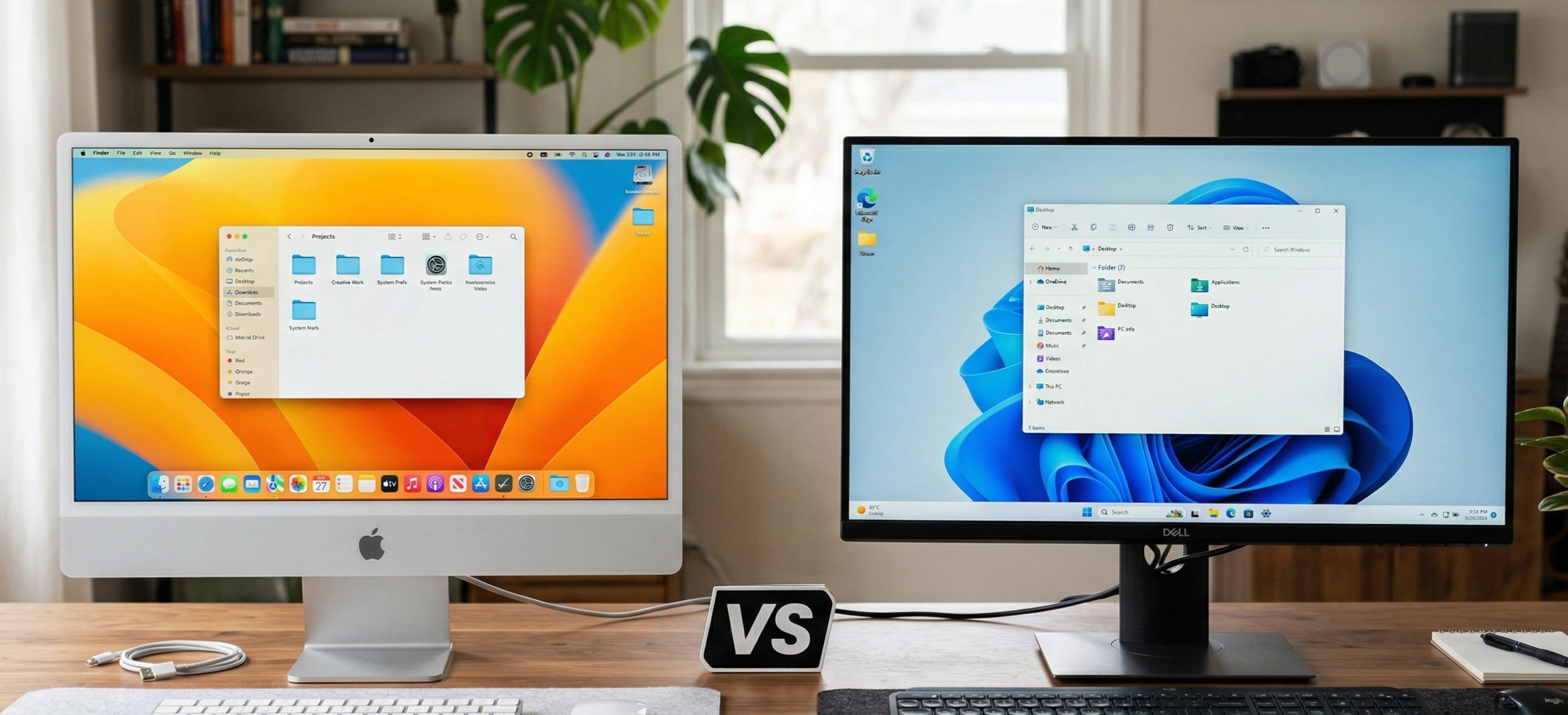
The latest chapter in this saga is almost satirical. Across YouTube, a fresh wave of videos has appeared praising the new Mac Neo — a machine that ships with 8 gigabytes of unified memory as its base configuration. Eight. Gigabytes. In 2026. Reviewers who received these machines for free are calling it transformative, revolutionary, the future of personal computing. Google Chrome alone will consume that RAM like an appetizer. But the checks cleared, the laptops arrived in their beautiful packaging, and here we are.
I want to do something most of those videos will not: go through what an operating system actually needs to do — feature by feature — and compare Windows 11 and macOS honestly, with facts. Then we will talk about what Apple is selling you and why the truth of the matter is more embarrassing for them than they would like.
The Influencer Problem: When Free Hardware Buys Favorable Reviews
YouTube’s tech review ecosystem has a dirty secret that nobody openly discusses. Apple does not just send review units to journalists — it runs a sustained gifting program aimed at mid-tier and large creators whose audiences skew toward purchase decisions. The playbook is simple: provide the hardware for free, establish a relationship, repeat for every product cycle. No explicit contract is needed. The psychological mechanism of reciprocity does the rest.
The result is a content environment where the same creators who would eviscerate a Windows laptop for shipping with 8GB of RAM will spend twelve minutes explaining why Apple’s “unified memory architecture” makes 8GB equivalent to 16GB of conventional RAM. This claim, repeated ad nauseam across hundreds of videos, is not supported by independent benchmarks under real workloads. It is marketing language that migrated directly from Apple’s press release into creator scripts without meaningful scrutiny.
To be fair: not every positive Mac review is paid for. Some people genuinely prefer macOS, and that preference is legitimate. But when a product receives uniformly glowing coverage from dozens of creators who all received free units within the same week, you are not watching organic enthusiasm. You are watching a distribution campaign.
Round 1: Multitasking and Window Management
This is where the conversation should end, but almost never does, because it is so damaging to Apple’s narrative. Windows has had robust, native window snapping and tiling since Windows 7. Windows 11 elevated this with Snap Layouts — a system that lets you organize any number of windows into predefined grid configurations instantly, from the taskbar hover, without any third-party software.
macOS, in 2026, still cannot natively display two full application windows side by side, with their complete menu bars visible, without resorting to Stage Manager (which most professionals despise), third-party tools like Magnet or Rectangle (which cost money), or entering a split-view mode that hijacks the entire screen and hides the menu bar.
Let that sink in: Apple’s desktop operating system, in its current version, cannot show two standard application windows simultaneously without degrading the user experience in some meaningful way. This is not a minor inconvenience. For anyone doing research, writing, development, or financial work — anyone who needs two windows open and operational at the same time — this is a fundamental productivity failure.
Windows 11 wins this category completely and it is not close.
Round 2: Hardware Compatibility and Ecosystem Openness
Windows 11 runs on hardware from hundreds of manufacturers across every price point on earth. You can buy a capable Windows machine for under $400 or build a workstation with 192GB of RAM and dual professional GPUs. You can replace any component, upgrade your storage, swap your RAM, and extend the life of your hardware for years. The platform is open by design.
Apple’s ecosystem is a closed loop with a velvet rope. You buy what Apple makes at the price Apple sets. Until recently, RAM was soldered to the motherboard. Storage is soldered. The “M-series chips” are remarkable silicon — genuinely impressive engineering — but they come with a ransom note attached: want more memory? Buy the next tier up. There is no upgrade path. There is only the purchase path.
The Mac Neo ships with 8GB of unified memory. A Windows machine at the same price point ships with 16GB minimum, often 32GB, and that RAM can be upgraded or replaced at any time. The idea that a $600 machine with 8GB of non-upgradeable memory represents “the future of computing” is something only a gifted marketing department — or a creator who received one for free — could say with a straight face.
Round 3: Gaming
This one requires almost no elaboration. Windows 11 is the gaming platform. Full stop. The entire PC gaming ecosystem — Steam, Epic Games Store, Xbox Game Pass, virtually every title released in the last three decades — runs on Windows. DirectX 12 Ultimate, hardware ray tracing, DLSS, FSR, frame generation: all of it exists on Windows.
macOS gaming is a rounding error. Apple introduced Metal and has made noise about gaming in recent keynotes, but the library is a fraction of what Windows offers, AAA titles arrive late or not at all, and performance in the titles that do run is consistently lower than comparable Windows hardware. If you game, there is no serious conversation to be had here.
Round 4: Software Availability and Professional Tooling
Windows 11 runs the broadest software library of any desktop operating system. Enterprise software, industry-specific applications, legacy tooling, government systems, CAD software, ERP systems, scientific computing environments — the overwhelming majority of professional software is written for Windows first, or Windows exclusively.
macOS has genuine strengths in creative professional software — Final Cut Pro, Logic Pro, and the broader Apple creative ecosystem are excellent products. If you are a musician, video editor, or photographer working entirely within Apple’s walled garden, the platform serves you well. But outside of that lane, Windows is the universal platform. Software vendors do not need to support macOS. They nearly always need to support Windows.
Windows 11 also runs virtualization, Docker, WSL2 (the Windows Subsystem for Linux), and .NET natively with full enterprise support. Developers building for enterprise environments live in a Windows-native or Windows-compatible world by necessity, not preference.
Round 5: Security and Enterprise Management
Windows 11 ships with BitLocker, Windows Hello, TPM 2.0 requirements, Microsoft Defender (which has become genuinely excellent), and deep integration with Active Directory, Azure AD, Intune, and every enterprise MDM and security toolchain in existence. Managing a fleet of Windows devices at scale is a solved problem with decades of tooling, documentation, and institutional knowledge behind it.
macOS security is solid at the consumer level. At the enterprise level, it is manageable but expensive and comparatively immature. Apple Business Manager and third-party MDM tools have improved significantly, but the ecosystem of enterprise security tooling, compliance frameworks, and institutional deployment experience remains Windows-centric by an enormous margin.
The notion that macOS is categorically “more secure” than Windows — a claim repeated endlessly in influencer content — was perhaps defensible a decade ago when macOS obscurity provided some protection. In 2026, macOS malware is real, macOS vulnerabilities are regularly disclosed, and the security gap between the two platforms has narrowed dramatically. Windows 11’s security architecture is enterprise-grade by default.
Round 6: Customization, Control, and the User’s Autonomy
Windows gives you control over your machine. You can modify the registry, install unsigned software, customize virtually every visual and behavioral element of the operating system, run the software of your choosing without gatekeeping, and configure the system to an extraordinary degree of specificity. Power users have always lived on Windows for exactly this reason.
macOS is opinionated by design. Apple decides what the interface looks like. Apple decides what software is permissible. Apple’s Gatekeeper actively resists running software from outside the App Store. The system is designed to be used Apple’s way. For many users, that opinionated simplicity is genuinely appealing — but let us not pretend it represents superior capability. It represents superior control by Apple over your experience.
The Core Truth Apple Does Not Want Discussed
Here is the foundation that none of the sponsored content will address directly: macOS is a Unix-based operating system with a lineage that traces through NeXTSTEP, through BSD, to the foundational Unix work of the late 1960s and early 1970s. That heritage is real and it has genuine technical merits for certain workloads.
But it also means that Apple’s desktop operating system is built on an architectural foundation that predates the personal computer. The window management model, the menu bar paradigm, the application model with its persistent menu bar anchored to the top of the screen — these are design decisions that date back to the original Macintosh in 1984, which were themselves inherited from Xerox PARC research from the 1970s. Apple has iterated on top of this foundation, sometimes brilliantly, but the foundation itself has not fundamentally changed.
This is why, in 2026, you still cannot show two full windows with their menus at the same time without workarounds. The single-menu-bar design — where the menu bar always belongs to the frontmost application — was a reasonable decision for 1984 single-tasking environments. It is an anachronism on a modern multi-monitor workstation. Windows solved this problem by giving each window its own controls and menu, which is the correct answer for a multitasking operating system, and it did so decades ago.
Apple has built an extraordinary marketing machine on top of a legacy architecture and premium hardware. The M-series silicon is genuinely impressive. The build quality of Mac hardware is excellent. The macOS aesthetic is polished. These are real advantages in specific contexts.
But they do not justify the claim that Mac is categorically superior for most users. And they do not change the fact that a coordinated influencer campaign is sending free computers to creators specifically to generate content framing 8GB of soldered RAM as acceptable in premium hardware.
Conclusion: Hardware Gifts Do Not Change Hardware Facts
Send a hundred creators a free laptop and you will get a hundred videos explaining why it is revolutionary. That is not a technology story. That is an advertising story.
The actual technology story is this: Windows 11 is a mature, capable, open, customizable, enterprise-ready operating system that runs on the broadest hardware ecosystem in the history of personal computing. It handles multitasking correctly. It runs virtually all professional software. It serves enterprise environments at scale. It supports gaming comprehensively. And it lets you buy upgradeable hardware at every price point.
macOS is a beautiful, well-engineered, opinionated operating system that excels in specific creative professional contexts, runs on impressive but sealed and non-upgradeable hardware, still cannot manage two windows properly without third-party help, and has built its premium reputation as much on aesthetics and marketing as on objective capability.
You can prefer macOS. That is a completely legitimate preference. But the next time you watch a glowing review from a creator who received a free unit, ask yourself: would this video exist without the gift? And would the conclusion be the same?
— Gal Ratner is a CTO and software architect with 30+ years of experience building enterprise platforms. He writes about technology, AI, and the industry’s recurring failure to be honest with itself.
I understand why a software developer or a gamer would say this, and it’s true: in terms of “compute” per dollar, Macs are slower and more expensive. The stuff about multiple applications running in native mode, blah-blah. I’m a retired tech writer, I’ll take your word for it. But when I switched from Windows machines to a Mac about 25 years ago, it felt like being released after 20 years of unjust imprisonment. Mac OS (9 and everything since then) just… thinks and works the way I do. Windows gets in my way and interferes with my workflow. The Mac’s OS and overall UX works the way I expect it to do and lets me get to it. Can’t really put it more specifically than that, but that’s my experience. Windows has improved, over the years — far fewer Blue Screen of Death™ instances and so on. But it still sucks compared to a Mac, as far as I’m concerned. And my only “influencer,” in this regard, was my wife, who made the switch a few years before I did!