


On Tuesday morning, July 28, Apple traded at $342.89 and its market capitalization touched $5.036 trillion. It held the number for a few minutes and gave most of it back before the close, but the milestone was real. Apple became the second company in history to reach five trillion dollars, after Nvidia. The day before, it had passed Nvidia to reclaim the title of most valuable public company in the world. That crown has changed hands repeatedly this month. Apple first took it back around July 17 at roughly $4.88 trillion, ending a run Nvidia had held since June 2025, and the two companies have traded places several times since.
Apple stock is up roughly 25 percent in 2026. Nvidia is up somewhere between three and six percent depending on which day and which source you check. Four months ago, in late March, Apple was down seven percent year to date, trading near $251, and the consensus view was that the company had slept through the most important platform shift since mobile.
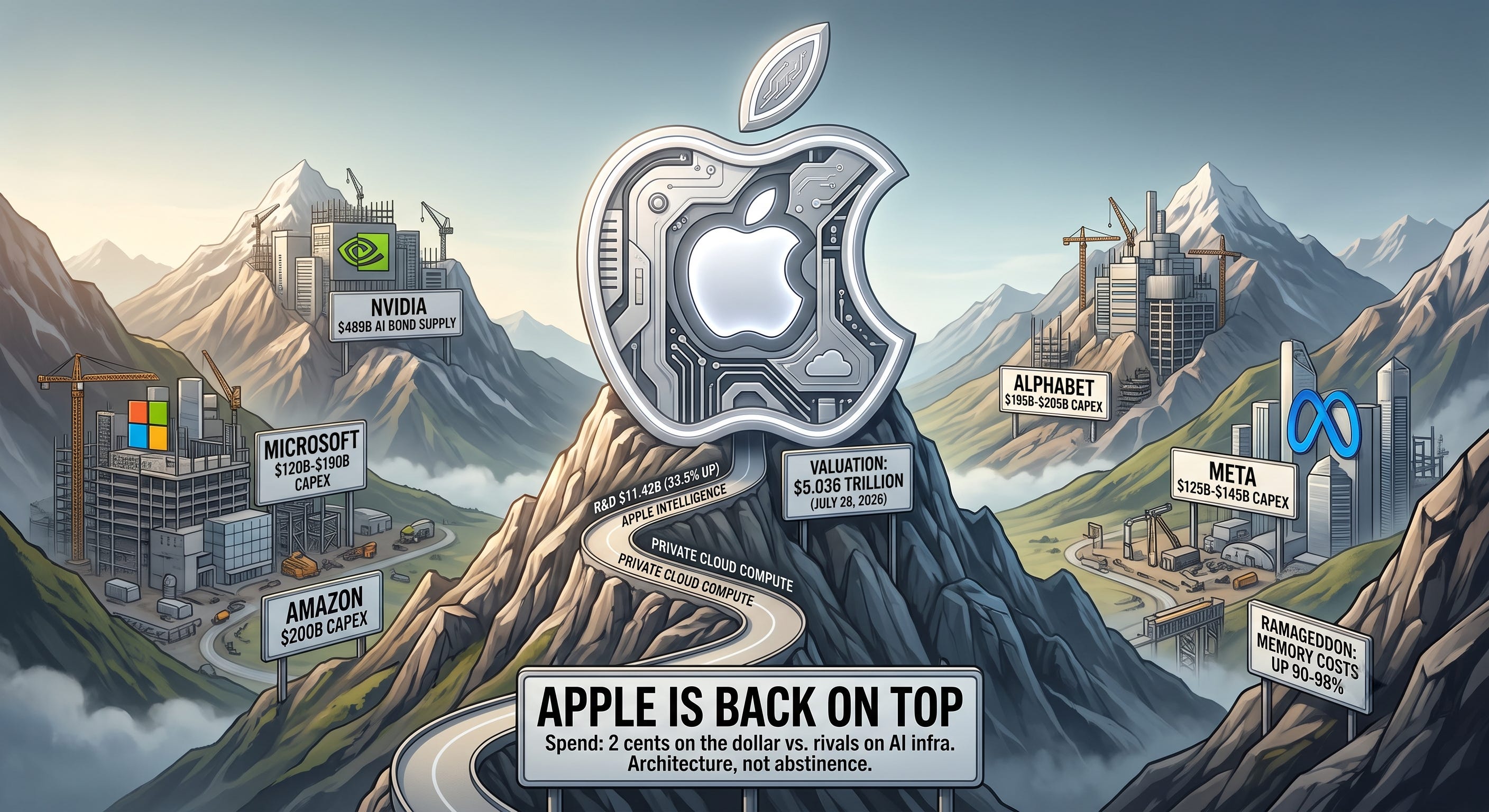
The explanation now circulating in every headline is short enough to fit in a push notification. Apple won by not spending on AI.
That story is half right, which makes it considerably more dangerous than if it were simply wrong.
The spending gap is real
Start by giving the number its due, because it is genuinely absurd. Amazon, Alphabet, Meta, and Microsoft have collectively guided to roughly $725 billion in capital expenditure for 2026, up about 77 percent from approximately $410 billion in 2025. Moody’s puts the six-company hyperscaler group at about $785 billion this year and close to a trillion dollars in 2027. Amazon alone is around $200 billion. Alphabet has raised its guidance to $195 to $205 billion. Meta is at $125 to $145 billion. Microsoft is tracking somewhere between $120 and $190 billion depending on whose calendar you use, fiscal or calendar, which makes it the softest number in the set.
Apple’s number for fiscal 2026 is $13 to $14 billion, up from $12.72 billion in fiscal 2025. Essentially flat. In the first half of fiscal 2026 the company actually spent less than it had a year earlier, $4.3 billion against roughly $6 billion. Apple’s full-year capital expenditure equals about two percent of what the four largest hyperscalers will spend. The ratio is roughly fifty to one.
So yes, the gap is real, and it is the largest divergence in capital allocation strategy among megacap technology companies in the modern era. But calling it abstinence is a reporting error, and the error matters.
Apple is not abstaining. It is expensing.
In the quarter ending March 28, 2026, Apple spent $11.42 billion on research and development. That is up 33.5 percent year over year, the highest quarterly R&D figure in the company’s history, and it represents 10.3 percent of revenue. Apple has not spent more than ten cents of every revenue dollar on R&D in at least thirty years. The prior quarter was 7.6 percent. A year earlier it was nine percent. R&D grew at roughly twice the rate of revenue in a quarter where revenue grew 17 percent, the fastest since 2021.
Apple’s own 10-Q attributes the increase to higher infrastructure-related costs and headcount-related expenses. Tim Cook, asked directly on the call how Apple thinks about investing across the AI stack, said the company is clearly investing more. Gene Munster noted that the megacap average R&D increase that quarter was 29 percent, meaning Apple out-invested the field on the line item nobody was watching.
Here is the distinction the headlines are flattening. Capital expenditure creates an asset and a depreciation schedule. Research and development is expensed in the period it is incurred. When Amazon books $200 billion of capex, it also books years of depreciation against equipment whose competitive half-life nobody in this industry can honestly forecast. Apple concluded that in a market where the useful life of a training cluster is a guess, the safer place to put the money is the income statement rather than the balance sheet.
That is not timidity. That is a position on obsolescence risk, and it happens to be the correct one for a company that does not sell compute.
Where Apple’s compute actually lives
This is the part the avoidance narrative misses completely, and it is the part that should interest anyone who designs systems rather than trades them.
Apple did not decline to buy inference capacity. It relocated it. Apple Intelligence runs primarily on A-series and M-series silicon inside a phone, tablet, or laptop that a customer already purchased, at a company gross margin of 49.3 percent last quarter. The neural silicon and the memory it requires are bill-of-materials line items. The customer pays for that compute up front, at a markup, and it depreciates in their pocket rather than in Apple’s data center.
Read that again as an engineer instead of an investor. Every hyperscaler on earth is financing inference capacity with corporate bonds and writing it down over five years. Apple sells its inference capacity, at a profit, and recognizes the revenue in the quarter. It is the same physical silicon problem solved with the opposite cash flow sign.
When a workload exceeds what the device can handle, Apple routes it to Private Cloud Compute. And on June 8 at WWDC, Apple announced that PCC now runs outside Apple’s own data centers for the first time, on Google Cloud, using Nvidia Blackwell GPUs with confidential computing, Intel CPUs with Trust Domain Extensions, and Google’s Titan security chip. The five original PCC requirements are unchanged: stateless computation, enforceable guarantees, no privileged runtime access, non-targetability, and verifiable transparency. Apple still publishes the binaries for public inspection. Apple devices still refuse to trust software Apple has not cryptographically approved. Software attestation for any component that could exfiltrate user data is rooted in at least two independent vendors, so compromising Intel or Nvidia or Google alone is not sufficient to break the chain.
What changed is who owns the metal. Apple bought the trust boundary and rented the floating-point operations.
If you build production systems for a living, that is the cleanest architectural statement any of these companies made this year. Apple separated the thing that is defensible, which is attestation, identity, the user relationship, and the privacy contract, from the thing that is a commodity on a falling price curve, which is raw inference. It capitalized the first and rented the second. Everything else in this story is downstream of that decision.
The best trade in the industry
Now the money, because the money is where this stops being clever and becomes almost unfair.
Apple pays Google roughly $1 billion a year under the multi-year agreement that produced the next generation of Apple Foundation Models and the rebuilt Siri unveiled at WWDC 2026, which entered public beta this month and ships in full this fall alongside new iPhone hardware.
Google pays Apple roughly $20 billion a year to be the default search engine in Safari. That precise figure is the 2022 number, unsealed in the antitrust record along with the revenue share, which a Google witness put at 36 percent. Neither company discloses it in securities filings, and it remains the commonly cited annual run rate rather than a confirmed current one. In 2020, Google’s payments to Apple constituted 17.5 percent of Apple’s entire operating income.
Twenty to one. Apple collects approximately twenty dollars from the frontier AI economy for every dollar it spends on frontier AI. That is not sitting out the race. That is owning the on-ramp and collecting tolls in both directions while the traffic pays for the road.
The obvious caveat is that this arrangement now lives under a remedy regime. No exclusivity, explicitly including for generative AI products and features. No exclusivity-adjacent incentives such as higher revenue share tiers for bundling. A twelve-month cap on default terms, meaning Google’s competitors get an annual shot at outbidding it. Google has appealed. So has the Justice Department. Anyone modeling Apple’s services margin a decade out is really modeling a court docket.
What actually flipped the narrative
The rotation into Apple is not a verdict on artificial intelligence. It is a verdict on financing, and the distinction is the whole ballgame.
Through fiscal 2024, hyperscaler capital expenditure was essentially self-funded, with incremental debt running about nine percent of capex. By the middle of 2026 that figure was 32 percent on a trailing twelve-month basis. Through July 22, five companies, Alphabet, Amazon, Meta, Microsoft, and Oracle, had raised nearly $302 billion in the capital markets across debt and equity. Goldman Sachs counted $489 billion of AI-related supply in global corporate bond and loan markets so far this year, already well above its full-year 2025 estimate of $322 billion.
Moody’s puts direct debt across the six largest hyperscalers at roughly $460 billion. The larger number sits off the balance sheet entirely: data center lease commitments of approximately $1.2 trillion, of which more than $820 billion is tied to facilities that are not yet operating. Moody’s counts those as debt-equivalent liabilities and warns of declining and in some cases negative free cash flow, along with strained leverage ratios.
The individual cases are worse than the aggregate. Alphabet’s quarterly free cash flow turned negative for the first time in the company’s history. In June it announced an $80 billion equity raise, upsized and priced the next day at $84.75 billion, the largest equity capital transaction ever executed by a listed corporate. Roughly $44.75 billion of that, including a $10 billion private placement with Berkshire Hathaway, is directed at general corporate purposes such as AI capital expenditure. The remaining $40 billion is an at-the-market program largely covering employee equity-award tax obligations, an administrative shift that nonetheless preserves cash for investment. Oracle closed fiscal 2026 with negative $23.7 billion of free cash flow against $32 billion of operating cash flow, on capital expenditure of $55.7 billion that grew 162 percent and overshot its own guidance by $5.7 billion. Oracle’s credit default swap spread widened past 125 basis points, a level not seen since 2009, and management authorized a $20 billion at-the-market equity program specifically to protect a BBB rating.
Against all of that, here is Apple. Operating cash flow of $82.6 billion in the first half of fiscal 2026. Thirty-six billion dollars of stock repurchased in six months. Term debt reduced from $90.7 billion to $82.7 billion. A dividend increase. An additional $100 billion buyback authorization on top of the more than $840 billion the company has repurchased since 2012.
Investors did not reward Apple for being right about AI. They rewarded Apple for still having free cash flow at a moment when nobody else in the cohort does. Those are different propositions, and conflating them is exactly how people get the next call wrong.
One detail from April deserves more attention than it received. Apple abandoned its decade-old net cash neutral target and now evaluates cash and debt independently. A company sitting on well over $130 billion in cash and marketable securities just quietly untied its own hands, in a market where AI startup valuations are one bad quarter away from compressing hard. Apple did not swear off the AI buildout. It reserved the right to enter it later, cheaper, as a buyer in a distressed market rather than a bidder in a hot one.
The tax Apple could not avoid
Here is the part that should keep every architect honest, and the part I find most instructive. Apple did not escape the AI capital cycle. It simply pays the bill at a different counter.
The industry calls it RAMageddon. DRAM contract prices rose roughly 90 to 98 percent in the first quarter of 2026 and another 58 to 63 percent in the second, according to TrendForce. The cause was not a fire or a flood or a failed fab. It was an allocation decision. Samsung, SK Hynix, and Micron, which together control about 95 percent of global DRAM production, redirected capacity toward high-bandwidth memory for AI accelerators. Nvidia locked in long-term supply agreements ahead of consumer electronics in the queue. Laptops and tablets went to the back of the line.
On June 25, Apple raised prices across the entire Mac lineup, both iPad families, HomePod, Vision Pro, and Apple TV, by up to $300. No product event. No press release. No new features. The store went dark for a few minutes and came back with higher numbers on it. The MacBook Air went from $1,099 to $1,299. Apple shares fell more than six percent that day, the worst single session since April 2025, erasing roughly $275 billion in market value. Cook had prepared the ground a week earlier, telling the Wall Street Journal on June 17 that price increases were unavoidable and describing the memory crunch as a hundred-year flood, something he had never seen the likes of in over forty years on the job. The iPhone, Apple Watch, and AirPods were spared, for now, though TechInsights estimates Apple would need to price the iPhone 18 Pro roughly $270 higher to hold its current margin, and analysts broadly expect an increase when it launches.
HP now says memory accounts for about 35 percent of total laptop material cost, up from 15 to 18 percent a single quarter earlier. Gartner expects the shortage to cut 2026 global PC shipments by 10.4 percent and smartphone shipments by 8.4 percent. Microsoft has raised Xbox prices three times in fourteen months. Dell, HP, Lenovo, and Asus have all flagged 15 to 20 percent increases.
So the company that refused to buy the compute still pays for the compute, in the price of the memory, set by the people who are buying the compute. There is no seat outside this cycle. There are only different seats inside it. Apple chose one where the bill arrives as a passthrough component cost instead of a depreciation schedule it cannot unwind. That is a better seat. It is not an exit.
The bear case, stated fairly
I do not write hagiography, and there are four real arguments against everything above.
The first is valuation. Apple trades around 34 times forward earnings and roughly 40 times trailing, against a ten-year average closer to 25 and a hardware industry median near 21. The market is paying a growth multiple for a replacement-cycle business whose unit volumes are about to be squeezed by the same memory shortage that is inflating its costs. There is no room for an execution miss at this price.
The second is dependency, and it is the serious one. Apple does not own a frontier model. Its supplier for frontier reasoning is simultaneously its largest competitor in mobile operating systems and its single largest revenue partner. The entire strategy rests on a thesis that the model layer commoditizes. So far the evidence supports it, since capability leadership rotates every few months and price per token keeps collapsing. If that thesis breaks, if proprietary data and compounding capability produce a durable moat at the model layer, Apple has rented itself into a structural second position and will be buying its way out at whatever the price is then.
The third is disintermediation. If the assistant becomes the interface, both the App Store toll and the search revenue share are exposed to it. Apple’s answer is that it owns the invocation surface, that when a user says Hey Siri and Gemini answers, Apple delivers the answer and the supplier is invisible. That is the Safari playbook applied one floor up the stack, and it is a good answer. It is not a guaranteed one.
The fourth is regulatory. Everything above depends on a commercial relationship that a federal court has already found to be part of illegal monopoly maintenance, currently on appeal from both directions, at a moment when the Justice Department is explicitly looking for ways to prevent Google from repeating the search playbook in AI distribution.
What a practitioner should actually take from this
I ship agentic systems on the Microsoft stack for a living, and the useful lesson here has nothing to do with whether you like Apple products.
Separate the model layer from the product layer, and be honest with yourself about which one you can actually defend. Apple bet that weights are a commodity and that identity, data, distribution, and the trust boundary are not. Nearly every enterprise AI architecture I have watched go sideways in the past two years got that backwards. Teams treated the model as the product and the plumbing as an afterthought, then discovered that the model they built their differentiation on was superseded by a cheaper one in a quarter and that they owned nothing durable underneath it.
Route inference to the cheapest place that satisfies your latency and privacy requirements, in that order. On-device first, confidential cloud second, frontier API last. Apple built that routing table into an operating system and shipped it across an eligible base of roughly a billion devices, deliberately gated by hardware. Most enterprises send every single request to the most expensive endpoint they have available and call that an AI strategy. That is not a strategy, it is a subscription.
Understand the difference between spending on AI and capitalizing AI. Apple spends 10.3 percent of revenue on research and development and about one percent on capital expenditure. That ratio is available to almost everyone reading this. The hyperscaler ratio is available to about five companies on earth. Copying the wrong one is how a mid-size firm ends up owning a depreciating GPU cluster running at 30 percent utilization while its competitors rent capacity by the hour and keep their balance sheet clean.
And remember what capitalized compute actually is. It is a bet on utilization. If you cannot fill it, you did not buy an asset. You bought a liability with a schedule attached to it.
Thursday
Tim Cook takes his final earnings call as chief executive on July 30 before handing the company to John Ternus on September 1. Consensus sits at roughly $108.8 to $109 billion in revenue and about $1.89 in earnings per share, against Apple’s own guidance of 14 to 17 percent growth and gross margin of 47.5 to 48.5 percent.
Revenue is not the number that matters. Gross margin is. This is the first quarter in which memory costs are fully loaded into Apple’s cost structure, partly absorbed and partly passed through to customers, and it is the first real test of whether the capital-light architecture survives contact with the second-order effects of everybody else’s capital-heavy one.
If margin holds near the top of that range, the thesis has evidence behind it and the re-rating was earned. If it does not, then the market just paid five trillion dollars for a company that is exposed to the AI buildout on the cost side and not on the revenue side, and told itself a flattering story about discipline.
Apple did not win by avoiding AI. Apple won, so far, by refusing to own the part of AI that depreciates. That is a much narrower claim than the headlines are making, and a considerably more useful one.
About the Author
Gal Ratner is the founder and CTO of Inverted Software and WhiteStar Labs, and Chief Architect at Prana Entertainment, a Las Vegas-based enterprise software and AI consultancy specializing in the Microsoft and .NET stack. He has nearly thirty years of production software experience, with client work spanning Microsoft, Sony, Rockstar Games, 2K Games, Best Buy, and Allegiant Air, and he was employee number six at Break.com. He is a Los Angeles Business Journal CTO of the Year finalist.
His current work is production agentic AI: MCP servers, Microsoft Agent Framework, RAG pipelines, SQL Server 2025 vector search, and the PLogger observability framework. He writes about what actually ships versus what gets announced, which means he spends a lot of time reading capital expenditure disclosures that were not written to be read. He is the author of the novel The Archive of Lost Suns, co-hosts Edge Grip Podcast, trains Brazilian jiu-jitsu under Sergio Penha in Las Vegas, and rides motorcycles when the desert allows it.
He is the .NET AI guy that ships.