


Microsoft is about to push thousands of its longest-serving employees out the door, and for the first time in its 51-year history, it’s going to ask them to leave politely.
The Financial Times and every other outlet with a Redmond source reported this week that Microsoft is rolling out its first-ever voluntary retirement program. The formula is called the “Rule of 70”: if your age plus your years of service at Microsoft add up to 70 or more, and you’re at senior director level or below, you qualify. Roughly 8,750 people — about 7% of Microsoft’s 125,000 U.S. employees — meet the criteria. Chief People Officer Amy Coleman announced it internally Thursday. Full terms land May 7. Employees get a 30-day window to decide.
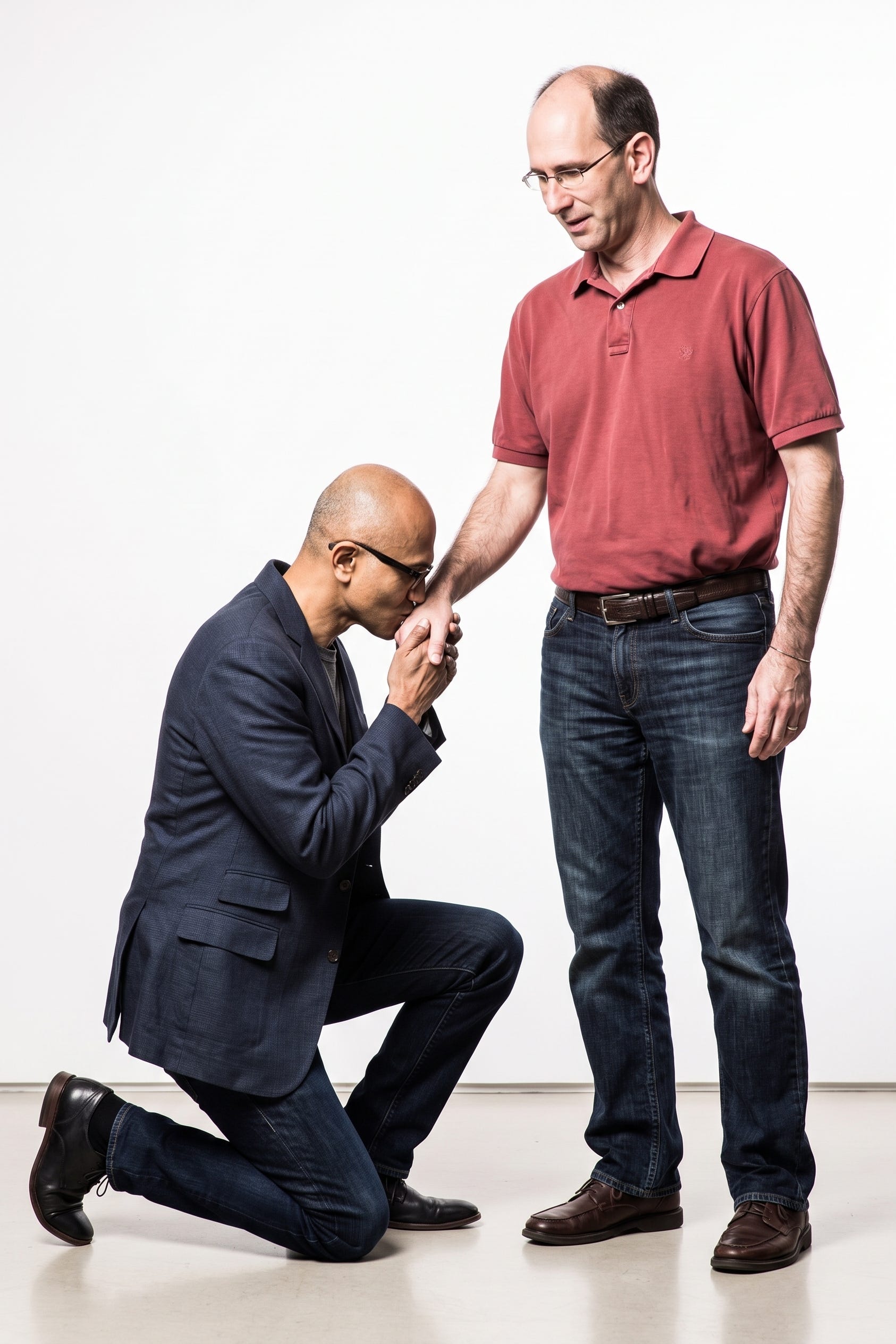
Microsoft would like you to know this is a “voluntary retirement program.” It is a buyout. It is a buyout targeted at the people who built pre-AI Microsoft, whose institutional knowledge is hardest to replace but whose roles are — in the company’s own internal calculus — the most replaceable by the same AI infrastructure Microsoft is spending $80 billion a year building. The hiring freeze announced last month? AI and Copilot teams are exempt. The layoffs over the past two years? More than 40% of them hit software engineering. The buyout targets? The people who kept Exchange running and SQL Server humming while Satya Nadella was on a keynote stage promising agentic workflows.
Let me save you the Google. Here is Microsoft’s layoff ledger since 2022.
• 2022: Quiet “summer cleanup” rounds, mostly under the radar.
• January 2023: 10,000 people, roughly 5% of the workforce. Biggest round since the 2014 Nokia integration.
• 2024: Another 4,000–5,000 across the year, including 1,900 gaming employees just months after the $68.7 billion Activision Blizzard acquisition closed. Tango Gameworks was shut down weeks after shipping Hi-Fi Rush, a critical hit.
• January 2025: “Performance-based” cuts under 1% of headcount but still thousands of people. HR was instructed to issue 30% more PIPs in Q1 — performance plans designed to be nearly impossible to pass.
• May 2025: 6,000 jobs gone. About 3% of the workforce.
• June 2025: Another 300.
• July 2025: 9,000 more — the biggest single round since 2023. Over 40% of these cuts hit software engineering.
• April 2026: The buyout. 8,750 potential exits.
That’s north of 27,000 employees shown the door since 2022. Add the 8,750 potential buyouts on top and you’re closer to 36,000. All of this at a company that just reported $81.3 billion in quarterly revenue and $38.5 billion in net income, up 60% year over year.
This is not a company in distress. This is a company swapping people for GPUs.
And what exactly are those GPUs producing? Let’s talk about that.
The Microslop Era
There is a term circulating on the internet for what Microsoft has become. It is “Microslop.” It did not come from a Reddit edgelord. It came from Satya Nadella.
In a New Year 2026 blog post, Nadella told the public to “get beyond the arguments of slop vs. sophistication” regarding AI quality. What happened next was the textbook Streisand effect: within hours, “Microslop” was trending across X and Reddit. Someone built a browser extension around it. The official Copilot Discord started auto-deleting messages containing the word, then locked entire channels when users simply typed it more. The moderation incident became bigger than the original complaint.
Because the complaint is real, and every Windows user has a list.
Windows 11 in 2025 was, pick your source, the worst year for the platform since Windows 8. Windows Latest logged 20+ major update problems in a single year. The greatest hits included a bug that displayed the Windows 11 interface in two languages simultaneously. An invisible password login button that Microsoft advised users to locate by flailing the mouse cursor across the screen. Dark mode that flashed white every time you opened a folder. Task Manager instances that refused to close and silently drained RAM. A March 2025 patch that caused bootloops and BSODs. A Windows Hello update that broke login if you had a webcam privacy shutter. A flawed January 2026 update, KB5074109, that caused black screens and frozen Outlook POP accounts just weeks into the new year.
And Copilot. Copilot everywhere. Copilot in Notepad — the text editor that has existed for 40 years as a place to type three sentences and save a .txt file. Right-click selected text and you get the option to “summarize” or “rewrite” your three sentences with AI. Copilot in Paint. Copilot in Photos. Copilot in File Explorer. Copilot on the keyboard, with a dedicated physical key that many users would happily trade for the Menu key it replaced.
Dell’s COO Jeffrey Clarke said the quiet part loud on Dell’s Q3 earnings call: 500 million Windows 11–compatible PCs have refused to upgrade. Another 500 million are locked out entirely by the TPM 2.0 and Secure Boot requirements. That’s a billion machines sitting in the opposite of Microsoft’s roadmap. After Windows 10 hit end-of-life in October 2025, Windows 11 adoption didn’t accelerate. StatCounter shows it flatlined and then declined, as people installed 11, tried it, and rolled back. That has never happened before in Windows history. Not even Vista produced a billion compatible-but-unwilling holdouts.
Windows VP Pavan Davuluri finally put out a March 2026 blog titled “Our commitment to Windows quality,” admitting the company needed to “be more intentional about how and where Copilot integrates across Windows.” Translation: users hate it and we are backing off. Copilot is being removed as a default entry point in Notepad, Snipping Tool, Photos, and Widgets — the same features Microsoft rammed into those apps eight months earlier.
Microsoft has even been caught using Copilot to generate the screenshots in its own Windows Learning Center tutorials. Some of those AI-generated images show a Windows 11 widget panel that looks nothing like the actual widget panel. Official how-to documentation illustrated by hallucinated UI. You cannot make this up.
Agent Mode Is Nothing But a Clippy With a Master’s Degree
Which brings us, on a very convenient timeline, to yesterday. April 23, 2026.
Satya Nadella posts on X and announces Copilot Agent Mode is “generally available and now the default across Copilot in Word, Excel, and PowerPoint.” As models become more capable, he writes, “we’re bringing that power to where real work happens, right in the canvas.” Microsoft ran an ad recreating the iconic 1990s Excel elevator commercial — same guy, smarter spreadsheet.
Nobody asked for this.
Agent Mode, by Microsoft’s own description, means Copilot now actively modifies your documents, spreadsheets, and slides without waiting for a prompt. It rewrites sections of your Word doc. It “spots trends” in your Excel workbook and reshapes the data layout. It “refreshes” your PowerPoint slides to match a template. It does this by default. Admins can disable it at the tenant level. End users cannot disable it per-file. Early feedback on forums is exactly what you would predict from anyone who has ever used a real spreadsheet: “It misinterpreted the data and made the wrong chart.”
There is a direct historical parallel here. His name was Clippy. Microsoft shipped Clippy — officially Clippit — in Office 97, and for roughly a decade Clippy popped up in every Word document asking if you were writing a letter every time you tried to do anything. Users despised him. Microsoft spent the early 2000s gradually demoting Clippy, disabling him by default in Office XP, and removing him entirely by Office 2007. It remains one of the most studied cases of a tech company misreading its users in software history.
Agent Mode is Clippy with a larger context window. It is the same instinct — an assistant nobody asked for, enabled by default, inserting itself into the flow of actual work — scaled up by 25 years of compute. The difference is that Clippy was a cartoon paperclip making suggestions. Agent Mode is making edits to your document and calling it productivity.
Microsoft’s own forums tell you where this ends. A marketing manager says her quarterly report used to take three hours and now takes one. An accountant says Copilot “misinterpreted the data and created wrong charts.” Guess which one you care about when the document has financial numbers in it.
Satya Qualifies For The Buyout
Here is something the Microsoft PR team did not put in the memo.
Satya Nadella was born August 19, 1967. He is 58 years old. He joined Microsoft in 1992, which is 34 years of service. Age plus tenure: 92. The Rule of 70 would clear him with a 22-year buffer. He would qualify twice over.
He doesn’t, of course. The program is capped at senior director and below. He is the chairman and chief executive officer.
But at this point the board should stop and consider whether he should be.
Under Nadella, Microsoft stock has gone up. Azure has scaled. OpenAI got funded. Those are real accomplishments and I am not going to pretend they are not. What is also true: the entire consumer and developer face of Microsoft has been degraded. Windows 11 has the worst reputation the platform has had since Windows 8. Copilot is a meme. Quality has collapsed to the point where the CEO’s own blog post asking people not to call his product “slop” turned the word into a global hashtag, and his own moderators made it worse by banning it on Discord. The Office suite is being weaponized against the people who use it. More than 27,000 employees have been pushed out since 2022, and another 8,750 are being offered the exit door right now.
A CEO’s job is to set culture and direction. The direction under Nadella is clear: AI at any cost, shoved into every product, human expertise treated as a line item to be optimized against GPUs. The culture is: layoff, rumor, freeze, buyout. Coverage of the buyout has already noted the obvious — this program disproportionately targets employees in their fifties and sixties, the people who built pre-AI Microsoft. Employment lawyers are already circling the Older Workers Benefit Protection Act compliance question.
Satya should take the package he isn’t technically eligible for. The board should make the math work.
The Developer The Company Already Has
There is a better candidate already inside the building. His name is Scott Guthrie.

If you don’t know the name, here’s the short version. Guthrie joined Microsoft in 1997 straight out of Duke with a CS degree. Over Christmas break that year, as a 22-year-old, he and Mark Anders built the first prototype of ASP.NET. That framework became — and still is — the backbone of more enterprise web applications than anyone outside the .NET world wants to admit. He was one of the original founders of the .NET project itself. He led Windows Phone developer tools. In the early 2010s, he was handed a failing Azure — a cloud service that had launched three years behind AWS and was losing badly — and he built it into the #2 hyperscaler on earth, running 95% of the Fortune 500. Since 2014 he has been EVP of Cloud + AI, which means he owns Azure, Dynamics 365, Visual Studio, VS Code, GitHub, .NET, SQL Server, Power BI, and Power Apps.
His org built Fairwater, the liquid-cooled Wisconsin and Atlanta AI datacenters linking hundreds of thousands of NVIDIA GB200 GPUs into what Microsoft calls the world’s first planet-scale AI superfactory. His team built Maia 200, Microsoft’s own inference silicon, which beats Amazon’s third-generation Trainium on FP4 throughput and outperforms Google’s seventh-generation TPU on FP8. The $80 billion in AI capex Nadella announces on earnings calls? That runs through Guthrie’s org to actually exist in concrete and copper.
He also wears a red polo to every public appearance and is still, at 51, a programmer. Longtime Microsoft exec Jason Zander has said on the record that Guthrie is “probably the best product manager at the company.” Charlotte Yarkoni has said he is “amazing in his ability to go up and down in terms of depth” — meaning he can argue architecture with an engineer in one breath and business model with the board in the next. That is a rare thing, and Microsoft already pays for it.
The argument for Guthrie is not sentimental. It is operational. Nadella is a sales-and-platform executive who came up through BizTalk, online services, and Server and Tools. He is good at enterprise deals and press narratives. Guthrie is the person who actually ships the infrastructure those press narratives depend on. When Azure and AI are now the vast majority of what matters at Microsoft, putting the guy who built Azure and AI in the CEO chair is not a radical idea. It is a succession plan that writes itself.
And here’s the part that should have been obvious for a decade. In 2000, Steve Ballmer stood on a stage in a sweat-soaked shirt and screamed “Developers, developers, developers” until he lost his voice. The internet has mocked that clip for 26 years. It was also the single most important thing any Microsoft CEO has ever said. Microsoft, even today, lives and dies on whether developers choose to build on its stack. GitHub, VS Code, TypeScript, .NET, Azure, Copilot — every one of those products is a bet that developers will write code on Microsoft tools. Ballmer understood it. Nadella talks about it. Guthrie actually does it.
Guthrie is the developer. He built the tools other developers use. He has been winning hearts and minds at every BUILD keynote for 20 years, wearing that same red polo.
A CEO picked from the cloud-sales lineage produced Microslop. A CEO picked from the developer-tools lineage would produce something closer to Microsoft’s original DNA. That is not nostalgia. It is a product thesis.
Take The Package
To Microsoft’s board: the Rule of 70 would enroll your CEO twice over. The metrics on his watch look great on a balance sheet and terrible everywhere a user actually touches the product. Windows is at war with its users. Copilot is a meme the company cannot moderate out of its own Discord. Twenty-seven thousand employees have been shown the door since 2022, and 8,750 more are being asked to leave politely, while the company spends $80 billion a year on infrastructure to automate the rest.
Give Satya the buyout he is two decades over-qualified for. Put Scott Guthrie in the chair. Let the man in the red polo go fix it.
Developers, developers, developers. It was right the first time.