


A relationship coach told Fox News last week that AI is making us “relationally stupid.” My first instinct was to roll my eyes. Every generation blames its newest dating tool for the death of romance — the personal ad, the phone number on a napkin, the swipe. The panic is a genre. But she’s half right, and the half she’s right about is something I watch happen in engineering every single day. It just shows up wearing a nicer outfit.
The complaint is specific. People are handing their love lives to a chatbot — profiles, opening lines, witty banter, even the breakups. The output is charming. It’s warm, it’s quick, it lands. Then the person shows up in the flesh and their date thinks: wait, is this the same human who wrote that? Because in person they’re not that funny. They’re not that fast. The profile wrote a check the person can’t cash.
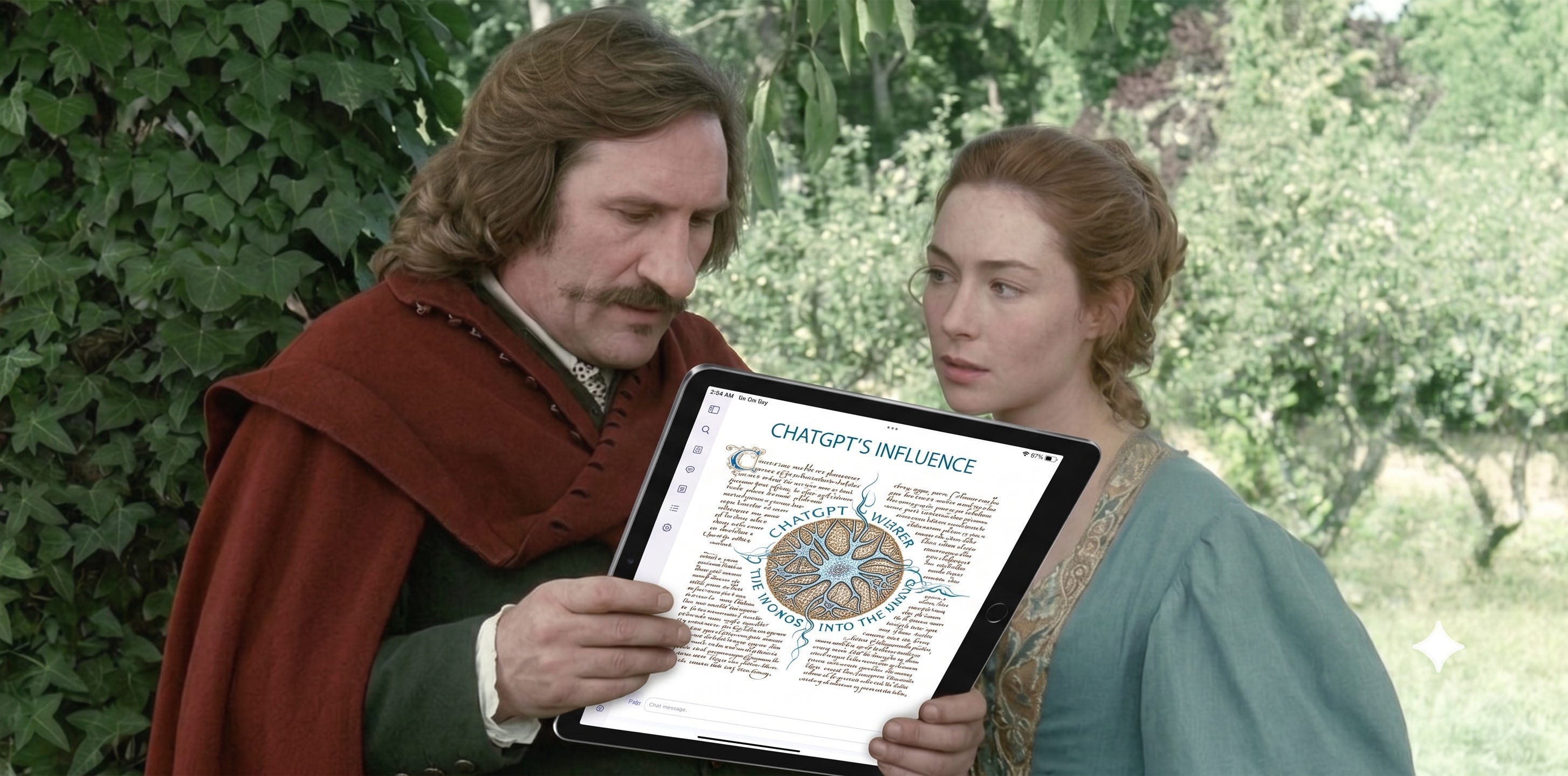
This is not a new problem. Edmond Rostand wrote the definitive version in 1897 and called it Cyrano de Bergerac. Cyrano is brilliant — poet, swordsman, a wit who can improvise verse in the middle of a duel — and convinced that his enormous nose makes him unlovable. He loves his cousin Roxane. So does Christian, a handsome young cadet with the face Cyrano lacks and none of the words. So they merge. Christian is the front end; Cyrano is the back end. Cyrano writes the letters, feeds the lines, and in the play’s most famous scene stands in the dark beneath the balcony, whispering the love that Christian merely lip-syncs above him. Roxane falls, completely, for the words. She just thinks the wrong man is compiling them.
But notice what happens before the words even get a turn. Drop Cyrano onto a modern dating app and it does not read his poetry — it renders his photo, clocks the nose, and swipes left in about the time it takes to load the next face. His genius never gets to argue its case. And this is not a Cyrano problem; it is the median-man problem, and the numbers are brutally consistent. Women swipe right on roughly one profile in seven; men swipe on about half. Hinge’s own data showed that half of every like women hand out goes to the top fifteen percent of men. One much-passed-around analysis — a flaky little sample, but the direction keeps getting confirmed — estimated that a man of average looks gets liked by under one percent of women, and put the inequality of the whole “like economy” as more lopsided than the wealth gap in most countries on Earth. Cyrano is the average man in that math. His entire soul sits behind a filter that closed before he could open his mouth.
Say he somehow clears the photo. Here is the part that should sting. Rostand gives Cyrano this, to be spoken up to a woman on a balcony: “Love, I love beyond breath, beyond reason, beyond love’s own power of loving.” Hand the same assignment to a chatbot and it gives you: “I really feel like we have a genuine connection and I’d love to see where this goes! 😊” Cyrano, on her name: “Your name is like a golden bell hung in my heart.” The machine: “Roxane is such a pretty name — it really suits you! 💕” Cyrano, on a kiss: “a rosy dot placed on the ‘i’ in loving; a secret told to the mouth instead of to the ear.” The machine: “A kiss can be a great way to deepen your connection! Just make sure you both feel comfortable and have enthusiastic consent. Want a few tips? 👍”
One of these is a man setting his soul on fire in public. The other is a compliance seminar with a rose emoji. And remember, that is the good output — the stuff that clears the filter and makes it into the profile. It arrives pre-loaded with the house style: the tricolon nobody asked for, the compulsive em-dash, the word “genuine” doing the job that specificity used to do, the reflexive urge to “delve” into your “journey.” Roxane reviewed this centuries ago. Speak to me, she tells her lover, be eloquent, be brilliant — and then, when he fumbles, the verdict: “I ask for cream and you give me milk and water.” That is every AI dating profile ever written. Milk and water, served with total confidence.
And before this curdles into a men-behaving-badly sermon, look at the other side of the glass. A man running his opening lines through a chatbot is gaming the filter with words. A heavily filtered, heavily contoured photo is gaming the same filter with a face. One is verbal contouring; the other is visual autocomplete. Both are surface engineered to clear the gate, and both write a check the in-person self is then handed to cash. The therapist in that Fox piece described the mechanism without ever mentioning AI: we put forward our best, most polished selves, close the deal, and then — her words — let down our hair. AI didn’t invent that con. It just industrialized one that both sexes were already running by hand. The medium is new. The bait-and-switch is ancient.
And yet reaching for Cyrano actually flatters the whole enterprise, because the comparison breaks in a way that should worry you more, not less. Cyrano’s words were real. He meant every syllable. The tragedy was never fraud — it was a routing error, a real soul hidden behind an acceptable face. There is a moment where he watches Roxane kiss Christian and thinks: “on another’s lips I feel her kiss, kissing the passionate words I spoke — my words.” That is the ache of a ghostwriter who gave away something that cost him. Now run the modern version. The prompt-and-paste dater feels no such ache, because nothing was taken from him. The words were never his to lose. Cyrano was substance without an acceptable surface. The AI-assisted dater is surface with nothing behind it at all. When Roxane finally learns the truth, there is a there there — there is a Cyrano to love. Swap the chatbot in and the structure holds perfectly, but the center is gone. That is not a love story with a sad ending. It is a demo.
And demo is the word that should make every engineer in the room sit up, because we have been running this exact play, and lately we have a name for it: vibe coding. You prompt a model, it hands back something that looks like a working feature, it sails down the happy path, everyone claps. Then it meets production — real traffic, real edge cases, the one input nobody tested — and it folds, because there was never any engineering underneath the output. Just fluent surface. The AI wrote a gorgeous profile. The system cannot show up on the date.
Here is the rule underneath both, and it does not care whether you are in a wine bar or a war room. Generated fluency is a loan, not income. You can borrow charm for the profile, competence for the pull request, the smart-sounding answer for the phone screen. But there is always a moment of contact — the first date, the first outage at three in the morning, the first real question from someone who actually knows the domain — where the loan gets called. And you either have the substance to cover it or you don’t. AI does not erase that moment. It moves it later and marks up the price, because now there is a promise attached to your name.
There is a second cost, and honestly it is the one I lose sleep over. That same coach made a sharper point buried under the “relationally stupid” line: people aren’t putting in the reps. They haven’t done the awkward work of walking up to someone, saying something stupid, dying a little, and learning from it. Hold that against Rostand. Cyrano didn’t need a ghostwriter — he was the ghostwriter. He had done the reps: the reading, the duels, the years of being the most brilliant man in the room and going home alone. The tool people are nervous about isn’t dangerous because it can write a good sentence. It is dangerous because it lets you skip the part where you become the kind of person who can write it — or say it, or build it — without the machine. Every line it writes for you is a rep you didn’t take. And reps are the only thing that has ever turned a Christian into a Cyrano.
Let me be fair, because the coaches in that piece lean toward a moral panic I don’t share. A tool that helps an anxious person organize a message they were otherwise too scared to send is doing something genuinely good. The tool was never the problem. Using it to replace the capability instead of to build it — that is the problem. Draft with it, then actually learn from the draft. Scaffold with it, then understand the scaffold well enough to defend it. Use it as a sparring partner, never as a stunt double.

Full disclosure, because you should know where I am standing when I say all this: I build in this space. I run GetXPersonal, a local personals and dating ads board with an MCP server sitting over it at mcp.getxpersonal.com, so I have an obvious dog in this fight. Which is precisely why I will tell you the part the pitch decks leave out. The swipe app throws Cyrano out on his face in half a second; an ads board at least makes him lead with a written ad — words about who he actually is and what he actually wants — which is the one setup where his kind of substance gets a hearing at all. But no format, and no model, rescues you from the moment of contact. The only honest job the tool has is to get you into the room faster — not to send a counterfeit of you in your place.
Because the balcony always empties. The demo always meets production. The date always, eventually, arrives. Cyrano dies with nothing left but what he calls his white plume — his panache — the one thing that was entirely, unmistakably his, that no one fed him and no one could take. That is the whole point of him. When the account finally comes due, the only thing that survives contact is whatever you actually are. AI can make you look like a great catch. It cannot make you one.
You still have to show up.
About the Author
Gal Ratner is the founder and CTO of Inverted Software and WhiteStar Labs and Chief Architect at Prana Entertainment. He has spent nearly thirty years shipping production software on the Microsoft and .NET stack for clients including Microsoft, Sony, Rockstar Games, 2K Games, Best Buy, and Allegiant Air, and now builds production agentic AI systems — Microsoft Agent Framework, MCP servers, RAG pipelines, and SQL Server 2025 vector search. He is also the builder of GetXPersonal, a local personals and dating ads board with a public MCP server at mcp.getxpersonal.com. He writes about what actually survives contact with production, and he is unapologetically the .NET AI guy who ships.