


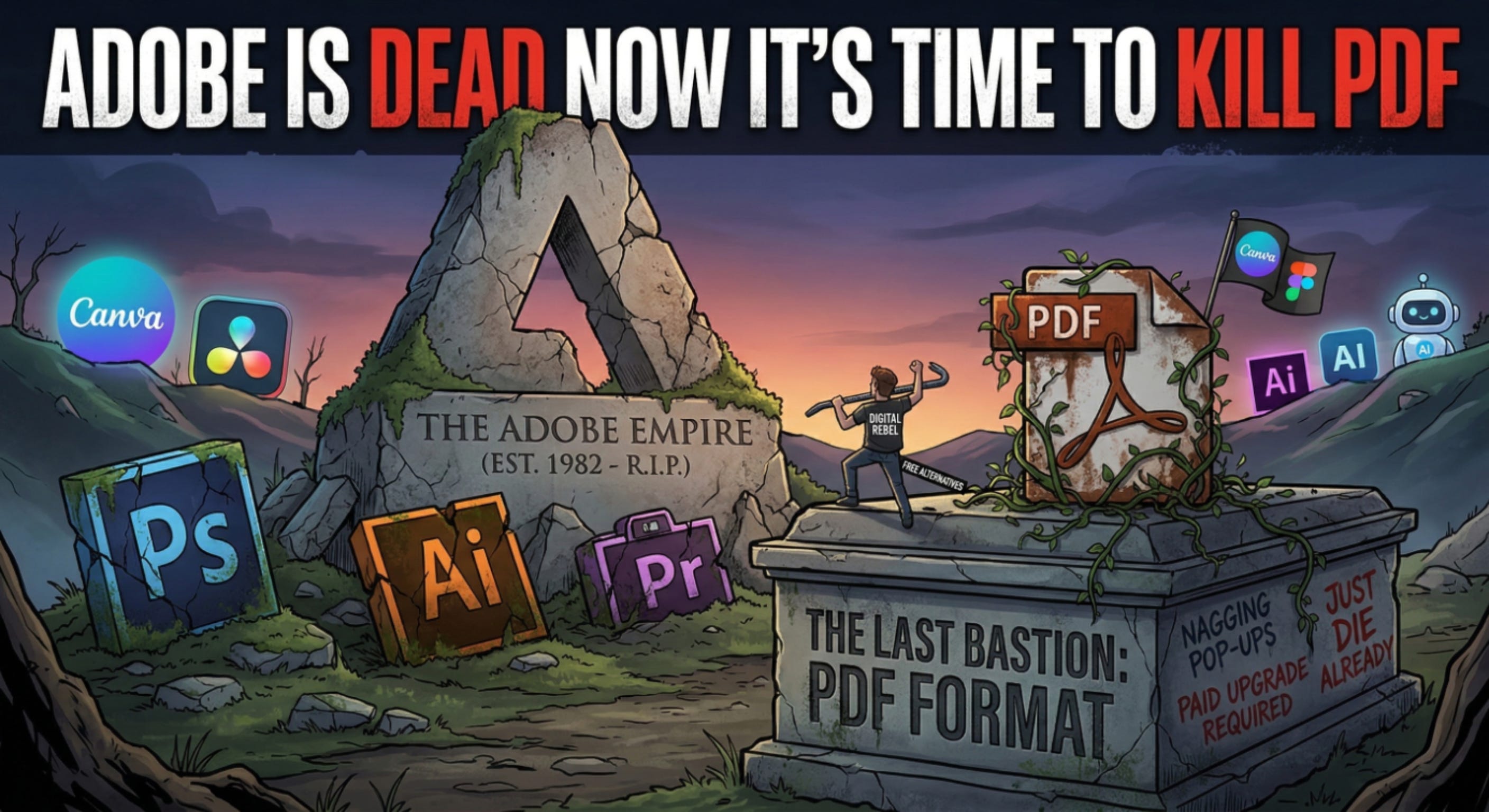
Remember when you could actually own software? You’d walk into a store, buy a box with a CD-ROM, and that was it. You and Photoshop were bonded for life, or at least until you upgraded your OS. Then Adobe had a “brilliant” idea: The Creative Cloud.
Suddenly, you weren’t buying a tool; you were renting your own productivity. Adobe realized that if they stopped selling the hammer and started charging you $52.99 a month for the privilege of holding it, they’d be rich beyond their wildest dreams. They leveraged their monopoly to force users into a digital hostage situation.
“Oh, you want to open that file you made three years ago? That’ll be sixty bucks, or we’ll lock your creative history in a vault,” they essentially said. They began squeezing users with unfair subscription fees for desktop applications that were already sitting on our hard drives. It was like a landlord charging you a daily fee to use the front door of a house you already bought.
The Suite of Sorrows vs. The New Guard
Adobe’s lineup is a sprawling metropolis of icons: Photoshop, Illustrator, InDesign, Premiere Pro, After Effects, Lightroom, Animate, Audition. For years, these were the gold standard. But today? They feel like bloated, over-engineered dinosaurs.
Enter the giant-killers:
Canva: The friendly neighborhood hero. While Photoshop requires a PhD in “Layers and Masking,” Canva lets you design a professional-grade wedding invite or a pitch deck while you’re waiting for your coffee to brew. It’s cheaper, faster, and doesn’t make you feel like an idiot.
Figma: It ate Adobe’s lunch in the UI/UX world so thoroughly that Adobe tried to buy them for $20 billion just to make the “pain” stop (thankfully, regulators stepped in).
DaVinci Resolve: A powerhouse for video editing that makes Premiere Pro’s “Unexpected Crash” screen look like a cruel joke.
The AI Executioner
If the “New Guard” of software was the crack in the dam, Generative AI is the flood. The recent generation of AI models—Midjourney, DALL-E 3, Stable Diffusion, and Sora—can now do in seconds what used to take a senior designer three days and six Red Bulls in Photoshop or After Effects.
Need to remove a background? AI does it perfectly. Want to expand an image? Generative Fill (which Adobe scrambled to add just to stay relevant) is now available in a dozen better, cheaper tools. Want to create high-fidelity video? Veo and other video models are making the complex timelines of After Effects look like a loom from the 1800s.
Adobe’s moat has dried up. Everything they make can now be replaced by a prompt and a prayer. Well, almost everything.
The Final Boss: The PDF
The only reason Adobe is still breathing is the Portable Document Format (PDF). It is the cockroach of the digital world—it survives everything.
We’ve all been there: You just want to sign a document or read a white paper. You open Adobe Acrobat Reader, and the nightmare begins. It’s not a “reader”; it’s a high-pressure sales pitch disguised as software.
The Nagging: “Want to Edit? Upgrade to Pro!” “Want to Export? Upgrade to Pro!” “Want to breathe? Please enter your credit card details!”
The Interface: A cluttered mess of sidebars and pop-ups that seem designed specifically to ruin your Tuesday.
The Weight: It takes 400MB of RAM just to display a single page of text. Why?
The Solution? Stop Using It.
The secret Adobe doesn’t want you to know is that you don’t need them. * Modern Browsers: Chrome, Safari, and Edge can read and annotate PDFs perfectly.
Open Source/Lightweight Alts: Look at SumatraPDF (for speed) or Okular. They don’t nag you. They don’t want your soul. They just want to show you the document.
A Final Resting Place
Adobe is destined to join the “Software Ghost Club.” It’s time for them to take their place alongside the legends of “companies that stayed too greedy for too long”:
Symantec: Once the king of security, now a memory of bloated Norton pop-ups.
Sun Microsystems: The powerhouse that forgot to keep up.
Borland: The king of compilers that simply faded away.
Adobe had a great run. They changed the world. But their legacy is now one of “Cancelation Fees” and “Incompatibility.” It’s time to uninstall the Creative Cloud, delete the Acrobat Reader, and finally kill the PDF for good.
The future is creative, it’s AI-driven, and most importantly—it doesn’t require a monthly subscription just to see your own work.