


Last spring I wrote that if you were a computer science student, a bootcamp graduate, or a parent writing tuition checks for either, you should stop, get out, and do it now. The email that came back was about what you would expect. Some of it was thoughtful. Most of it accused me of talking my own book, which is a strange charge to level at a man who has spent thirty years on the Microsoft stack and whose mortgage depends on software continuing to be a job that people get paid to do.
That piece was advice. Advice assumes the decision is still yours.
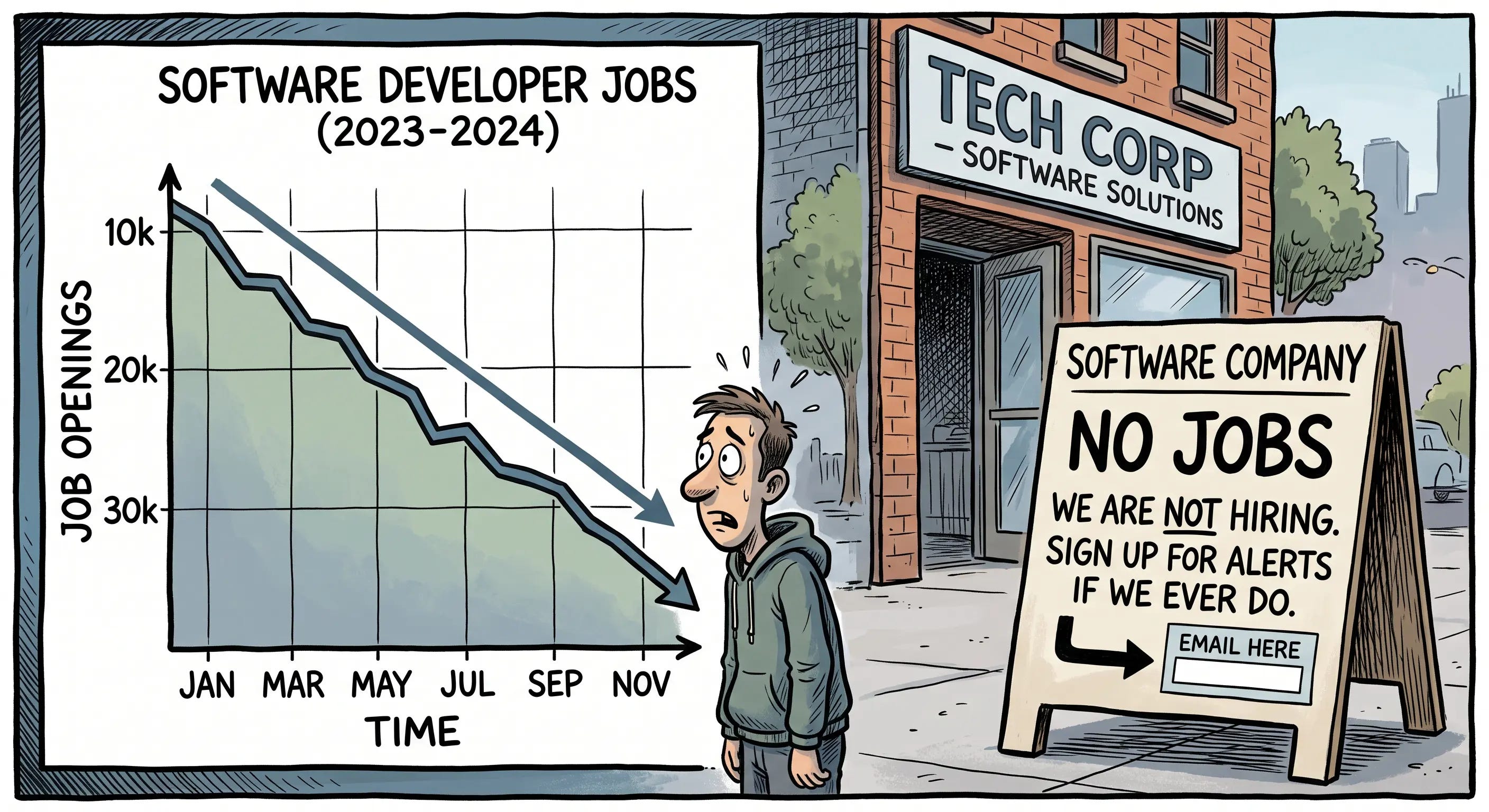
The August employment report came out this morning and it is the first one I have read where I would not call it advice anymore.
Open Table B-1
Total nonfarm payrolls rose 162,000 and the unemployment rate held at 4.1 percent, against a consensus in the low fifties. The business press read this as the labor market tipping toward blue collar and service work. Fine. Now open Table B-1.
Information lost 23,000 jobs. Inside that number, computing infrastructure providers, data processing and web hosting shed 7,700. Publishing lost 6,700. Broadcasting and content providers lost 5,000. Information and financial activities were the only two major sectors in the entire report that went negative, and one of them is us.
The escape hatch everyone points to is professional and business services, which added 10,000 and is up about seven tenths of a percent over the year. That is true and it is not about you. Computer systems design and related services, the line where consultancies and dev shops actually live, fell 900 on the month and sits at 2,362,700 against 2,394,000 a year ago. That is roughly 31,000 fewer jobs in the one subsector inside professional services where an engineer would plausibly land. The growth in that category is management consulting and temporary help.
As for the 162,000 itself, food services and drinking places contributed 59,200 and local government education contributed 41,900, which the Bureau explicitly describes as offsetting the previous month’s drop. Arts, entertainment and recreation went backward by 6,300. Health care added 12,900 against its own twelve-month average of 32,000. The twelve-month average monthly gain for the whole economy is 31,000, so August ran five times trend on the back of restaurants and school hiring. That is not a structural tilt toward anything. It is a calendar.
About that recovery
Indeed’s overall Job Postings Index was sitting at 101.8 in mid-August, slightly above where it was in February 2020. The Software Development index was at 74.4. Six years on, the rest of the American labor market walked back to its pre-pandemic baseline and we did not. That part is a level, and levels are hard to argue with.
The recovery story built on top of that level is another matter. Indeed reported software development postings up almost 15 percent since Claude Code shipped in February 2025 while overall postings fell 7 percent, and reported that 71 percent of the net increase between May 2025 and May 2026 came from senior roles with 37 percent carrying AI in the title. The trade press ran it as proof that experienced engineers are back in demand to supervise the machines.
I wrote in May about what those postings actually are, and nothing has changed since. Open Indeed, search software developer, pick a metro. You get DataAnnotation, then DataAnnotation, then DataAnnotation. Sometimes the title reads Software Developer, AI Trainer. Sometimes Contract Mobile App Developer, AI Trainer. Sometimes Staff Software Engineer, AI Trainer. Scroll far enough and Indeed serves you its own automated notice that it has removed thirty-odd postings very similar to the ones already shown. DataAnnotation is a subsidiary of Surge AI, the labeling company Forbes estimated above a billion dollars of 2024 revenue training models for Anthropic, OpenAI, Microsoft and Google. Mercor, Outlier, micro1 and Alignerr run the same play with the same titles. The pay is hourly, the account can be closed without appeal, and there is no role waiting at the end of the queue.
Now notice what a title like that does to the arithmetic. Staff Software Engineer, AI Trainer classifies as software development, classifies as senior, and contains AI in the title. One gig listing scores in all three of the categories being used to prove the recovery, including the senior share. Indeed’s own documentation says it de-duplicates when the same job is collected from multiple sources. It does not say it collapses one employer’s near-identical listing across forty metropolitan areas, and the removal notice on the results page is a display behavior rather than an index one. Indeed publishes no employer decomposition. Nobody outside that company can tell you how much of the fifteen percent is real, and that is the whole objection. A figure you cannot take apart should not be carrying an argument.
Some of the AI-titled growth is genuine and I will not pretend otherwise. Dice has AI and machine learning job titles up 173 percent year over year into the first quarter of 2026, at median salaries roughly 22 percent above the overall IT market, and a piece-rate annotation queue does not publish salary bands. There is real demand for people who build model infrastructure. It is a small number of jobs at a small number of companies and it is not the job you have.
Do the arithmetic
Indeed publishes the underlying sector series to a public repository, so I pulled the file rather than trusting anyone’s summary of it, this article included. What follows is their number with my arithmetic on top, and you can check both.
Software Development peaked at 233.84 on February 28, 2022, against a February 2020 baseline of 100. On August 28, 2026, it read 74.61. That is a fall of 68.1 percent from peak before anyone adjusts anything for anything. The separate series Indeed keeps for new postings rather than live ones peaked at 250.42 in May 2022 and now reads 78.99, a fall of 68.5 percent. Two different ways of counting, four tenths of a point apart. The collapse is not an artifact of method.
Now the adjustments, starting with the one everybody gets backwards.
Ghost jobs mostly cancel. If roughly the same share of listings was fake in 2022 as is fake today, removing them scales both ends of the ratio by the same factor and the percentage decline does not move. Strip twenty percent from both ends and you get 68 percent. Strip forty-eight percent from both ends and you still get 68 percent. Fake postings only change the answer if the rate went up, and nobody has a clean tech-specific 2022 baseline to prove that it did.
What does exist is a current tech figure. A Columbia Law Review analysis of the Bureau’s own openings data puts information and technology near 48 percent, against Greenhouse’s economy-wide range of 18 to 22. Accept that the tech rate roughly doubled from something like twenty percent in 2022, and the peak-to-present decline moves from 68.1 percent to 80.6. Take a milder reading of thirty-three percent today and you land on 75.1. Take the most conservative numbers available, fifteen percent then against twenty now, and it is still 72 percent.
The AI training work is the adjustment that does not cancel, because in February 2022 the category did not exist. ChatGPT was nine months away. Every DataAnnotation, Outlier, Mercor and Alignerr listing sitting inside today’s software development count has no counterpart anywhere in the peak number.
I cannot tell you how large that share is. Indeed does not publish it and I am not going to invent a figure to win an argument. What Indeed did publish is that 37 percent of the net increase between May 2025 and May 2026 carried AI in the title. Apply that to the rebound alone, which is the narrowest reading anyone could object to, and 4.99 of the 13.49 index points recovered since the May 2025 trough come off. The index drops from 74.61 to 69.62 and the decline from peak becomes 70.2 percent. That is a floor rather than an estimate, because it removes AI titles from the gain and leaves every single one of them sitting in the base.
So the defensible range runs from 70 percent at the floor to roughly 81 percent if the tech ghost rate genuinely reached half of all listings. Fifty percent is not the finding. Fifty percent was passed on the way down, sometime in 2022, with no adjustments applied at all.
One more column from the same file, because it belongs in this article in particular. Of every occupational sector Indeed tracks, exactly one fell further from its own peak than software development, and that is Data and Analytics at 70.4 percent. There is nobody below us but the analysts. Above us, sitting at or well above where they stood in February 2020, are Electrical Engineering at plus 40 percent, Personal Care and Home Health at plus 53, Mechanical Engineering at plus 57, Therapy at plus 79 and Physicians and Surgeons at plus 84. I published a piece telling developers to look seriously at the trades and was called a crank for it in my own comments. That is the same spreadsheet, four columns over.
Cross it against what employers actually report
Postings are scraped. Openings and hires are surveyed, which means an employer has to answer for them, and no marketing budget can flood the sample.
Information sector job openings were down 33 percent year over year as of March, the steepest decline of any private sector. The national hires rate fell to 3.2 percent in July, with total hires down 294,000 to 5.054 million. The Economic Policy Institute places that hires rate at the level last seen in 2013 and 2014, when unemployment ran three full percentage points above where it sits today. Quits are at 1.9 percent, the post-pandemic floor, which the series has now printed four separate times. Layoffs are at 1.0 percent.
Stanford’s work with ADP payroll records found employment for software developers aged 22 to 25 down close to 20 percent since generative AI went mainstream, while older engineers in the same occupations held steady or grew. A Harvard study found junior headcount falling at AI-adopting firms while senior headcount kept climbing. New graduates have gone from roughly a third of Big Tech hires in 2019 to something near seven percent.
Now hold the two measurements side by side, because separately each one gets misused by somebody. Software postings fell 68 percent from peak. Information sector payroll fell about 11.6 percent from its own late-2022 peak, from roughly 3.105 million people to 2.745 million. Postings fell almost six times as far as employment did.
That gap is not a contradiction and it is not a data error. It is the whole structure of this market written in two numbers. Employment barely moved because hardly anyone is being let go. Postings collapsed because hardly anyone is being brought in. The stock held and the flow stopped. If you already have the job, the last four years have felt survivable and the panic in your feed has looked overblown, and I understand why. If you are trying to get one, you have been standing in front of a door that has not opened since 2022, being told by the people on the other side of it that the room is fine.
The profession stopped hiring its own replacements. That is what the title means. Not that you get fired next quarter if you are forty-five with a decade of production behind you. That the entrance closed, and the people inside are the ones who were already inside when it did.
What it looks like from the candidate’s chair
Nobody funds much research on this side of it because there is no product to sell at the end. What exists is damning enough.
Greenhouse puts ghost jobs at 18 to 22 percent of online postings. A Clarify Capital survey of a thousand employers found nearly one in three had listings open more than thirty days, with a quarter saying they had no plan to fill for at least three months. Resume Builder surveyed 649 companies and found 59 percent of hiring managers admitting they post ads specifically to collect resumes for later, and two thirds admitting they post to create the appearance that the company is growing. A MyPerfectResume survey put the share of recruiters who say their employer has done it at 81 percent. A Columbia Law Review analysis of the Bureau’s own openings data placed information and technology around 48 percent.
Hold that against the July openings figure of 7.27 million and decide for yourself what fraction of it is real.
Regulators noticed. Ontario’s disclosure requirement took effect this year and forces employers to say whether a posting reflects an actual vacancy and to follow up with people they interviewed. Kentucky introduced a ban in January 2025. California’s AB 1251 would require a disclosure statement on every private-sector posting. New Jersey has its own bill, there is a federal Truth in Job Advertising and Accountability Act circulating, and the FTC named deceptive job advertising a priority for its Joint Labor Task Force in February 2025. A petition on the subject crossed roughly fifty thousand signatures by February. None of that has changed anything you experienced last week.
The flood, and the twenty-five hours
Greenhouse data covering more than 640 million applications across over 6,000 companies puts the average at 244 applications per open role in 2025, up from 116. Ashby, working across more than a hundred million applications and two hundred thousand jobs, published a figure of 300 or more per role, with the applications-per-hire ratio tripled since 2021 and candidates roughly 50 percent less likely to reach an interview than they were five years ago. LinkedIn is processing something like eleven thousand submissions a minute, up 45 percent in a single year, and says generative AI is the reason. Over the same stretch, recruiters per organization fell from 10.43 to 4.62.
The cost of submitting an application went to zero. The cost of reading one did not move. That is the entire mechanism, and everything downstream of it is a consequence.
So both sides pointed models at each other. Willo’s 2026 report has 77 percent of hiring teams regularly encountering AI-generated applications, up from 53 percent in early 2024. A Robert Half survey in March found 67 percent of US HR leaders saying that reviewing AI-generated applications has slowed their process, with one in five reporting delays over two weeks. You generate the cover letter, a screener scores it, and no human being reads either one.
If you do get through, Ashby’s numbers say the company will run 11.7 interviews to make one hire, a 36 percent increase since 2021, and will spend between 24.7 and 24.9 hours interviewing per technical hire. Time to fill for technical roles is running around ten weeks. Five to seven rounds is now unremarkable.
Here is the part that should end careers in talent acquisition and will not. Fabric analyzed 19,368 interviews and found candidate use of real-time AI assistance climbing from 15 percent in June 2025 to 35 percent by December. An interviewing.io survey found 75 percent of FAANG interviewers believe AI assistance is letting weaker candidates pass rounds they should not. Google brought back in-person interviews for engineering candidates. Some vendors now sell gaze tracking and typing-rhythm analysis to catch you reading off a second monitor.
Your current employer mandates Copilot, measures your throughput on the assumption you are using it, and puts AI adoption in your review. The company interviewing you next Tuesday will watch your eyes to confirm you are not. Twenty-five hours of panel time per hire, spent selecting for a skill they will instruct you to abandon on your second day.
For anyone entering, NACE has graduating seniors averaging 0.78 offers each. The New York Fed has recent graduate unemployment around 5.6 percent with underemployment at 42 percent through the second quarter. Those are not people being picky.
H-1B is not a talent search
There is a polite version of this section where the program has flaws, reasonable people disagree, and the truth sits somewhere in the middle. I am not writing it. Read the government’s own filing instead.
The cap is 85,000, sixty-five thousand plus twenty thousand reserved for US advanced degrees. Selection was 25 percent in FY2024 and 35.3 percent in FY2026.
Presidential Proclamation 10973, signed September 19 2025 and effective two days later, imposed a hundred thousand dollar supplemental payment on new petitions for beneficiaries outside the country going through consular processing. On June 8 2026 the District of Massachusetts vacated it, holding that the payment functioned as a tax the executive had no authority to impose. The government appealed and asked for a stay. The First Circuit denied the stay on July 24. A DC district court had reached the opposite conclusion in December 2025, so the split is live and the Supreme Court may end up with it. As of this week the fee is not collectible, and the proclamation is scheduled to lapse on September 21 unless it is extended. That is seventeen days from now.
The fee will be forgotten. The rule that replaces the lottery will not. DHS finalized the weighted selection rule on December 29 2025, it took effect February 27 2026, and it governed the FY2027 registration window that ran March 4 to March 19. Registrations are now weighted by Department of Labor wage level. A Level IV offer gets four entries. A Level I offer gets one. Manifest Law reported its own Level III and Level IV registrants selected at roughly 2.5 to 2.8 times the Level I rate. Attorneys projected total registrations falling to somewhere between 200,000 and 250,000, down from 343,981 eligible in FY2026.
In March the Department of Labor proposed raising the prevailing wage floors across all four tiers, and the justification section of that proposal is the most useful document written about this program in twenty years, because it is the agency that administers it explaining why it does not work. Sixty-three percent of certified labor condition applications in fiscal 2024 came in at Level I or Level II, the two lowest tiers, both of which sit below the local median wage for the occupation. Across the small employers the department examined, the average wage offered to an H-1B worker ran roughly ten thousand one hundred and ninety-one dollars below the average its own survey reports for the same job. The department stated that some employers use the program to replace American workers rather than supplement them, and cited as evidence computer science graduates at 7.5 percent unemployment and the twenty percent collapse in domestic software developers aged 22 to 25.
Read that last sentence again. The federal agency that certifies these applications used the destruction of the entry-level developer market as its reason to raise the wage floor. The two halves of this article are joined in a rulemaking docket.
The volume sits where you would expect it to sit. Half of the thirty largest H-1B employers run an outsourcing model, placing workers at a client’s site rather than hiring them to do the company’s own work. The department describes the mechanism exactly: the outsourcing firm bills a client whose own staff earn considerably more, while the firm’s internal actual-wage benchmark never has to reflect that client’s pay scale. The actual-wage provision has been in the statute since the beginning and has never once been enforced. In 2019 and 2020, by the government’s own count, eighty-five percent of visas went to entry-level and junior workers paid twenty to forty percent under market.
Now look at who has been filing lately. Fifteen of the twenty-five largest H-1B sponsors in fiscal 2026 announced layoffs in the preceding fifteen months. Oracle cut sixteen thousand corporate roles in January after fourteen thousand the previous October, and filed roughly 2,675 H-1B petitions across the same two-year window. An earlier study of the top thirty sponsors counted eighty-five thousand people laid off against thirty-four thousand H-1B workers hired over one overlapping stretch. Durbin and Grassley wrote to the ten heaviest users of the program last September asking, in substance, how a company can be unable to locate American engineers in the same quarter it is dismissing them by the thousand.
A shortage raises wages. This produces a legal floor beneath the median, a comparison test nobody enforces, and a worker whose right to remain in the country is attached to the person who signs his paycheck. That last item is the real mechanism and almost nobody names it. An engineer who cannot change employers without restarting a green card queue that runs decades for Indian nationals does not negotiate. Not because he is worth less. Because he cannot walk. The employer is not buying a skill it could not find. It is buying an employee who cannot quit, and the discount on that is the entire product.
I want to be exact about the limits, because the counterargument is coming and it is not stupid. The median H-1B salary in fiscal 2026 was $130,707, far above the American median in any occupation, and a handful of sponsors pay half again that. Cato’s standing objection to the wage-level research is that the prevailing wage is a mean at a given skill tier rather than the median across the whole occupation, and means exceeded medians in ninety-seven percent of occupations, so nearly every employer technically clears the bar. That is true and it misses the point. The bar is what is being described. Choosing which tier to certify against is choosing what you will be legally obligated to pay, and sixty-three percent of filers chose one of the bottom two.
And if you assumed the new weighted lottery fixes this, it may do the opposite. EPI’s comment on the rule cites modeling from the Institute for Progress projecting that weighted selection hands IT outsourcing firms about eight percent more visas, gives graduates of American universities on student visas seven percent fewer, and lifts the median H-1B salary by roughly three percent. The reform sold as the end of wage arbitrage could route more of a shrinking cap to the precise firms whose business model is wage arbitrage, and take it from the international students who paid American tuition to be here.
If your hope was that this hands junior American developers the roles, look again at who is on payroll. Developers aged 22 to 25 are down close to twenty percent. New graduates have collapsed from about a third of Big Tech hires to roughly seven percent. The jobs are not going to a junior on a visa, and they are not going to a junior without one. They are not being filled.
The alternatives are the same ones they have always been. O-1 for extraordinary ability, EB-2 with a national interest waiver, cap-exempt sponsorship through universities and nonprofit research, L-1 intracompany transfer, TN for Canadians and Mexicans, F-1 practical training and the STEM extension for people already here on student status. Every one of them still requires a company to want a human being physically inside the United States.
Increasingly they do not, and the visa is only the onshore half of the arrangement anyway. Half the top thirty sponsors are staffing firms whose model, by both the department’s description and EPI’s, includes moving American work abroad. The H-1B holder standing in the client’s office is not himself the arbitrage. He is the beachhead for it, the coordination layer and the billable American address for a delivery team sitting eleven and a half time zones away. We are having a loud argument about the width of a door while the wall came down on the other side of the building.
The center in Hyderabad is not an export business
India now hosts more than 2,100 global capability centers employing over 2.3 million professionals and producing revenue north of seventy billion dollars, with NASSCOM projecting 2.8 million people and a hundred and five billion by 2030. A capability center is not a vendor. It is a wholly owned subsidiary of the parent company, staffed with the parent’s own employees, running product engineering, machine learning, security architecture and platform teams under global mandates. Forty percent of them sit in Bangalore.
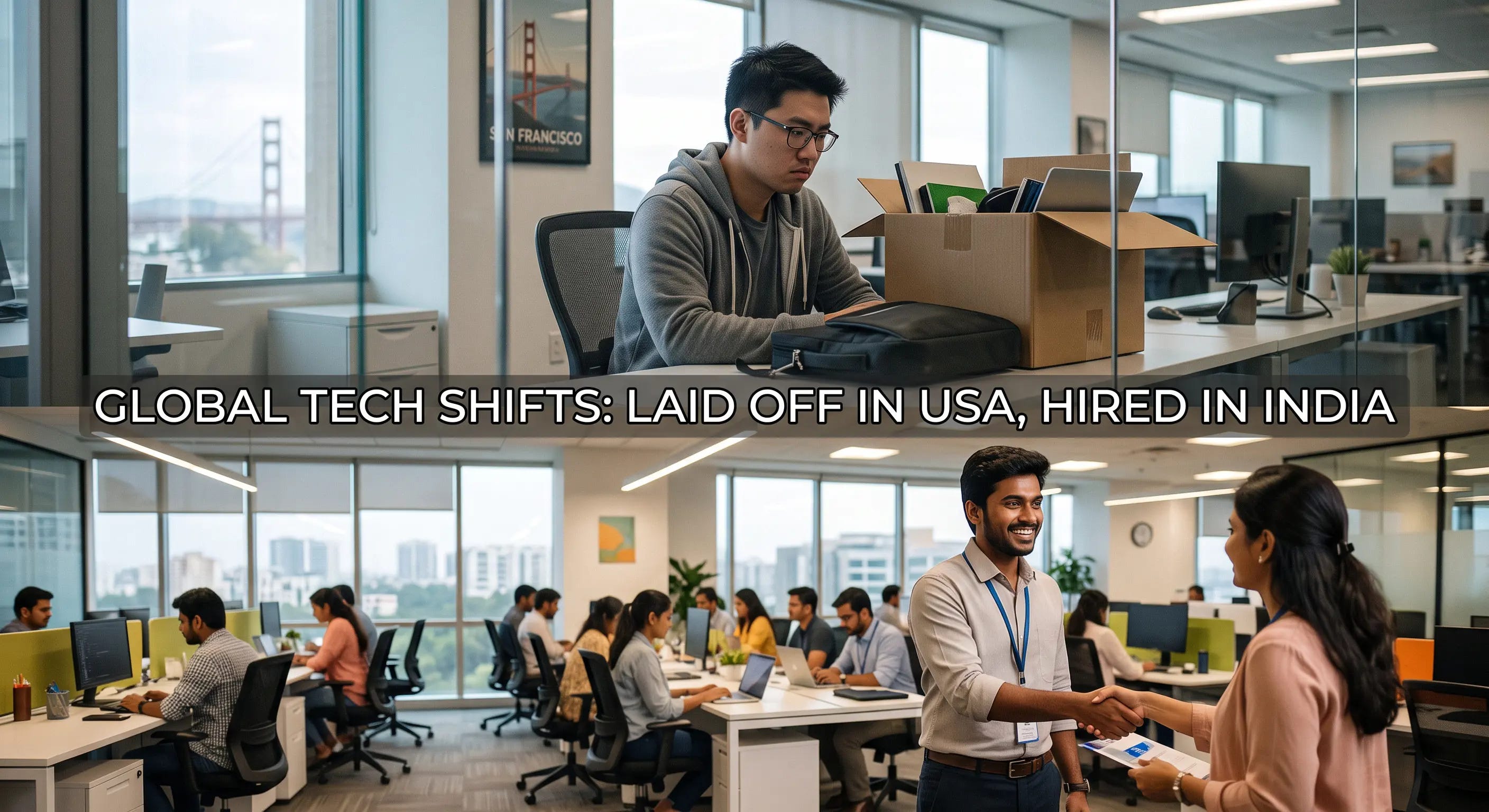
Here is the part that gets described as globalization and is really something narrower. The software those teams build is sold to Americans, priced in dollars, at American prices, and the revenue is booked in Delaware. The wage bill is denominated in rupees. A senior backend engineer at a Hyderabad capability center earns between thirty-five and fifty lakh, which at eighty-four rupees to the dollar is roughly forty-two to sixty thousand dollars. The fully loaded cost of the American who held that seat in 2021 was three to four times that. The customer’s price did not move by a cent. The gap is margin.
I am not going to pretend the Indian engineer is a victim in this, because he is not. Capability centers pay forty to sixty percent above domestic IT services firms and have become the most desirable employer category in the country, which is why attrition in Bangalore and Hyderabad runs sixteen to eighteen percent as those companies poach each other. The consultancies will also tell you the cost era is finished and they are buying capability rather than cheap hours, and two thirds of them now run dedicated innovation teams to prove it. Some of that is true. None of it explains why the same seat, on the same product, sold to the same buyer, is compensated against two different continents’ wage scales, only one of which has to keep pace with American rent.
So follow the job
Take a twenty-two year old with a computer science degree from a state school, class of 2026, four hundred applications out and no offer, living in his parents’ house. The rational move is not another bootcamp. It is to go where his job went. He should be able to walk into the Bangalore office of the American company that would not interview him in Columbus and ask for the seat.
On paper it works, and I ran the numbers before writing that. Entry-level software engineering at a Bangalore capability center pays eight to twelve lakh, about nine thousand five hundred to fourteen thousand dollars a year. That sounds like an insult until you price the life. A comfortable single expatriate in Bangalore runs eight hundred to fifteen hundred dollars a month, and ten lakh nets him roughly nine hundred and sixty a month after Indian tax, which under the new regime at that income is about three percent. It clears. It clears better than zero, which is what he is currently earning.
The tax picture is better than that. The foreign earned income exclusion for 2026 is one hundred thirty-two thousand nine hundred dollars, so his entire Indian salary sits under it and his American federal income tax on that money is nothing. He files a 1040 and a Form 2555 and owes zero. Even at twenty-one lakh his combined Indian burden runs about ten percent after the standard deduction and cess. His total tax across two countries would be lower than the American peer who did get hired.
He is not allowed to take the job.
India’s Employment Visa carries four conditions and all four apply at once. The sponsor must be a registered Indian entity, which a capability center is. The role must be highly skilled or senior. The gross salary must exceed twenty-five thousand US dollars, which at current exchange runs about twenty-one lakh, though the ministry’s own guidance still cites the rupee figure of sixteen point two five lakh set at an older rate. And the employer must establish, through a labour market test, that no qualified Indian national was available for the position.
Condition three eliminates him by itself. Entry pay at the center is eight to twelve lakh and the floor is at least sixteen and probably twenty-one. He would need mid-level compensation, which means four to six years of experience he does not have and cannot get, because the entry job that produces it is the one he is standing in front of.
Condition four eliminates him permanently. There are millions of qualified Indian nationals. Their availability is the entire reason the center exists. No employer on earth could pass that test for this candidate, and India wrote the rule precisely so that none would try.
Now say the last part slowly. India requires an employer to demonstrate that no local worker was available before it may hire a foreigner. The United States does not. The labor condition application contains an actual-wage and non-displacement attestation that has sat in the statute since 1990 and which, by EPI’s account, has never once been enforced. India built the protection and enforces it at the visa counter. We wrote ours and filed it.
There is a coda to this that I found while checking the rule and did not expect. The twenty-five thousand dollar floor drops to three lakh sixty thousand rupees, about four thousand three hundred dollars, for a person of Indian origin or the spouse or child of an Indian citizen or OCI cardholder. Registered OCI holders need no employment visa at all. The threshold that bars the kid from Columbus is roughly six times lower for someone with the right grandparent. That is a country making a deliberate, tiered, openly stated decision about who may work inside its borders. Countries are allowed to do that. Ours has decided not to.
So the scenario resolves like this. The work left. The country it went to will not permit him to follow it. The country he is standing in will not require anyone to look for him first. He is not losing a competition with an engineer in Bangalore. He is not eligible to enter it. The only way he can reach that work is to underbid a Bangalore salary while paying Ohio rent, which is not a competition either. It is a floor he cannot get down to.
The money, briefly, because it is worse than it looks
Average hourly earnings across the private economy rose 3.1 percent over the year. Inflation has been above the Fed’s target for sixty-five consecutive months by the current chair’s own count. The Fed held at 3.50 to 3.75 percent on August 31 with three dissents who wanted to go higher, and after this morning’s print traders moved further toward a hike at the September 15-16 meeting. Your raise is a rounding error against your grocery bill, and the central bank is weighing whether to make your mortgage worse.
Layoffs.fyi has 127,180 tech job cuts across 281 companies so far in 2026. All of 2025 was 122,606. We passed last year’s total in the first week of August. It is still well under the 265,660 of 2023, which is the only genuinely encouraging sentence in this section.
So what do you actually do
If you are senior, with real production years and a working understanding of distributed systems, security, regulated data or legacy modernization, the market is bifurcating in your favor and you should behave accordingly. Raise your rate. Specialize into the work that does not compress: domains where the data cannot legally move, systems older than the people maintaining them, and the operational layer around agents rather than the agents themselves. Take the contract work. Bill like the runway has an end, because the shape of the payroll data says it does.
I have a specific reason for believing that, and it is not a forecast. Years ago I built a free .NET shopping cart, shipped it through the Microsoft Web Application Gallery with the source on CodePlex, and watched it pass fifty thousand installs. I sold support contracts and an enterprise edition alongside it. I closed exactly zero support sales. One business running their entire operation on my free code emailed to ask for a free enterprise license, and offered as payment the modifications their outsourced developer had already made to my software. That is what this industry does with something valuable that costs nothing. It takes it and hires the cheapest available person to change it. Generated code is that same transaction at a scale where the cheapest available person is a monthly subscription, and I am watching it happen from inside the loops I am describing, because I am consulting myself right now at the executive level. The recruiter who tells you five rounds is standard has genuinely stopped hearing the sentence come out of their mouth.
If you are junior, I owe you a more precise version of what I said last year, because get out was too blunt to be useful.
There is no version of learn AI that solves this at population scale. The AI-titled roles that carry a real salary are model infrastructure jobs at a handful of companies, and they go to people who already have a track record. A large share of what surfaces when you go looking for the rest is piece-rate annotation work wearing a software engineering title. The tools removed the rung you used to climb to build the track record in the first place. Anyone selling you a six-week course that fixes that is selling you the thing that stopped working.
What still works is narrow and unglamorous. Get inside a company through any adjacent door, support, QA, solutions, data operations, and become the person who ships. Build something public and inspectable, because proof of work survives both the model screen and the human one in a way a resume no longer does. Or take the third option seriously. Nvidia’s chief executive has spent two years telling anyone who will listen that the money in this build-out is in the hands. Associated Builders and Contractors puts the construction shortfall at 349,000 net new workers this year and 456,000 next, most of it from retirements rather than new demand. Electricians are the binding constraint on the data centers that run the models that took your first job. There is a joke in there and I do not find it funny.
The part I would rather not write
Everything I do for a living sits in the distance between what executives claim AI is doing and what actually gets merged into a production branch. That gap is real, it is wide, and it is where my consulting revenue lives. I could write you a comfortable column about how the machines still cannot handle a legacy billing system or a regulated integration, and I would be right, and you would feel better.
The labor data does not record the gap. It records the hiring decision. And the hiring decision has been made, in the same direction, across the entire industry, for four consecutive years, by people who have never read a diff in their lives.
A year ago the door was open and I was telling you not to walk through it. Go check it now.
About the Author
Gal Ratner is the founder and CTO of Inverted Software and WhiteStar Labs, and Chief Architect at Prana Entertainment, an enterprise software and AI consultancy in Las Vegas. He has spent nearly thirty years shipping production systems on the Microsoft and .NET stack for clients including Microsoft, Sony, Rockstar Games, 2K Games, Best Buy and Allegiant Air, and was employee number six at Break.com during the user-generated content era. He is a Los Angeles Business Journal CTO of the Year finalist.
His current work is production agentic AI: MCP servers, the Microsoft Agent Framework, retrieval pipelines, SQL Server 2025 vector search, and the PLogger observability framework. He builds and operates agents that run in front of real customers, including a shopping assistant for ShopSnap storefronts and a wedding planning agent for a Las Vegas wedding chapel. He is also the author of the novel The Archive of Lost Suns.
He writes about the gap between what executives say AI is doing and what practitioners actually ship, at galratner.substack.com.