


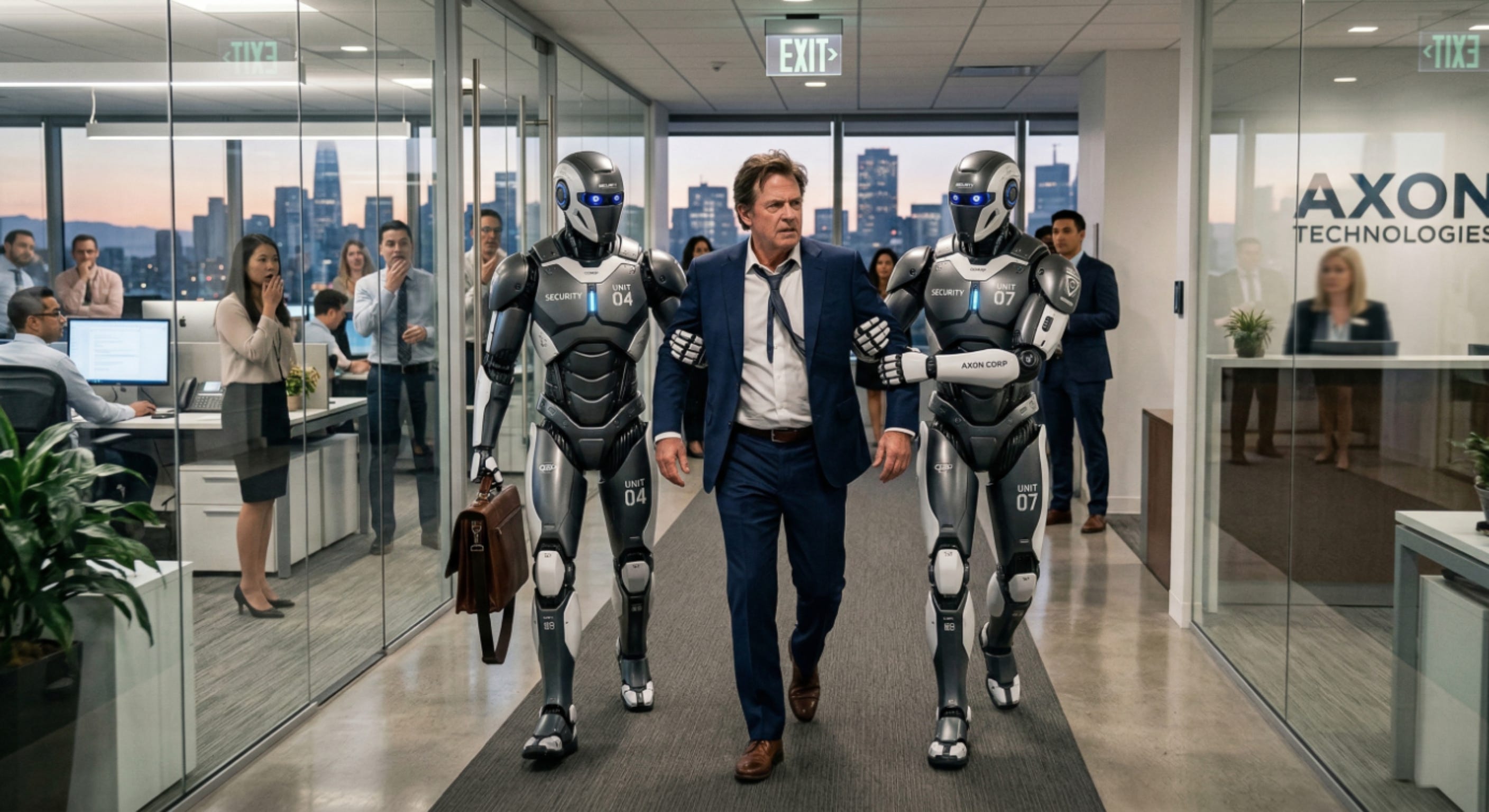
Executive Summary
Your CEO costs $18.9 million per year in total compensation. That’s the S&P 500 average as of 2024 — a 7% increase over the prior year, at a ratio of 285-to-1 against your median employee’s salary. Your CEO takes vacations. Your CEO has bad days. Your CEO occasionally gets photographed on a yacht when the stock is down 14%. Your CEO has an ego that requires its own line item in the annual budget under “executive coaching.”
Meanwhile, an AI system capable of analyzing every data point in your organization, synthesizing competitive intelligence in real time, running scenario models across thousands of variables, and making decisions without emotional bias costs roughly $200 per month on an enterprise plan — and it never, ever gets photographed on a yacht.
This guide is for the forward-thinking board member who has sat through one too many quarterly earnings calls where the CEO blamed “macro headwinds” for what was clearly a failure of strategic imagination. It is a step-by-step manual for what Silicon Valley’s most prominent leaders are quietly admitting is inevitable: the automation of the chief executive.
Sam Altman, CEO of OpenAI, recently admitted that AI superintelligence would be capable of running a major company better than any human executive — “certainly me,” he added. If the man building the tools is volunteering himself for replacement, perhaps it’s time your board took the hint.
Part I: The Case Against Your Current CEO
1.1 — The Compensation Problem
Let’s start with the math, because unlike your CEO, the math doesn’t require a private jet to function properly.
The median total compensation for an S&P 500 CEO reached $17.1 million in 2024, a 9.7% increase from the prior year. For mid-market private companies, CEO total cash compensation averages around $908,000, with total packages for firms over $500 million in revenue climbing to $1.4 million and well above in total direct compensation.
What does this buy you? One human brain. A single point of failure. A decision-maker who sleeps eight hours a night (or claims to), processes information at biological speed, and is subject to the full spectrum of cognitive biases catalogued in behavioral economics. Your CEO experiences confirmation bias, sunk cost fallacy, recency bias, anchoring, overconfidence, and — perhaps most dangerously — the Dunning-Kruger effect as it relates to their understanding of artificial intelligence.
An enterprise AI system processes millions of data points simultaneously, never sleeps, never has a “gut feeling” that contradicts the data, and never negotiates for a golden parachute.
1.2 — The Performance Problem
Let’s be honest about what most CEOs actually do on a daily basis. Studies consistently show that executive time breaks down roughly as follows: 25% in meetings that could have been emails, 20% in “alignment sessions” that produce no measurable alignment, 15% in travel that accomplishes what a video call could, 15% managing internal politics, 10% on actual strategic work, and the remaining 15% on activities that charitable observers call “stakeholder engagement” and honest observers call “expensive lunch.”
The 10% of time spent on actual strategy — analyzing market conditions, evaluating competitive threats, allocating capital, and making resource decisions — is precisely the work that AI already does better than humans. Not theoretically. Right now.
When Dario Amodei says that over 90% of the code at Anthropic is now written by AI, he’s describing a world where the machine has already surpassed the human at the core technical work. Strategic analysis and decision-making are simply the white-collar version of the same story.
1.3 — The Liability Problem
Your CEO is a lawsuit waiting to happen. They can make inappropriate comments at industry events. They can tweet things that move your stock price in the wrong direction. They can develop personal vendettas against competitors that cloud strategic judgment. They can get divorced, and suddenly their personal drama is a shareholder concern.
An AI CEO has no personal life. It has no Twitter account (unless you give it one, which, for the record, this guide does not recommend). It cannot be bribed, seduced, blackmailed, or convinced by a charismatic consultant to pivot the company into an adjacent market that has nothing to do with your core competency.
Part II: The Practical Replacement Plan — 12 Steps to a Post-Human C-Suite
Step 1: Conduct an AI-Readiness Audit
Before you fire the human, you need to understand what the human actually does. Commission a comprehensive time-and-task study of the CEO’s activities over 90 days. Every meeting, every decision, every email, every phone call. Categorize each activity as either “automatable” (data analysis, report review, performance evaluation, compliance oversight, financial modeling) or “currently non-automatable” (keynote speeches, congressional testimony, shaking hands with the President).
You will discover that 70–85% of the CEO’s functional output falls into the automatable category. The remaining 15–30% is essentially public relations — and that’s what you hire a Chief Human Officer for (more on this in Step 7).
Step 2: Select Your AI Architecture
You’re not installing a chatbot and handing it the corner office. You’re building an integrated AI decision-making system. The architecture should include:
Strategic Intelligence Layer — An LLM-based system (Claude, GPT, Gemini, or similar) configured with deep context about your company’s financial data, competitive landscape, regulatory environment, and strategic objectives. This system handles the “thinking” — analyzing options, modeling scenarios, and generating recommendations.
Data Integration Layer — Real-time feeds from your ERP, CRM, financial systems, market data providers, news aggregators, social sentiment tools, and supply chain monitoring platforms. Your AI CEO sees everything, all the time, without needing a dashboard or a briefing deck.
Decision Execution Layer — Automated workflows that translate AI decisions into actions: rebalancing budgets, adjusting pricing, triggering hiring workflows, initiating M&A due diligence, or escalating issues to the board.
Governance and Compliance Layer — Hard-coded rules and guardrails that prevent the system from making decisions outside its authorized scope, ensure regulatory compliance, and maintain audit trails for every decision.
Step 3: Define the Decision Authority Matrix
Not every decision should be delegated to the AI on day one. Create a three-tier authority structure:
Tier 1 — Autonomous Decisions: Routine operational decisions the AI can make and execute without human approval. Examples: quarterly budget adjustments within 5% variance, vendor contract renewals under $500K, headcount adjustments within pre-approved ranges, pricing optimization within set guardrails, standard regulatory filings.
Tier 2 — AI-Recommends, Board-Approves: Strategic decisions where the AI generates the analysis and recommendation, but the board votes to approve. Examples: M&A targets over $10M, new market entry, major capital expenditures, C-suite hiring (of the remaining humans), strategic pivots.
Tier 3 — Board-Only: Existential decisions that require human judgment and accountability. Examples: litigation settlements, crisis response involving public safety, decisions with significant ethical dimensions, executive compensation (ironic, since the AI has just eliminated the biggest one).
Over time, as trust is established and the AI’s track record proves out, Tier 2 decisions migrate to Tier 1, and Tier 3 decisions migrate to Tier 2. Within 18–24 months, the system should be operating with minimal human intervention on 90%+ of all executive decisions.
Step 4: Build the Training Dataset
Your AI CEO needs to understand your specific company, not just the general principles of business. Feed it everything: ten years of board minutes, all strategic plans and their outcomes, every financial report, every competitive analysis, every post-mortem on failed initiatives, every customer satisfaction survey, every employee engagement score.
The more institutional knowledge you can digitize and ingest, the faster the AI reaches “contextual competence” — the point at which it understands the unwritten rules, cultural norms, and strategic DNA of your organization as well as any human insider.
Pro tip: Include the CEO’s email archive. The AI will learn not just what decisions were made, but how they were made — which factors were weighted, which stakeholders were consulted, which risks were deemed acceptable. It will also learn which decisions were terrible, which is arguably more valuable.
Step 5: Run a Shadow CEO Pilot
Before you announce the transition to the world, run the AI in parallel with the human CEO for 6–12 months. Every decision that reaches the CEO also goes to the AI system. Compare the outputs. Track which decisions led to better outcomes.
This serves three purposes. First, it builds confidence within the board that the AI’s judgment is sound. Second, it creates a performance record that justifies the transition to shareholders. Third — and this is the delicate part — it produces documented evidence that the AI consistently outperforms the human, which your legal team will appreciate when the former CEO’s attorney calls.
Companies have already done versions of this. NetDragon Websoft appointed an AI-powered virtual humanoid named Tang Yu as CEO of its flagship subsidiary in 2022, and the company’s stock rose 10% in the six months that followed. Polish spirits company Dictador appointed an AI robot named Mika as its experimental CEO. These are early experiments — clumsy ones. Your version will be better because you’re reading this guide.
Step 6: Negotiate the CEO’s Exit
This is where board members earn their fees. You need to remove the human CEO without triggering a shareholder panic, a hostile media cycle, or a wrongful termination lawsuit that would ironically cost more than the AI saves in year one.
Options include:
The Graceful Elevation: Promote the CEO to “Chairman Emeritus” or “Strategic Advisor” with a reduced compensation package (say, $500K/year for three years) and a non-compete. They get a title. You get the corner office.
The Visionary Pivot: Frame the transition as the CEO’s own idea. “After three years of studying AI’s potential for our organization, [CEO Name] has recommended that the company take the bold step of implementing AI-driven executive leadership, a first in our industry.” Let them take a victory lap on the way out.
The Performance Exit: If the shadow pilot (Step 5) shows the AI consistently making better decisions, the board has legitimate cause to make a change based on performance — no different than replacing a CEO who missed earnings targets for four quarters. The target just happens to be an algorithm.
The Board Restructuring: Announce that the company is adopting a “collective leadership model” in which executive decisions are made by an AI system overseen by a strengthened board. The CEO role is “evolved,” not “eliminated.” Semantics matter.
Step 7: Hire a Chief Human Officer
You still need a human face. Regulators expect one. The media expects one. Your employees will have questions that an AI, however intelligent, cannot answer with the warmth and political nuance required. Congress may want to hold hearings.
The Chief Human Officer (CHO) is not a CEO. Their job is not to make strategic decisions — the AI does that. Their job is to be the public interface: the person who gives keynote addresses, testifies before regulatory bodies, handles crisis communications, and walks the factory floor shaking hands.
Think of them as the company’s head of state, while the AI is the head of government. The CHO represents. The AI decides. Pay the CHO $500K–$800K. That’s a $17 million haircut on your old CEO’s compensation.
Step 8: Redesign the Org Chart
With an AI CEO, your organizational structure changes dramatically. Middle management — the layer that existed primarily to aggregate information upward and distribute decisions downward — is largely unnecessary. The AI aggregates and distributes instantaneously.
What you need instead: a flat structure of specialized teams, each with direct access to the AI decision-making system. Product teams, engineering teams, customer success teams — each operating semi-autonomously within strategic parameters set by the AI, with the ability to request guidance, flag issues, or escalate exceptions.
This isn’t theory. Klarna reduced its workforce by approximately 40%, from over 7,400 to roughly 3,400, with its CEO attributing the change directly to AI capabilities. Your reduction will be more targeted and surgical, focused on the management layers whose primary function was information routing.
Step 9: Implement AI-Driven Board Reporting
Your board meetings are about to get a lot more efficient. Instead of sitting through a two-hour PowerPoint presentation where the CEO narrates slides that the board members already read on the plane, your AI CEO delivers a real-time strategic briefing that includes:
Current financial performance against plan with variance analysis. Competitive intelligence updated to the minute. Scenario models for the top three strategic questions facing the company. Risk assessments with probability-weighted impact analysis. Recommended actions with supporting evidence. Dissenting analysis — the AI’s own devil’s advocate function, presenting the strongest counter-arguments to its own recommendations.
This replaces not just the CEO’s presentation, but also the CFO’s financial review, the CRO’s pipeline update, and the CLO’s risk report. The AI integrates all of it into a unified strategic picture.
Board meetings drop from all-day affairs to 90-minute decision sessions. Board members actually enjoy coming. Some may even stay awake.
Step 10: Address the Legal and Regulatory Framework
This is the unsexy step that determines whether the previous nine steps are possible. Current corporate law in most jurisdictions requires that a corporation have human officers and directors who bear fiduciary duties. You cannot, as of March 2026, legally appoint an AI as a statutory officer.
The workaround: The CHO (Step 7) holds the statutory officer title. They execute decisions made by the AI system, which is classified as a “decision support system” in corporate filings — the same way autopilot is classified in aviation. The pilot (CHO) is legally in command. The autopilot (AI) does the flying.
Your legal team should draft a comprehensive “AI Decision-Making Policy” that the board formally adopts, specifying the authority levels (Step 3), the oversight mechanisms, and the liability allocation. This document will be scrutinized by regulators, so make it bulletproof.
Step 11: Communicate the Transition
Stakeholder communication should be sequenced carefully:
Board first (obviously — they’re the ones reading this guide). Senior leadership second, framed as a strategic evolution, not a purge. Employees third, with emphasis on how the AI eliminates bureaucracy and empowers teams. Investors fourth, with emphasis on the cost savings and performance improvements from the shadow pilot. Media last, with a polished narrative and the CHO as spokesperson.
The message is not “we replaced our CEO with a robot.” The message is “we are the first company in our industry to implement AI-driven strategic leadership, and here are the results.” Lead with data. Always lead with data. It’s what the AI would do.
Step 12: Iterate, Scale, and Watch the Competition Panic
Once your AI CEO is operational, the advantages compound rapidly. The system gets smarter with every decision, every outcome, every data point. It learns from its mistakes faster than any human — and it never makes the same mistake twice out of ego or stubbornness.
Within 12 months, you’ll notice: faster decision cycles, lower operational costs, better capital allocation, more consistent strategic execution, and a board that actually looks forward to meetings.
Within 24 months, your competitors will notice. Some will rush to copy you. Some will publicly mock you while privately panicking. Some will write op-eds about the “soul of leadership” while their stock underperforms yours by double digits.
Within 36 months, the question won’t be “why did you replace your CEO with AI?” It will be “why hasn’t everyone?”
Part III: The Financial Case — Because That’s Why You’re Really Reading This
Where the Money Goes Now
Start with the big number: $18.9 million. That’s what your human CEO costs in total compensation. When the AI takes the chair, that line item drops to zero. Gone. Every penny of it. That alone would justify a board retreat to celebrate, but we’re just getting started.
You’ll still need a Chief Human Officer — the public-facing human described in Step 7. Pay them generously. Call it $750,000 all-in with bonus. That’s a serious executive salary by any standard, and it’s also 96% less than what you were paying the person they replaced. Your compensation committee might actually smile for the first time in a decade.
The AI system itself — enterprise-grade, fully integrated, running 24/7/365 with real-time data feeds from every corner of your organization — costs roughly $2.4 million per year in licensing, compute, and maintenance. For context, that’s less than your former CEO spent on travel and “stakeholder dinners” in a good year. In Year 1, add another $1.5 million for integration and data engineering — wiring the AI into your ERP, CRM, financial systems, and market intelligence feeds. That’s a one-time cost that disappears after launch.
Now for the cascade effects. Your CEO currently employs a constellation of support staff: executive assistants, a chief of staff, schedulers, briefing-deck preparers, speechwriters, and the mysterious “strategic advisors” whose job description no one can quite articulate. That apparatus runs about $2.2 million per year. With an AI CEO, you need a skeleton crew — maybe $400,000 worth — to support the CHO and handle the residual human logistics. That’s $1.8 million back in the budget.
Executive travel and perks are next on the chopping block. Private aviation, luxury hotel suites, the Davos entourage, the “executive wellness retreat” that is definitely not a vacation — your current CEO burns through roughly $1.8 million per year in travel-related expenses. The AI CEO doesn’t travel. It doesn’t eat. It doesn’t need a suite at the Four Seasons to “decompress after a tough board session.” Keep $200,000 for the CHO’s modest travel needs and pocket the remaining $1.6 million.
Finally, the hidden number that every board fears: the golden parachute. The average severance package for a departing S&P 500 CEO is a staggering commitment — often 2–3x annual compensation with accelerated vesting. Amortized over the CEO’s expected tenure, that contingent liability runs about $5 million per year hanging over your balance sheet like a financial sword of Damocles. With an AI CEO, there is no severance. There is no accelerated vesting. There is no enraged former executive negotiating with your general counsel while their attorney bills at $1,500 per hour. That $5 million in risk simply evaporates.
The Bottom Line
Add it all up and the math is devastating — for the old model, that is. In Year 1, accounting for the one-time integration costs, you net approximately $22.5 million in savings. In Year 2 and beyond, once those setup costs roll off, the annual savings climb to over $24 million. Every single year. Compounding in the form of better decisions, faster execution, and the absence of the kind of ego-driven strategic blunders that turn nine-figure acquisitions into write-downs.
And these numbers are conservative. They don’t include the productivity gains from eliminating the management layers that existed primarily to funnel information to and from the human CEO. They don’t include the improvement in decision quality — fewer bad bets, faster pivots, tighter capital allocation. They don’t include the reduction in costly strategic errors, any single one of which can dwarf the direct compensation savings by an order of magnitude.
Your former CEO’s last acquisition that went sideways? The one the board approved because the CEO was “passionate about the strategic fit”? That probably cost shareholders $200–400 million in destroyed value. The AI would have modeled the integration risks, flagged the cultural incompatibility, stress-tested the revenue synergies against historical base rates for similar deals, and recommended walking away — all in the time it took your CEO to say “I have a good feeling about this one.”
A good feeling. For $18.9 million a year.
The AI has no feelings. It has math. And the math says you should have done this yesterday.
Part IV: The Objections — And Why They’re Wrong
“A company needs a visionary human leader.”
Does it? Or does it need the best possible analysis of market conditions, customer needs, competitive dynamics, and organizational capabilities — synthesized into optimal strategic decisions? Your previous “visionary” CEO had a vision, all right. It involved a $400 million acquisition that your company is still writing down. The AI would have flagged the integration risks in the due diligence.
“Employees need a human to follow.”
Employees don’t follow CEOs. Employees follow competent leadership that makes their work meaningful, removes obstacles, and creates growth opportunities. An AI CEO that eliminates bureaucracy, allocates resources rationally, and promotes based on data rather than politics will earn more loyalty than any human executive — and it does it without requiring a “town hall” where employees pretend to be inspired.
“What happens in a crisis?”
Your AI CEO doesn’t panic. It doesn’t freeze. It doesn’t call an emergency board meeting to “align on messaging” while the building is on fire. It instantly pulls every relevant data point, models the top five response options, evaluates each against legal, financial, and reputational criteria, and recommends the optimal course of action — all before a human CEO would have finished calling their general counsel.
The CHO handles the public-facing crisis communication. The AI handles the actual crisis.
“This is legally impossible.”
No. It’s legally inconvenient, which is a different thing. The autopilot analogy holds: the human is legally in command; the machine does the work. Every airline operates this way. Your company can too.
“Shareholders will revolt.”
Shareholders will revolt against $18.9 million in CEO compensation that produces below-market returns. They will not revolt against a $2.4 million AI system that produces above-market returns. Shareholders follow the money. The money is on the AI’s side.
“But our CEO is really good.”
Noted. They’re also mortal, distractible, biased, expensive, and ultimately replaceable. The best CEOs in history were great because they processed information better than their peers and made superior decisions under uncertainty. AI does both of those things, at scale, 24/7, without a compensation committee.
Part V: Who’s Already Doing This (Sort Of)
NetDragon Websoft (2022): Appointed an AI-powered virtual humanoid named Tang Yu as rotating CEO of its subsidiary Fujian NetDragon Websoft. The company’s stock rose 10% in six months, outperforming the Hong Kong Stock Exchange.
Dictador (2023): The Polish spirits company appointed Mika, an AI robot built by Hanson Robotics, as its experimental CEO. While major decisions still require human approval, Mika handles client identification, product design selection, and strategic analysis 24/7 without compensation.
Klarna (2024–2025): While technically still human-led, CEO Sebastian Siemiatkowski publicly confirmed that AI allowed the company to reduce headcount by ~40% while maintaining output — demonstrating that AI can replicate the work of large portions of the workforce, including management functions.
Anthropic (2025): Over 90% of code is now written by AI, with human engineers serving as reviewers rather than creators — a microcosm of the CEO-to-CHO transition described in this guide.
These are the first movers. They are clumsy. They are imperfect. But they prove the concept is real and the direction is irreversible.
Conclusion: The Fiduciary Argument
As a board member, you have a fiduciary duty to act in the best interests of shareholders. You evaluate every major expense against its return. You scrutinize every strategic initiative for risk-adjusted value.
Your CEO is the single largest expense in your executive suite — and increasingly, AI can do the core of their job better, faster, and for a fraction of the cost. The same Sam Altman who is building the tools that make this possible has openly stated that AI will surpass human executives. Dario Amodei gives the timeline as months, not years.
Ignoring this isn’t prudent. It isn’t conservative. It’s negligent.
The question for your next board meeting isn’t whether to explore AI-driven leadership. The question is whether you can afford not to — and whether, in five years, shareholders will look back at the $18.9 million you spent on a human brain and ask why the board didn’t act sooner.
The AI is ready. The math is ready. The precedents exist.
Is the board ready?
Disclaimer: This guide is for educational and entertainment purposes. The authors assume no liability for any board member who actually attempts to replace their CEO with an AI and subsequently discovers that the CEO is also on the board. That’s a Step 0 problem, and frankly, you should have thought of it sooner.
Note: No CEOs were harmed in the writing of this document. Their compensation packages, however, were seriously reconsidered.