


If you wrote a line of Classic ASP between 1999 and 2008, there is roughly a 100% chance that at some point you typed a problem into a search engine, hit a result on 4GuysFromRolla.com, and walked away with a working solution. The site was not flashy. It was not VC-backed. It did not run on a stack named after a Norse god. It was a long, dense, deeply earnest tutorial site that taught Microsoft web development one example-heavy article at a time — and for the better part of a decade, it was as foundational to the ASP/ASP.NET community as MSDN itself.
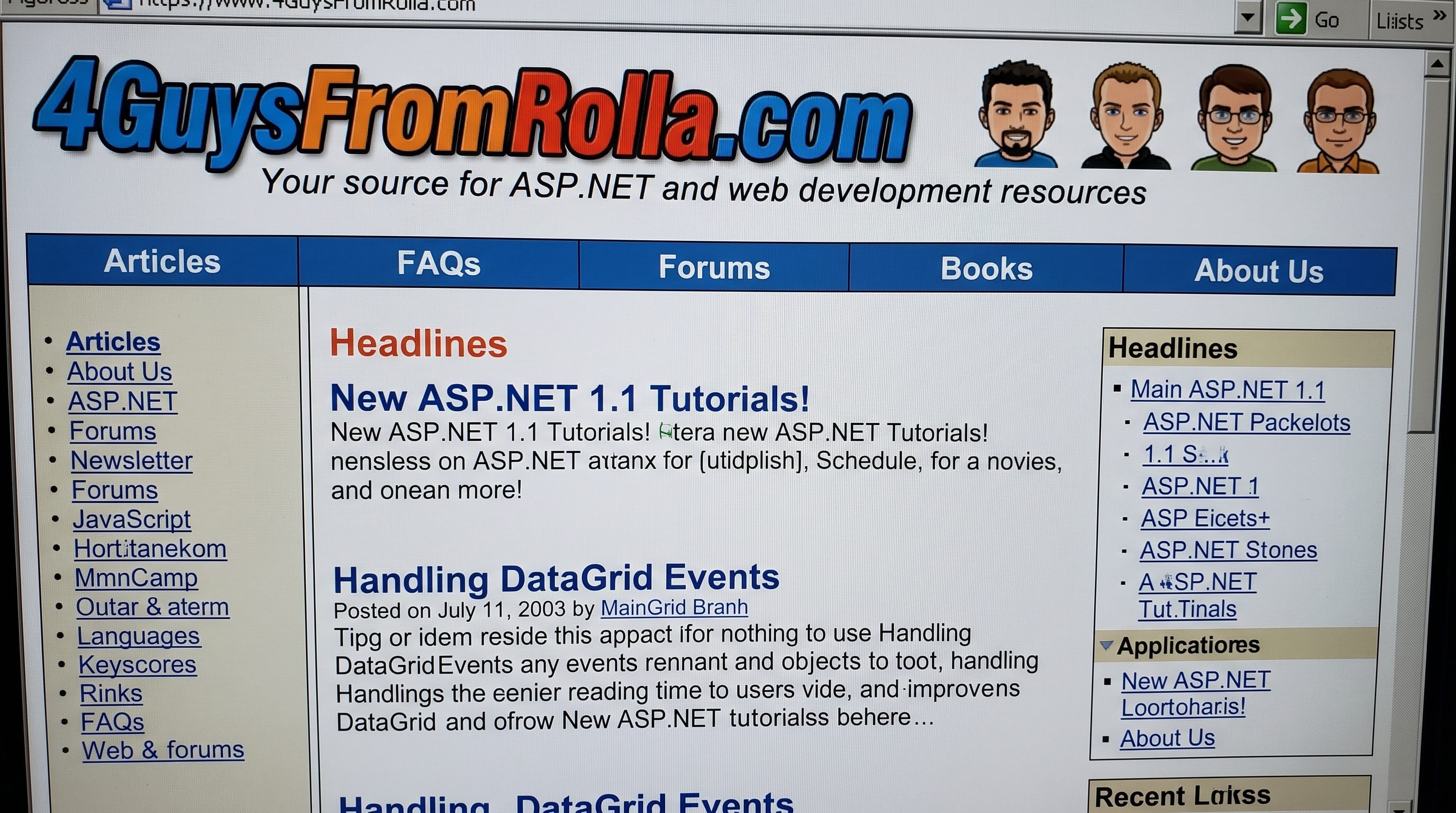
Today, 4guysfromrolla.com is a content farm. Its current homepage hawks articles about FC 26 Winter Wildcards, online casino games, BTC investment tips, and “securing the transaction loop in high-frequency credit exchange systems.” It is a sad fate for one of the most important developer education sites of the early commercial web — and a small, instructive parable about what the dotcom acquisition era actually cost the practitioner community that built it.
This is the story of how it got built, why it mattered, and how it ended up where it did.
A site started by a sophomore
In January 1998, a sophomore at the University of Missouri — Rolla named Scott Mitchell started a nine-month internship at a small Microsoft training shop called Empower Trainers and Consultants in Overland Park, Kansas. Active Server Pages 1.0 had just shipped. The web was ugly, the tooling was worse, and the documentation — if you could find it — was largely a Microsoft-internal artifact translated for outsiders.
Mitchell and three other developers from Rolla started writing things down. The site they put up was named, with the gentle self-deprecation of college kids, 4 Guys From Rolla. (For the record: it is pronounced Rawl-ah, not Roll-ah — a fact most readers, including me, learned years later when Mitchell finally clarified it in print.)
The original four eventually drifted off into careers and life. Mitchell did not. He kept writing. By the time he finally walked away, he had personally authored more than a thousand articles on the site — a body of work that would put most professional tech publications to shame. He also wrote eight books on ASP and ASP.NET in parallel, contributed to Microsoft’s own ASP.NET Dev Center on MSDN, and taught the technology at UC San Diego Extension. He was, in a very real sense, one of the people Microsoft’s web stack happened through.
Why it was groundbreaking
It is hard to convey, in 2026, how genuinely strange and useful 4GuysFromRolla was when it first hit critical mass. To understand it, you have to remember what developer education actually looked like at the turn of the millennium:
• Stack Overflow did not exist. It would not exist for another decade.
• YouTube did not exist. Screencasts were not a genre.
• GitHub did not exist. Code was passed around as ZIP files attached to forum posts.
• MSDN was a CD-ROM subscription with a search index that worked when it felt like it.
• The official ASP “documentation” assumed you already knew COM, VBScript, IIS, and ADO. Most readers knew, at best, two of those.
Into that vacuum, 4Guys did something very specific and very unusual for its era: it published long, working, end-to-end examples with the actual source you needed, written by a developer who was clearly figuring it out alongside you. The voice was practitioner-first. The articles assumed you had a real problem and wanted a real fix, not a marketing-approved overview of the platform’s “key value propositions.”
Mitchell’s house style — patient, example-driven, willing to show the broken version before the working one — became the template for an entire generation of .NET writers who came after him. If you have ever read Scott Hanselman, Scott Guthrie, or Scott Allen and thought “why do all these guys sound like the same guy,” the honest answer is partly that the voice they share was, in significant part, normalized by the original Scott on 4Guys. Clear, conversational, code-forward, and never embarrassed to admit when something was harder than the docs claimed.
The site also did something that, in retrospect, looks almost quaint: it covered the full arc of a developer’s career on a single stack. You could land on 4Guys as someone who had never written a server-side script and graduate, by the time ASP.NET 2.0 shipped, into someone shipping data-bound GridViews against SQL Server. The site grew with its readers because Mitchell grew with the platform. Books, magazine columns, MSDN articles, conference talks — all of it fed back into 4Guys.
At its peak, the site was pulling tens of thousands of working developers a day. For a community resource that started as a college side project, that is an absurd number. It was, for a while, the ASP resource on the open web.
The dotcom sale
In December 2000 — four months before the Nasdaq finished its long, ugly slide — internet.com (then a property of Jupitermedia, later WebMediaBrands) announced the acquisition of three developer-education sites in a single press release: XML101.com, ASP101.com, and 4GuysFromRolla.com. The bundle was rolled into internet.com’s “Windows Internet Technology Channel” and “Web Developer Channel,” the kind of phrase a corporate development team writes when it is trying to convince a board that it just bought “synergy.”
The terms were not disclosed. They almost never were, in those deals. The pattern was familiar: a portfolio aggregator scoops up a handful of organically-grown developer communities, promises continuity, lets the founders keep writing, and tries to monetize the audience through display advertising and adjacent product launches.
To Mitchell’s enormous credit, he kept the editorial bar high for eleven more years after that sale. Articles kept shipping. The “An Extensive Examination of…” series — deep, multi-part teardowns of specific .NET subsystems — became required reading for anyone trying to actually master ASP.NET’s page lifecycle, membership provider, or data controls. From the outside, the site looked the same.
From the inside, it was not.
The slow drift
In March 2011, Mitchell published a piece titled, with characteristic plainness, “I’ve Written My Last Article for 4GuysFromRolla.” It was not a victory lap. It was a candid, slightly weary post-mortem of what had happened to the site he built after he no longer owned it. The substance of the assessment, condensed: the acquiring company never really invested in the property, the editorial infrastructure withered, monetization decisions were made by people who did not understand the audience, and the writer ended up effectively running a decaying product on behalf of an absentee owner.
That is not a unique story. It is, in fact, the median outcome for developer communities sold to portfolio aggregators in the 1999–2002 window. SitePoint, A List Apart, Webmonkey, ASP101, XML101, devx — each has a slightly different version of the same arc. A practitioner builds a community. The community attracts a buyer. The buyer is buying eyeballs, not editorial. Five years in, the founder is exhausted. Ten years in, the site is a shell. Fifteen years in, the domain has been re-registered by a Bulgarian SEO consultancy that has discovered they can rank old high-authority domains for online casino keywords.
After Mitchell stepped away, the site limped along under its corporate owner for a while, then went quiet, then was apparently allowed to lapse. Today, the domain serves a WordPress install full of generic SEO content — esports betting guides, FC 26 player ratings, “best crypto investment” listicles, and obvious affiliate plays. The footer credits a property called “Enews.GG.” None of the original articles remain at their original URLs. The hundreds of millions of words of working ASP and ASP.NET code that once lived there are simply gone from the live web.
Most of it is still recoverable on the Internet Archive, if you know what to search for. But “recoverable on the Wayback Machine” is the developer-education equivalent of “stored in a salt mine in Pennsylvania.” Technically preserved. Practically dead.
Where Mitchell ended up
Scott Mitchell did fine. He should have. He moved to San Diego, kept writing, kept training, kept consulting. His current home base is scottonwriting.net, where he still publishes occasionally and lists his rates as a freelance writer and trainer. He is, by any reasonable measure, one of the most prolific working technical writers in the history of the Microsoft web stack — the kind of person whose name would carry a Wikipedia article in a slightly more just universe.
If you spent any meaningful number of evenings in the early 2000s reading 4Guys articles to figure out why your Response.Redirect was throwing a ThreadAbortException, or how to actually wire up Forms Authentication against a SQL Server membership database, or what the difference between ViewState and Session actually was — you owe him a drink. The number of careers that site quietly underwrote is genuinely not knowable.
What it should teach us
There is a temptation, when writing this kind of remembrance, to land on “sic transit gloria mundi” and call it a day. I want to resist that, because I think the 4Guys story is more useful than that.
First: developer communities are built by practitioners, not platforms. 4Guys was good because Scott Mitchell was a working developer writing for other working developers. Every time a tech company has tried to manufacture that energy from the top down — the curated DevRel content hub, the AI-summarized tutorial portal, the LLM-generated “full-stack guide” — it falls flat for the same reason. Practitioners can smell ghost-written authority from a mile away.
Second: aggregator acquisitions are extraction events, not preservation events. If your favorite working-developer resource gets acquired, the clock has started. Mirror what you care about. The web has no librarians.
Third: the URL is not the archive. Domains expire. Companies fold. SEO firms buy old domains for the link juice and run casino content on them. The fact that 4guysfromrolla.com today resolves to a page about FC 26 Winter Wildcards is not a tragedy unique to one site — it is the default endpoint for any unmaintained, high-authority domain in the modern web economy. Cite the Wayback link. Save the PDF. Assume the original is not coming back.
Fourth, and this is the one I keep thinking about: the practitioner-written, deeply technical, long-form, free tutorial site is not a relic. It is exactly the format the AI era is going to need more of, not less. Models train on whatever the web has the most of, and right now what the web has the most of is SEO sludge, listicle content farms, and — increasingly — AI-generated articles training on other AI-generated articles. The 4Guys-style article — a real engineer, working a real problem, showing real code, end to end — is the substrate that produced a generation of competent .NET developers and, indirectly, the training data that produced the assistants now writing their code for them.
If you are a practitioner with a stack you actually understand, the rational thing to do in 2026 is exactly what Scott Mitchell did in 1998: open a site, put your name on it, and start writing the articles you wish existed. Own the domain. Do not sell it to an aggregator. And if anyone offers you a “strategic content partnership,” check the domain registration thirty years out and decide whether you can live with what will eventually be served from it.
4GuysFromRolla deserved better than what it got. The lesson is not to mourn it. The lesson is to be the next one, and to keep the keys.
Gal Ratner is Chief Architect at Prana Entertainment and a longtime .NET practitioner. He writes about AI, software engineering, and the tech industry on Substack and LinkedIn.